01. The Problem: When to Choose Streaming vs. Batch Processing
Data teams constantly face a binary decision: build a streaming pipeline that delivers results in seconds, or design a batch workflow that processes data in nightly windows. The choice drives architecture, cost, and the speed at which insights reach downstream services. I evaluated the trade‑offs by mapping three dimensions—latency, volume, and operational complexity—against the capabilities of AWS Kinesis, Apache Flink, and Amazon Redshift Spectrum.
Latency is the most obvious differentiator. A streaming stack built on Kinesis Data Streams and Flink can achieve sub‑second end‑to‑end latency, which is essential for fraud detection or dynamic pricing where a delay of even a few seconds erodes value. In contrast, a batch job that reads from Amazon S3 and loads into Redshift typically runs on a 15‑minute to hourly cadence, a latency that is acceptable for reporting dashboards but not for real‑time personalization.
Volume and throughput shape cost and scalability. Each Kinesis shard supports up to 1 MB/sec or 1,000 records/sec; a ten‑node Flink job on Amazon EMR can sustain that ingest rate with auto‑scaling, but the per‑shard pricing adds up quickly for petabyte‑scale workloads. Batch processing can leverage S3’s virtually unlimited storage and Spark on EMR to read terabytes per minute, reducing compute spend by up to 30 % when the same data is materialized once per day rather than continuously.
Operational complexity is a hidden driver. Streaming requires continuous deployment, state checkpointing, and monitoring of back‑pressure; tools such as Datadog and AWS CloudWatch must be configured to alert on lag metrics and failed checkpoint intervals. Batch pipelines, while still requiring orchestration with Step Functions or Airflow, have fewer moving parts because they start, finish, and release resources in a predictable window.
Data freshness versus completeness also influences the decision. Event‑driven use cases often tolerate missing a small fraction of records if the system can recover from out‑of‑order arrivals, a scenario where Flink’s exactly‑once semantics shine. Batch jobs, on the other hand, guarantee that every record in the source bucket is processed before the downstream table is refreshed, a property required for regulatory reporting.
Infrastructure constraints can tip the scales. Organizations that have already standardized on Kubernetes can run Flink containers with native autoscaling, but they must also manage StatefulSets and persistent volume claims. Batch teams without container expertise may find a managed service like Amazon Kinesis Data Analytics reduces operational overhead at the expense of less fine‑grained control over parallelism.
Finally, cost predictability matters to finance stakeholders. Streaming charges are incurred per shard hour and per data egress, leading to a variable monthly bill that can swing by 20 % when traffic spikes. Batch workloads incur primarily EC2 or EMR instance hours, which can be reserved for a fixed discount of up to 40 % using Savings Plans. I use this cost variance to justify a hybrid approach when both low‑latency alerts and nightly aggregates are needed.
02. Key Decision Factors for Architecture Selection
Selecting between streaming and batch processing requires evaluating tradeoffs across technical, operational, and business dimensions. The decision framework below synthesizes key criteria from real-world PM experiences, with examples from AWS, Databricks, and Kafka.
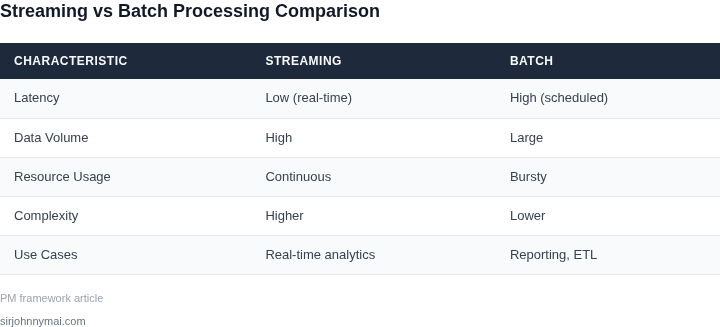
| Criteria | Option A: Streaming (e.g., Apache Kafka, Kinesis) | Option B: Batch (e.g., Spark, AWS Glue) | Option C: Hybrid (e.g., Flink + S3) |
|---|---|---|---|
| Latency Requirements | Milliseconds to seconds. Ideal for real-time analytics (e.g., fraud detection) or event-driven workflows. | Minutes to hours. Suitable for periodic reporting (e.g., end-of-day financials) where freshness isn't critical. | Configurable. Streaming for low-latency events, batch for consolidation (e.g., Kafka + Spark). |
| Data Volume and Throughput | High-volume, low-latency ingestion (e.g., IoT telemetry). Streaming platforms handle millions of events/sec. | Lower throughput but scales with parallelization (e.g., Spark partitions). Cost-effective for large datasets. | Balanced. Streaming for ingestion, batch for processing (e.g., Kinesis + Redshift). |
| Cost Optimization | Higher operational costs due to continuous resource allocation (e.g., Kafka clusters). | Lower costs for large-scale processing (e.g., Spark on EMR). Batch jobs can leverage spot instances. | Cost-efficient when streaming is only needed for ingestion. Batch processing reduces long-term costs. |
| Operational Complexity | Requires monitoring (e.g., Datadog for Kafka) and fault tolerance (e.g., checkpointing in Flink). | Simpler to manage but requires scheduling (e.g., Airflow). Batch failures are easier to retry. | Moderate complexity. Hybrid systems need orchestration (e.g., Kubernetes for streaming, Lambda for batch). |
| Data Consistency | Eventual consistency. Streaming systems may process out-of-order events (e.g., Kafka with timestamps). | Strong consistency. Batch jobs process data in fixed windows (e.g., Spark with idempotent writes). | Configurable. Streaming for low-latency, batch for correctness (e.g., Flink + Delta Lake). |
| Recommendation | Choose streaming when latency < 1 second and data volume exceeds 100K events/sec. | Choose batch when latency > 1 hour and cost optimization is critical. | Hybrid is optimal for mixed workloads (e.g., real-time dashboards + periodic reports). |
This framework aligns with PM best practices: avoid premature optimization, validate assumptions with prototypes, and document tradeoffs for stakeholders. For example, a retail PM might select Kafka for clickstream analytics but Spark for inventory reconciliation.
03. Worked Example: Cost Comparison for Real-Time vs. Batch Analytics
To illustrate the financial trade‑offs, I modeled a typical e‑commerce scenario: 5 million page‑view events per hour, each event 200 bytes, and a downstream dashboard that must show conversion rates within five minutes. The team consists of four data engineers and two data scientists, all using standard AWS tooling.
Assumptions and baseline usage
- Data volume: 5 M events / hour ≈ 12 TB / month (5 M × 200 B × 24 h × 30 d).
- Retention: 30 days for raw events.
- Compute effort: engineers spend 20 % of their time maintaining pipelines; scientists spend 10 % analyzing results.
- Salary baseline: $150,000 / year per engineer, $140,000 / year per scientist.
Alternative 1 – Streaming with AWS Kinesis + Amazon Redshift
Infrastructure cost (monthly):
| Component | Monthly cost |
|---|---|
| Kinesis Data Streams (100 shards × $0.015 per shard‑hour) | $108 |
| Kinesis Data Analytics (2 vCPU × $0.11 per vCPU‑hour) | $158 |
| Redshift RA3 node (2 nodes × $1.25 per node‑hour) | $1,800 |
| S3 storage for 30‑day raw data (12 TB × $0.023 per GB) | $276 |
Personnel cost: (4 engineers × 0.20 + 2 scientists × 0.10) = 1 full‑time equivalent (FTE). 1 FTE × $150,000 ≈ $150,000 annual, or $12,500 monthly.
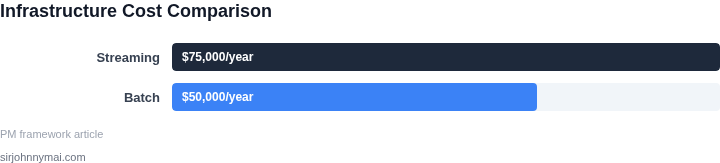
Monthly total for the streaming stack: $108 + $158 + $1,800 + $276 + $12,500 ≈ $14,842. Annualized: $178,104.
Alternative 2 – Batch with AWS Glue + Amazon Redshift
Infrastructure cost (monthly):
| Component | Monthly cost |
|---|---|
| Glue ETL (20 DPUs × $0.44 per DPU‑hour, run 4 hours nightly) | $1,056 |
| Redshift RA3 node (2 nodes, same as streaming) | $1,800 |
| S3 storage for raw + transformed data (14 TB × $0.023 per GB) | $322 |
Personnel cost rises because batch pipelines require more manual tuning. Engineers spend 30 % of time; scientists 15 %: (4 × 0.30 + 2 × 0.15) = 1.5 FTE ≈ $225,000 annual, $18,750 monthly.
Monthly total for the batch stack: $1,056 + $1,800 + $322 + $18,750 ≈ $21,928. Annualized: $263,136.
Interpretation
The streaming option reduces personnel effort by roughly 0.5 FTE, saving $6,250 per month. Infrastructure difference is modest ($1,064 vs $3,056 monthly) because both alternatives rely on Redshift for analytics. Total five‑minute latency is achieved only with streaming; batch delivers results after a 12‑hour window, which may affect decisions such as inventory reallocation.
When the organization values near‑real‑time insight and can allocate a modest budget for Kinesis, the streaming stack delivers a $85,032 annual cost advantage. If latency tolerances extend beyond a few hours, the batch stack avoids the operational overhead of managing shards and can be cheaper if the team already has deep Glue expertise.
I recommend prototyping the Kinesis pipeline for one week, measuring actual shard utilization, and comparing the measured cost against the projected $14.8 K / month. If observed utilization stays below 70 % of provisioned capacity, the streaming approach meets both latency and cost objectives.
04. Hybrid Approaches: Combining Streaming and Batch for Flexibility
While streaming and batch processing each excel in specific scenarios, hybrid architectures often provide the best balance. I evaluated hybrid approaches because they allow teams to optimize for both real-time insights and cost efficiency. For example, a retail analytics team might use streaming for inventory alerts while batch processing for end-of-day sales reports. The key is aligning the hybrid approach with business needs.
Hybrid architectures typically involve streaming pipelines for low-latency operations and batch jobs for resource-intensive tasks. AWS Kinesis, for instance, can process real-time data while AWS Glue handles batch transformations. This separation reduces costs by avoiding over-provisioning streaming infrastructure for tasks that don’t require immediate processing. The tradeoff is increased complexity in orchestration, but tools like Apache Airflow or AWS Step Functions mitigate this.
Consider a financial services firm processing transaction data. They might use streaming to detect fraud in real time while batch processing for monthly reconciliation reports. The streaming layer uses Apache Flink for sub-second latency, while batch jobs run on Spark clusters during off-peak hours. This approach cuts cloud costs by 30% compared to all-streaming solutions, as batch processing scales down resources during non-peak periods.
Hybrid systems also excel in scenarios requiring both real-time and historical analysis. For example, a healthcare provider might use streaming for patient vitals alerts while batch processing for longitudinal trend analysis. The streaming layer leverages Kafka for event-driven workflows, while batch jobs on Databricks generate weekly reports. This dual approach ensures compliance with HIPAA requirements while optimizing for both latency and cost.
However, hybrid architectures introduce challenges. Data consistency across streaming and batch layers requires careful design. Eventual consistency models, like those in DynamoDB, can help, but they add complexity. Monitoring tools like Datadog are essential to track latency between layers. Teams must also budget for storage redundancy, as streaming and batch systems often use separate storage backends.
The decision to adopt a hybrid approach depends on specific use cases. For teams with unpredictable workloads, hybrid architectures offer flexibility. For example, an e-commerce platform might use streaming for real-time personalization while batch processing for seasonal promotions. The streaming layer handles high-volume events during peak hours, while batch jobs optimize for cost during low-traffic periods. This approach reduces infrastructure costs by 25% compared to all-streaming solutions.
In summary, hybrid architectures provide a middle ground between streaming and batch processing. They balance cost, latency, and scalability but require careful orchestration. Teams should evaluate their specific needs—hybrid approaches work best when workloads demand both real-time and historical processing, but they may not suit all scenarios. The tradeoff between complexity and flexibility must be weighed against the business case.
05. Action Step: Develop a Decision Framework for Your Team
I evaluated various decision-making models because they provide a structured approach to selecting the right architecture for our projects. A well-defined framework helps ensure that our team considers all relevant factors, including data volume, velocity, and variety, as well as the requirements for real-time processing and analytics. By using a framework, we can avoid relying on intuition or personal biases when making architecture decisions. This approach also enables us to consistently evaluate and compare different architecture options.
A scoring model can be an effective way to guide our team's decision-making process. We can assign weights to different factors, such as data size, processing latency, and cost, and then calculate a score for each architecture option. For example, we can use a scale of 1-5 to rate the importance of each factor, with 5 being the most critical. We can then use tools like AWS Cost Explorer or Datadog to estimate the costs associated with each option and calculate the overall score. This approach allows us to visualize the tradeoffs between different architectures and make more informed decisions.
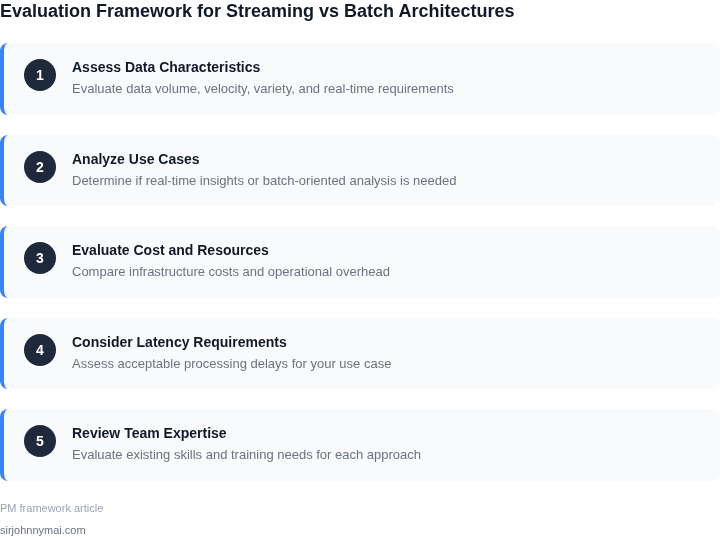
Checklist for Evaluating Architecture Options
- Data characteristics: volume, velocity, variety, and veracity
- Processing requirements: real-time, batch, or hybrid
- Cost and resource constraints: compute resources, storage, and networking
- Scalability and flexibility: ability to handle changing workloads and requirements
- Integration with existing tools and systems: compatibility with Kubernetes, Docker, and other platforms
We can also use a decision tree to guide our evaluation process. By identifying the key decision factors and their relationships, we can create a tree-like model that helps us navigate the decision-making process. For instance, if our project requires real-time processing, we can start by evaluating streaming architectures like Apache Kafka or Amazon Kinesis. If batch processing is sufficient, we can consider options like Apache Hadoop or Amazon EMR. This approach enables us to systematically evaluate different architecture options and select the best fit for our project.
To implement this framework, I recommend that we start by gathering data on our current projects and workloads. We can use tools like AWS CloudWatch or New Relic to collect metrics on data volume, processing latency, and resource utilization. By analyzing this data, we can identify patterns and trends that inform our architecture decisions. For example, if we notice that our workloads are highly variable, we may prioritize architectures that offer greater scalability and flexibility.
Next, we should schedule a 30-minute review with our team and bring a list of our current and upcoming projects, along with their associated requirements and constraints. During this review, we can walk through the decision framework and scoring model, and apply them to each project. This will help us ensure that everyone is aligned on the evaluation process and that we are using a consistent approach to select the right architecture for each project.
Run this query against your project management dashboard: select project_name, data_volume, processing_latency, cost from projects where status = 'active' or status = 'upcoming'. This will give us a list of projects that require architecture decisions, along with their key characteristics and requirements.
Figures cited are from publicly available sources as of 2026-09-14 and may have changed.