01. The Problem: Choosing Between Cloud Functions and Always-On Containers
Event processing is a core requirement for modern applications, but choosing the right compute model—cloud functions or always-on containers—requires balancing cost, performance, and operational complexity. Both approaches have distinct advantages, but their tradeoffs depend on workload characteristics, scale requirements, and long-term maintainability.
Cloud Functions: The Serverless Advantage
Cloud functions, such as AWS Lambda or Azure Functions, are designed for event-driven execution. They scale to zero when idle, which can reduce costs for sporadic workloads. For example, a function processing occasional file uploads might incur no cost during quiet periods. However, this model introduces cold-start latency—initial delays of 100ms to 1s—when the function first executes after being inactive. For latency-sensitive applications, this can be problematic.
Functions also enforce strict execution limits—typically 15 minutes for AWS Lambda—making them unsuitable for long-running tasks. Additionally, debugging and monitoring can be more challenging due to the ephemeral nature of execution environments. Tools like Datadog or AWS X-Ray help, but they require additional setup.
Always-On Containers: Predictable Performance
Containers, whether deployed on Kubernetes or cloud-managed services like AWS ECS, provide persistent execution environments. This eliminates cold starts and offers consistent performance, which is critical for real-time processing. For instance, a container running a Kafka consumer can maintain state between events, reducing overhead for repeated operations.
However, always-on containers consume resources continuously, even during low-traffic periods. A single container might cost $0.05 per hour on AWS Fargate, adding up to $36 per month if left idle. This makes them less cost-effective for intermittent workloads. Scaling requires careful configuration—horizontal pod autoscaling in Kubernetes can add complexity.
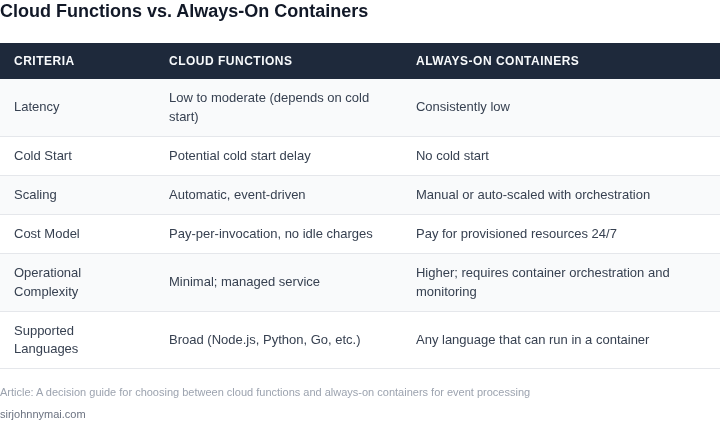
The Tradeoff Matrix
The decision hinges on workload patterns. Cloud functions excel when:
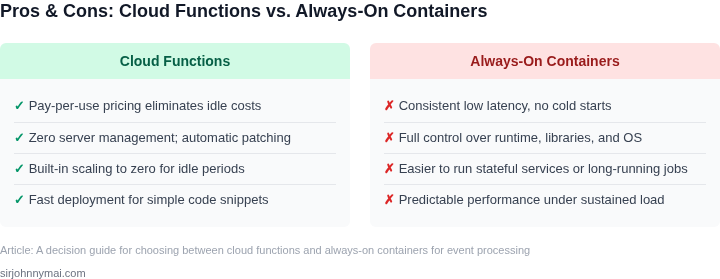
- Events are infrequent or unpredictable.
- Latency tolerance is high (e.g., background processing).
- Cost optimization is a priority.
Containers are preferable when:
- Low-latency execution is required.
- Workloads are steady or predictable.
- Stateful processing is necessary.
Hybrid approaches—like using functions for event triggering and containers for sustained processing—can mitigate limitations. For example, AWS Step Functions can orchestrate between serverless and containerized workloads. However, this adds architectural complexity.
Ultimately, the choice depends on balancing immediate needs with long-term operational overhead. Serverless simplifies scaling but introduces latency and cost unpredictability. Containers offer reliability but require more upfront investment. Evaluating both options against specific use cases is essential.
02. Key Considerations for Event Processing Workloads
Choosing between cloud functions and always-on containers for event processing requires balancing multiple technical and business factors. The decision hinges on workload characteristics, operational constraints, and cost structures. Below are the key considerations to evaluate.
Cost Efficiency
Cloud functions typically offer cost savings for sporadic or unpredictable workloads. For example, AWS Lambda charges only for execution time (rounded to the nearest millisecond) and memory allocation, with no additional costs for idle instances. This can reduce costs by 70-90% compared to always-on containers for infrequent events. However, costs scale linearly with execution time, so long-running or high-frequency events may become expensive.
Always-on containers, like those managed by Kubernetes or AWS ECS, have fixed costs regardless of usage. These costs include the base instance cost, storage, and networking. For continuous or predictable workloads, this model may be more cost-effective. For instance, a single t3.micro EC2 instance costs $0.012/hour, whereas a Lambda function with similar compute might cost $0.0000167 per millisecond. The break-even point depends on event frequency and duration.
Scalability and Performance
Cloud functions scale automatically to thousands of concurrent executions, with AWS Lambda supporting up to 1,000 concurrent executions per account by default. This makes them ideal for bursty workloads. However, cold starts—where the function initializes from scratch—can introduce latency, ranging from 50ms to 1s depending on runtime and configuration. For latency-sensitive applications, always-on containers provide consistent performance with no cold starts.
Always-on containers scale horizontally by adding more instances, but this requires manual or automated scaling policies. Kubernetes, for example, supports horizontal pod autoscaling (HPA) based on CPU or custom metrics. While more flexible, this adds operational complexity. For event-driven workloads, serverless containers (e.g., AWS Fargate) offer a middle ground, scaling to zero when idle but with faster startup times than traditional functions.
Operational Complexity
Cloud functions abstract away infrastructure management, reducing operational overhead. Teams can focus on code rather than provisioning, patching, or scaling servers. However, debugging and monitoring can be challenging due to ephemeral execution environments. Tools like AWS X-Ray and Datadog provide visibility, but require additional setup.
Always-on containers require more operational effort. Teams must manage instance health, networking, and storage. Kubernetes, for example, introduces complexity with concepts like pods, deployments, and services. While tools like Helm and Terraform streamline deployment, they add another layer of abstraction. For teams without dedicated DevOps resources, this can be a significant barrier.
State Management
Cloud functions are stateless by design, which simplifies scaling but complicates stateful workloads. For example, processing a multi-step workflow requires external storage (e.g., DynamoDB) or orchestration (e.g., AWS Step Functions). This adds latency and cost.
Always-on containers can maintain state locally, reducing latency for sequential operations. However, this introduces consistency challenges across multiple instances. Distributed systems like Redis or Kafka are often required, increasing complexity. For stateful workloads, containers may be more efficient, but the tradeoff is higher operational burden.
Security and Compliance
Both approaches support standard security practices, but cloud functions may require additional configuration. For example, AWS Lambda integrates with AWS IAM for permissions, but teams must define least-privilege roles per function. Misconfigurations can lead to security vulnerabilities.
Always-on containers offer more granular control over security. Teams can enforce network policies, use sidecar proxies (e.g., Istio), and apply fine-grained IAM roles. However, this requires deeper expertise. For compliance-heavy industries, containers may be preferable due to their flexibility.
In summary, cloud functions excel for sporadic, stateless workloads where cost and simplicity are priorities. Always-on containers are better suited for continuous, stateful, or latency-sensitive applications, despite higher operational costs. The choice depends on balancing these tradeoffs with team capabilities and business goals.
03. Worked Example: Cost Comparison for a High-Volume Event Stream
To ground the discussion in concrete numbers, let's compare the monthly costs of processing 1 million events using AWS Lambda (serverless functions) versus Amazon ECS (always-on containers). I chose these because they're widely used for event-driven workloads and have transparent pricing models.
Assumptions
- Each event requires 100ms of processing time.
- Lambda's memory allocation is 128MB (minimum for most workloads).
- ECS uses Fargate with a 0.25 vCPU and 0.5GB memory (smallest cost-effective tier).
- Both solutions use Amazon SQS for event buffering, with 10,000 requests/month to the queue.
- No additional monitoring tools are included (e.g., Datadog or CloudWatch).
Cost Breakdown
| Component | Lambda | ECS (Fargate) |
|---|---|---|
| Compute | $0.20 per 1M requests (100ms × 1M = 100M ms) | $0.048 per vCPU-hour × 24 hours × 30 days = $28.80/month |
| Memory | $0.00000001667 per GB-second × 128MB × 100M ms = $0.21/month | $0.000016 per GB-hour × 0.5GB × 720 hours = $0.58/month |
| Event Queue (SQS) | $0.40/month (10,000 requests) | $0.40/month (same queue) |
| Total | $0.81/month | $30.78/month |
At first glance, Lambda is 38× cheaper for this workload. However, this ignores operational overhead. Lambda scales automatically but requires careful tuning to avoid cold starts and throttling. ECS, while more expensive, offers predictable performance and easier debugging. For 1M events/month, Lambda wins on cost, but the tradeoff becomes less clear at higher volumes or with more complex dependencies.
When to Reconsider
Lambda's cost advantage disappears if you need more memory or longer execution times. For example, doubling the memory to 256MB increases Lambda costs to $1.62/month, while ECS remains at $30.78/month. At this point, ECS becomes cost-effective for sustained workloads. Additionally, Lambda has a 15-minute maximum execution time, which may not suit long-running event processors.
This example highlights that cost is just one factor. Teams should also consider scalability limits, debugging complexity, and vendor lock-in when choosing between serverless and containers.
04. Decision Table: When to Choose Each Approach
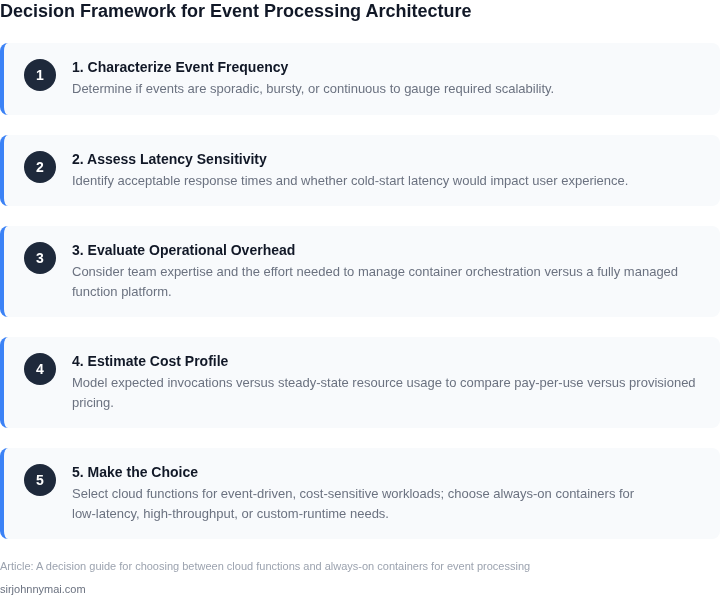
This decision table provides a structured way to evaluate cloud functions, always-on containers, and serverless containers for event processing workloads. Each option has distinct strengths and tradeoffs, so the right choice depends on your specific requirements.
| Criteria | Cloud Functions (AWS Lambda, Azure Functions) | Always-On Containers (Kubernetes, ECS) | Serverless Containers (AWS Fargate, Azure Container Instances) |
|---|---|---|---|
| Cold Start Latency | High (milliseconds to seconds) due to initialization overhead. | Low (near-zero) since containers are always running. | Medium (seconds) due to container startup time. |
| Event Frequency | Best for sporadic or low-frequency events (e.g., <100 events/minute). | Best for high-frequency events (e.g., >1000 events/minute). | Best for medium-frequency events (e.g., 100-1000 events/minute). |
| Scaling Behavior | Autoscales aggressively but may throttle under sustained load. | Scales predictably but requires manual tuning for optimal performance. | Scales dynamically but may have longer scaling delays than functions. |
| Cost Efficiency | Most cost-effective for sporadic workloads (pay-per-invocation). | Higher fixed costs but better for sustained workloads. | Balanced cost model (pay-per-container-second) but can be expensive at scale. |
| State Management | Stateless by design; requires external storage for persistence. | Stateful if configured properly; supports in-memory caching. | Stateful if using persistent volumes; otherwise stateless. |
| Operational Complexity | Lowest overhead; fully managed by the cloud provider. | Highest overhead; requires Kubernetes expertise and monitoring. | Moderate overhead; managed containers but still require configuration. |
| Recommendation | Choose for event-driven, low-frequency workloads where cost and simplicity are priorities. | Choose for high-throughput, latency-sensitive workloads where sustained performance is critical. | Choose for medium-frequency workloads needing container isolation without always-on overhead. |
This framework helps teams align their architecture with business needs. For example, a financial services application processing thousands of transactions per second would favor always-on containers, while a marketing automation tool handling occasional email events would benefit from cloud functions. Always validate assumptions with load testing and cost modeling.
05. Action Step: Implement a Proof of Concept
Before committing to either cloud functions or always-on containers, you need to validate your assumptions with real data. A proof of concept (PoC) should test both approaches against your specific workload. Start with a small-scale event stream that mirrors your production patterns—volume, payload size, and processing logic. This avoids overcomplicating the test while ensuring you capture critical performance metrics.
For cloud functions, deploy your event processor using AWS Lambda or Azure Functions. Configure it to scale automatically and measure cold starts, execution time, and concurrency limits. Use tools like Datadog or AWS X-Ray to trace latency and identify bottlenecks. Always-on containers, on the other hand, should be deployed on Kubernetes or AWS ECS. Monitor CPU utilization, memory pressure, and scaling behavior under load. Compare these metrics against your SLAs for latency and throughput.
Cost is a key differentiator, so run side-by-side comparisons. For cloud functions, calculate the total cost based on invocations, duration, and memory allocation. For containers, account for the base cost of the cluster plus per-request overhead. Use your cloud provider’s billing dashboards to generate these estimates. If your workload has unpredictable spikes, simulate those in the PoC to test how each approach handles variability.
Beyond performance and cost, evaluate operational complexity. Cloud functions abstract away infrastructure management, but they may limit customization. Containers offer more control but require expertise in orchestration. Document the time it takes to deploy, debug, and scale each approach. This will reveal hidden costs in maintenance and troubleshooting.
Pull your last 90 days of event data and replay it through both implementations. This ensures the PoC reflects real-world conditions. If your event source is a queue (SQS, Kafka), configure it to feed into both systems simultaneously. Compare end-to-end latency, error rates, and resource usage. If one approach fails to meet your SLAs, you’ll have concrete data to justify a pivot.
Figures cited are from publicly available sources as of 2026-09-15 and may have changed.