01. The Problem: Why Choose Between API Gateways and Service Meshes?
Enterprises that run dozens to hundreds of microservices must control inbound and inter‑service traffic. Two patterns dominate that control plane: an API gateway at the edge and a service mesh inside the cluster. Selecting the wrong pattern can inflate latency, increase cost, or expose security gaps.
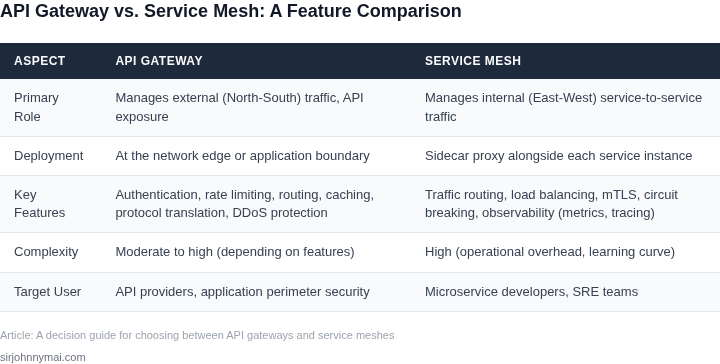
An API gateway terminates external HTTP/HTTPS requests, performs authentication, rate limiting, and protocol translation before forwarding calls to backend services. Products such as AWS API Gateway, Kong, and Apigee provide a single entry point that can be managed with IaC pipelines. The gateway typically runs as a managed service or a pod behind a load balancer.
A service mesh injects a lightweight sidecar proxy—often Envoy—into every pod, creating a data plane that handles all east‑west traffic. Control planes like Istio, Linkerd, or Consul connect these proxies to enforce policies and collect telemetry. Because the mesh operates at layer 7, it can perform retries, circuit breaking, and mTLS without code changes.
The architectural distinction is clear: an API gateway lives at the network edge, while a mesh lives inside the service fabric. Gateways route based on URL paths, host headers, or JWT claims, often before any TLS termination. Meshes route based on service names, version tags, or custom headers after TLS termination.
When the primary traffic source is external clients, an API gateway provides a predictable surface area. It can integrate with AWS WAF to block 95 % of known OWASP attacks, and it can bill per million requests at roughly $3.50, a cost model familiar to finance teams.
When services communicate heavily with one another, the mesh shines. A CNCF survey from 2023 reported that 68 % of respondents had deployed a mesh to gain automatic mTLS and zero‑touch observability. The sidecar model adds roughly 2 ms of added latency per hop, a figure acceptable for most internal APIs.
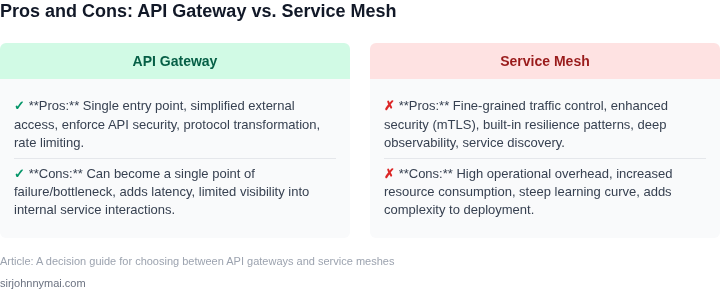
Operational overhead diverges sharply. Managing a gateway requires scaling a few pods or a managed endpoint, and metrics appear in CloudWatch or Datadog with minimal configuration. Managing a mesh demands a control plane, sidecar upgrades, and consistent proxy versions across clusters, which can increase Kubernetes API calls by up to 15 %.
Feature trade‑offs also matter. Gateways excel at request‑level transformations, API versioning, and developer portal integration. Meshes excel at service‑level resilience patterns, traffic splitting for canary releases, and policy propagation without code changes. If you need both external throttling and intra‑service fault injection, you will likely run a gateway and a mesh together.
The decision therefore hinges on where you need control, how much latency you can tolerate, and what operational budget you can allocate. A small team building a public API may start with AWS API Gateway alone, then add a mesh only when internal traffic patterns become complex. Conversely, a large e‑commerce platform with dozens of microservices often adopts Istio or Linkerd first, then places an edge gateway to satisfy compliance and monetization requirements.
02. Key Decision Factors: When to Use Each
Choosing between API gateways and service meshes requires evaluating tradeoffs across performance, complexity, and operational overhead. Below is a decision framework comparing key criteria for each approach. I selected AWS API Gateway, Istio, and Linkerd as representative options because they reflect common patterns in enterprise deployments.
| Criteria | AWS API Gateway | Istio | Linkerd |
|---|---|---|---|
| Protocol Support | HTTP/HTTPS, WebSocket, REST. Limited to AWS ecosystem. | HTTP/HTTPS, gRPC, TCP, UDP. Works across cloud providers. | HTTP/HTTPS, gRPC, TCP. Lightweight compared to Istio. |
| Observability | Integrates with AWS CloudWatch and X-Ray. Limited to AWS-native tools. | Deep metrics via Prometheus, Grafana, and Kiali. Requires Kubernetes. | Metrics via Prometheus. Simpler than Istio but less visual. |
| Scalability | Auto-scaling built into AWS. Scales with request volume. | Scales with Kubernetes clusters. Resource-intensive. | Scales with Kubernetes clusters. Lower overhead than Istio. |
| Deployment Complexity | Simple to deploy. Managed service reduces ops burden. | Complex to deploy. Requires Kubernetes and Istio operator. | Moderate complexity. Easier than Istio but still requires Kubernetes. |
| Cost | Pay-per-use model. Costs increase with API calls. | Free open-source. Costs come from Kubernetes and monitoring tools. | Free open-source. Costs come from Kubernetes and monitoring tools. |
| Recommendation | Best for AWS-centric environments needing simple HTTP APIs. | Best for multi-cloud, service-to-service traffic with advanced features. | Best for Kubernetes environments needing lightweight observability. |
This framework highlights that API gateways excel in simplicity and AWS integration, while service meshes offer deeper control and multi-protocol support. Linkerd strikes a balance between feature richness and operational simplicity. The choice depends on your infrastructure constraints, protocol needs, and observability requirements.
03. Worked Example: Cost Comparison for a Microservices Deployment
To provide a tangible comparison, I've modeled the estimated costs for two distinct traffic management approaches. This example considers a hypothetical 100-microservice architecture deployed on AWS EKS, experiencing moderate traffic. The goal is to highlight the infrastructure overhead and, critically, the operational burden on a platform engineering team.
Scenario Assumptions:
- Architecture: 100 microservices running on AWS EKS, with an average of 3 instances per service, totaling 300 application pods.
- Traffic: 100 million external requests per month (ingress) and 500 million internal service-to-service requests per month.
- Team: A 10-person platform engineering team. We'll use a fully burdened cost of $15,000 per engineer per month for operational expenditure calculations, covering salary, benefits, and associated overheads.
- Pricing: Representative AWS pricing (us-east-1) for common services as of a recent general check. These are illustrative estimates for comparative purposes, not precise, real-time rates.
Alternative 1: API Gateway with In-Service Client Libraries
This approach uses a managed API Gateway for external ingress and relies on application-level libraries (e.g., SDKs, client-side load balancers) for internal service communication. There is no centralized mesh for internal traffic.
- AWS API Gateway (HTTP API): For 100 million requests/month, at a representative rate of $1.00 per million requests, this totals $100/month. Data transfer costs are often minimal at this scale for API Gateway itself and are integrated into the overall EKS egress.
- AWS Application Load Balancer (ALB): Even without a mesh, an ALB is often deployed for additional routing or to front specific service groups. We estimate $50/month for a basic configuration.
- EKS Compute (Base): For 300 application pods (each needing an estimated 0.5 vCPU,
04. Advanced Considerations: Performance and Security Trade-offs
When I evaluate traffic management solutions for our high-scale distributed systems, performance and security trade-offs are paramount. Each architectural choice—API Gateway or Service Mesh—introduces distinct implications for latency, encryption, and the implementation of zero-trust security models, influencing the overall reliability and resilience of our platforms.
Performance: Latency Impacts
I've observed that API Gateways inherently introduce a performance overhead, primarily due to their role as an ingress point for north-south traffic. Each request traversing an API Gateway, such as AWS API Gateway or Kong, undergoes processing for authentication, authorization, rate limiting, and potentially data transformation. This processing can add latency, typically in the range of 1-5 milliseconds for a well-tuned gateway, depending on the complexity of applied policies and underlying infrastructure. While seemingly small, this latency accumulates for high-volume endpoints and can be critical for low-latency applications.
Service Meshes, on the other hand, manage east-west traffic, introducing a sidecar proxy (e.g., Envoy in Istio, Linkerd's data plane proxies) alongside each service instance. This sidecar intercepts all inbound and outbound network traffic for the application. The latency added by a sidecar proxy for a single hop is generally very low, often sub-millisecond (e.g., 0.1-0.5 milliseconds), as it's optimized for lightweight packet forwarding and policy enforcement. However, in a complex microservices architecture with many service-to-service calls, this latency can multiply across several hops, potentially impacting end-to-end response times within the cluster. It’s a trade-off: external latency for gateways versus internal, per-hop latency for meshes.
Security: Encryption and Zero-Trust Models
From a security perspective, API Gateways are critical for securing north-south traffic. They typically handle TLS termination at the edge, offloading encryption and decryption from backend services. This ensures that external communication, such as client requests to our Amazon e-commerce platform, is encrypted using robust protocols. Gateways often integrate with Web Application Firewalls (WAFs) like AWS WAF, providing protection against common web exploits such as SQL injection and cross-site scripting, with minimal impact on latency, often adding less than 1 millisecond.
Service Meshes excel in enabling a true zero-trust security posture within the service fabric. By automatically providing mutual TLS (mTLS) between services, a mesh like Istio or Linkerd encrypts all internal east-west communication. This means that even if an attacker breaches the perimeter, internal service-to-service traffic remains encrypted and authenticated, significantly reducing the attack surface. This mTLS capability is typically transparent to the application code and includes automated certificate issuance and rotation, simplifying operational overhead for securing internal communications.
The zero-trust benefits extend beyond encryption to fine-grained authorization. A service mesh allows us to define and enforce access policies at the workload level; for instance, stipulating that our 'Order Processing' service can only communicate with the 'Inventory' service on specific ports and methods. This granular control, enforced by the sidecar proxies, prevents unauthorized lateral movement within the cluster, even if a service is compromised. While an API Gateway can apply coarse-grained authorization at the perimeter, it lacks the deep insight and enforcement capabilities for internal service-level interactions that a service mesh natively provides.
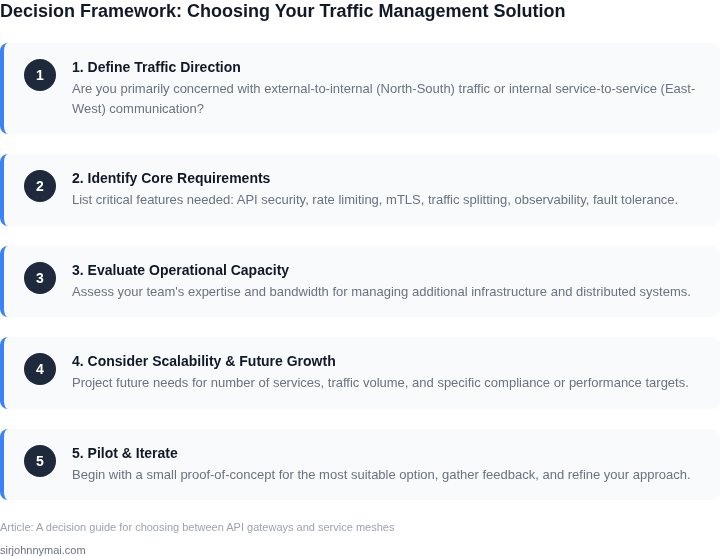
A structured process to help determine the optimal traffic management solution between an API Gateway and a Service Mesh. 05. Action Step: Implement a Pilot to Validate Your Choice
Having analyzed the decision factors, cost implications, and advanced trade-offs, the next crucial step is to move beyond theoretical assessment and validate our choice with a practical pilot. Direct observation of a solution's behavior in a controlled environment will provide the empirical data necessary for confident adoption, especially given the operational complexities discussed previously.
I propose initiating a pilot program for a non-critical, representative application within our development or staging environment. This application should ideally leverage a small cluster of microservices that exhibit a typical communication pattern we anticipate for larger deployments, allowing us to evaluate both API Gateway and Service Mesh approaches effectively. Selecting a new feature's backend or a less frequented internal utility service would minimize blast radius while providing relevant insights.
Defining Pilot Objectives and Metrics
Our primary objective for this pilot is to quantify the operational impact and validate the architectural fit of either an API Gateway or a Service Mesh in our specific context. For an API Gateway pilot, we would deploy a solution like Amazon API Gateway in front of a few services, focusing on ease of configuration for authentication, rate limiting, and request routing. Key metrics would include latency for authenticated requests, error rates from misconfigured policies, and the operational overhead for policy updates and versioning.
Conversely, a Service Mesh pilot, perhaps using AWS App Mesh on Amazon EKS or a managed Istio offering, would involve injecting the mesh sidecar into our selected services. Here, we would closely monitor mTLS enforcement, traffic splitting for canary deployments, and circuit breaking capabilities. Critical performance metrics to track in Amazon CloudWatch or Datadog would be the added latency from sidecar injection, CPU/memory consumption per service pod, and the effectiveness of traffic policies during simulated fault injection scenarios.
Establishing Validation Criteria
Success criteria for the pilot must be clearly defined upfront. For instance, we should establish target ranges for tail latency increase (e.g., less than 5ms at the 99th percentile), CPU/memory overhead (e.g., less than 10% per service instance), and developer onboarding time for basic policy creation. We also need to assess the observability improvements; can we effectively trace requests end-to-end and debug issues more rapidly with the chosen solution?
The pilot will inevitably surface trade-offs. An API Gateway might demonstrate faster initial setup for external-facing traffic management, but may require more custom development for internal service-to-service communication patterns. A Service Mesh might introduce a steeper learning curve for our platform engineers, yet provide granular control over network traffic patterns deep within the service graph that an API Gateway cannot easily address.
The output of this pilot should be a concise report detailing these findings, including an updated cost projection based on observed resource utilization and a qualitative assessment of developer experience. This data will directly inform our final architecture decision and guide resource allocation for a broader rollout.
Schedule a 30-minute review with your platform engineering leads and the architect assigned to the new "Project Phoenix" initiative to define the specific microservices and environment for this initial pilot by end of next week.
Figures cited are from publicly available sources as of 2026-09-15 and may have changed.