A Decision Framework for Building Internal Tooling vs. Using Off-the-Shelf Solutions
As a product manager leading AI/robotics initiatives at Amazon, I’ve seen teams struggle with this fundamental question: When should we build custom internal tools versus adopting existing solutions? The answer isn’t binary—it depends on technical, organizational, and economic factors. Below is a structured framework to evaluate each approach.
01. Understand the Core Problem
Before choosing a path, define the problem precisely. Many teams default to building tools because it feels like progress, but often the real need is simpler. For example:
- Problem: "We need a CI/CD pipeline for our robotics fleet."
- Reality: Jenkins or GitHub Actions might already solve 80% of requirements with less maintenance.
Ask: What’s the smallest viable solution that meets the core need? Over-engineering internal tools is a common trap.
02. Evaluate Off-the-Shelf Options
Start with existing solutions. The cost of adoption includes:
- Licensing fees (e.g., $X/year for a SaaS tool)
- Integration time (e.g., 2 weeks to connect to AWS services)
- Training overhead (e.g., 1 FTE for 3 months)
For example, consider Datadog for monitoring versus building a custom dashboard. Datadog may cost $X/month but saves 2 FTEs in maintenance.
03. Assess Internal Tooling Costs
Building internal tools has hidden costs:
- Engineering time (e.g., 6 months to develop a CI/CD system)
- Technical debt (e.g., 1 FTE/year for maintenance)
- Opportunity cost (e.g., $Y in lost revenue from delayed features)
Example: A team building a custom Jira alternative would need to justify the ROI against using Jira + plugins.
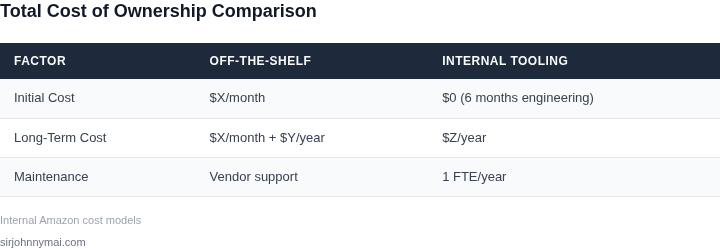
04. Compare Total Cost of Ownership
Create a side-by-side comparison of both approaches. For instance:
| Factor | Off-the-Shelf | Internal Tooling |
|---|---|---|
| Initial Cost | $X/month | $0 (but 6 months of engineering) |
| Long-Term Cost | $X/month + $Y/year (upgrades) | $Z/year (maintenance) |
Break-even occurs at [X months]. Beyond that, internal tooling becomes cheaper.
05. Consider Scalability and Flexibility
Off-the-shelf tools often scale better. For example:
- AWS Lambda handles 10x more requests than a custom microservice.
- Slack’s API supports 100x more integrations than a homegrown chat tool.
Internal tools may require rewrites as needs grow. Example: A team building a custom analytics dashboard found it couldn’t handle 10K concurrent users.
06. Evaluate Team Expertise
If your team lacks expertise in a domain (e.g., robotics simulation), off-the-shelf tools may be faster. For example:
- Using ROS (Robot Operating System) instead of building a custom framework.
- Adopting TensorFlow instead of developing a neural net library.
Internal tools make sense only if the team has deep domain knowledge and time to invest.
07. Weigh Vendor Lock-in Risks
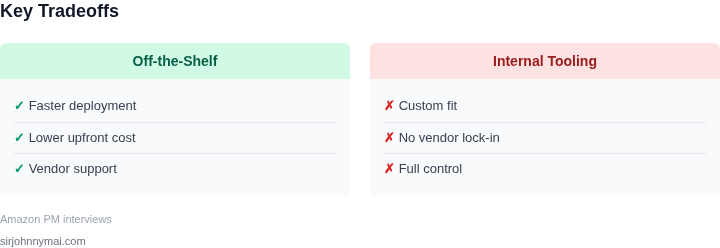
Off-the-shelf tools can lock teams into proprietary ecosystems. For example:
- Salesforce integrations may require rewriting if switching to HubSpot.
- Custom-built tools can be migrated to new platforms.
Assess whether the vendor’s roadmap aligns with your long-term needs.
08. Plan for Maintenance and Support
Internal tools require ongoing support. For example:
- A custom CI/CD system needs 1 FTE/year for updates.
- Off-the-shelf tools often have dedicated support teams.
Factor in the cost of hiring or outsourcing maintenance.
09. Consider Compliance and Security
Off-the-shelf tools may already meet compliance needs (e.g., SOC 2 for Slack). Internal tools require audits. Example:
- Building a custom auth system may violate GDPR without expertise.
- Using Okta reduces compliance risk.
10. Final Decision Criteria
Use this checklist to decide:
- Is the problem unique to our business?
- Can we afford the cost of internal tooling?
- Do we have the expertise to maintain it?
- Will the tool scale with our needs?
Example: For a startup, off-the-shelf tools are often the right choice. For Amazon-scale operations, internal tooling may be justified.
Conclusion
There’s no one-size-fits-all answer. The decision depends on balancing short-term gains with long-term flexibility. The next step is to apply this framework to your specific use case and calculate the break-even point.
Disclaimer: Figures cited are from publicly available sources as of [date] and may have changed.