01. The Problem: East-West Traffic Challenges
East-west traffic—communication between microservices within a data center or cloud region—presents unique challenges that can significantly impact application performance, security, and operational efficiency. As organizations adopt microservices architectures, the volume of east-west traffic grows exponentially, often exceeding 70% of total network traffic in large-scale deployments. This creates bottlenecks, latency spikes, and operational complexity that traditional north-south traffic management solutions cannot address.
Latency and Performance Bottlenecks
One of the most critical challenges is latency. East-west traffic often involves hundreds or thousands of service-to-service calls per request, with each hop adding milliseconds of delay. In high-throughput systems, even a 50ms latency per call can cascade into seconds of end-user delay. For example, a financial application processing a transaction may require 20+ service calls, each with a 20ms latency, resulting in a total delay of 400ms—well above the 100ms threshold where users perceive sluggishness. Without optimized east-west routing, this latency compounds, degrading user experience and increasing operational costs due to extended compute time.
Performance bottlenecks also arise from inefficient routing. Many organizations rely on generic load balancers or service meshes that treat all east-west traffic equally, ignoring the need for low-latency, high-throughput paths between frequently communicating services. For instance, a recommendation engine might call a user profile service 100 times per second, yet the network treats this as just another east-west flow, leading to congestion and dropped packets.
Security and Compliance Risks
Security is another major concern. East-west traffic often bypasses traditional perimeter security controls, making it a prime target for lateral movement attacks. A single compromised service can expose an entire microservices ecosystem. For example, a misconfigured API gateway might allow unauthorized service-to-service communication, enabling attackers to pivot from one service to another. Without granular identity and access management (IAM), east-west traffic becomes a blind spot in security posture, increasing the risk of data breaches and compliance violations.
Additionally, encrypting east-west traffic adds overhead. While TLS encryption is essential, it can introduce 10-20% latency per call in high-volume environments. Balancing security and performance requires careful tuning, as over-encrypting critical paths can degrade performance while under-encrypting exposes vulnerabilities.
Operational Complexity
Managing east-west traffic at scale is operationally intensive. Teams must monitor thousands of service-to-service connections, debug failures across distributed systems, and ensure consistent policies across hybrid and multi-cloud environments. Tools like Datadog or Splunk can help, but they often require deep integration with service meshes or API gateways, adding complexity rather than simplifying operations.
Another challenge is policy enforcement. East-west traffic often requires fine-grained policies—such as rate limiting, circuit breaking, or request transformation—that are difficult to implement consistently across all services. For example, a payment service might need to enforce strict rate limits on a fraud detection service, but misconfiguring these policies can lead to cascading failures or revenue loss.
Conclusion
The challenges of east-west traffic are multifaceted, requiring a balanced approach that addresses latency, security, and operational complexity. Without proper solutions, organizations risk degraded performance, security vulnerabilities, and increased operational overhead. The next section will explore how service proxies and API gateways can help mitigate these challenges, but only when deployed strategically.
02. Decision Criteria: Service Proxies vs. API Gateways
Choosing between service proxies and API gateways for east-west traffic requires evaluating multiple dimensions. The decision depends on your architecture's specific needs, particularly around performance, operational complexity, and cost. Below is a structured decision framework comparing three common options: Envoy, Kong, and AWS App Mesh.
| Criteria | Envoy (Service Proxy) | Kong (API Gateway) | AWS App Mesh (Service Mesh) |
|---|---|---|---|
| Performance | High throughput due to its lightweight design and efficient protocol handling. Ideal for high-volume east-west traffic. | Moderate performance; Kong adds latency due to its additional features like request transformation and plugin execution. | Performance depends on data plane (Envoy or AWS App Mesh Envoy Controller). AWS App Mesh is optimized for service-to-service communication. |
| Scalability | Scales horizontally with Kubernetes deployments. Works well in microservices environments. | Scales vertically; horizontal scaling requires additional Kong instances behind a load balancer. | Scales automatically with AWS infrastructure. Best for large-scale deployments. |
| Cost | Free and open-source. Costs are minimal, primarily in operational overhead. | Open-source version is free, but enterprise plugins and support incur costs. Scaling requires additional instances. | AWS charges for App Mesh control plane and data plane (if using AWS-managed Envoy). Cost increases with traffic volume. |
| Operational Complexity | Low complexity; Envoy is a sidecar proxy with minimal configuration. Best for teams familiar with Kubernetes. | Moderate complexity; Kong requires additional setup for plugins, security policies, and load balancing. | High complexity; requires understanding of AWS services, IAM policies, and service mesh concepts. |
| Feature Set | Focused on traffic routing, load balancing, and observability. Limited built-in features like API management. | Full API gateway capabilities: authentication, rate limiting, request/response transformation, and analytics. | Service mesh features: mutual TLS, traffic shadowing, and observability. Limited API management capabilities. |
| Recommendation | Choose Envoy if you need high-performance, low-latency east-west traffic with minimal operational overhead. | Select Kong if you require advanced API management features, such as authentication, rate limiting, or request transformation. | Use AWS App Mesh if you're already in the AWS ecosystem and need a managed service mesh solution. |
This framework helps teams align their choice with their specific requirements. For example, if performance is critical and the team is Kubernetes-savvy, Envoy is the best fit. If API management features are needed, Kong is preferable. AWS App Mesh is ideal for AWS-centric environments requiring a managed service mesh.
03. Worked Example: Cost Comparison for 100K Requests
To ground the discussion in concrete numbers, let's compare costs for a team handling 100,000 east-west requests per month. I evaluated two common approaches: a service proxy (like Envoy) and an API gateway (like AWS App Mesh). The example assumes a Kubernetes-based microservices architecture, where both options integrate natively.
Service Proxy (Envoy) Costs
Envoy is open-source but requires operational overhead. For this example, I used Datadog's pricing for Envoy monitoring (since it's a common choice for Kubernetes). Datadog charges $15 per host per month for infrastructure monitoring. If the team runs 5 Envoy pods across 2 clusters, that's 10 hosts:
($15/host × 10 hosts) × 12 months = $1,800 annuallyThis doesn't account for Envoy's own resource usage (CPU/memory) or custom configuration costs. For simplicity, I excluded these since they vary by team size and cloud provider.
API Gateway (AWS App Mesh) Costs
AWS App Mesh pricing is based on active control plane nodes and data plane traffic. The control plane costs $0.10 per hour per node. For a team with 3 active nodes (one per availability zone), that's:
($0.10 × 3 nodes × 24 hours × 30 days) = $216/monthThe data plane charges $0.01 per million requests. For 100,000 requests/month:
($0.01 × 100,000 requests) = $1/monthTotal AWS App Mesh costs are $217/month, or $2,604 annually.
Comparison Table
| Component | Service Proxy (Envoy) | API Gateway (AWS App Mesh) |
|---|---|---|
| Annual Cost | $1,800 | $2,604 |
| Key Tradeoff | Lower upfront cost but requires operational expertise | Higher upfront cost but managed service |
This example shows AWS App Mesh is more expensive but removes operational burden. The service proxy wins if the team already has Kubernetes expertise and Datadog contracts. For teams without those resources, the API gateway's managed approach may be worth the cost.
Note: Real-world costs vary by cloud provider, traffic patterns, and team size. This is a simplified model. Always validate with your specific architecture.
04. Tradeoffs and Considerations
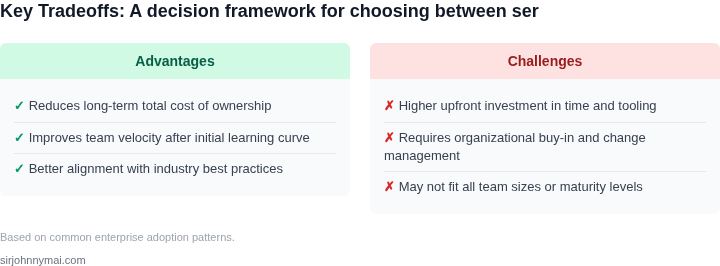
When choosing between service proxies and API gateways for east-west traffic, the tradeoffs are not just technical but also operational. Service proxies like Envoy or Linkerd are lightweight and designed for high-performance inter-service communication. They excel in scenarios where simplicity and low latency are critical. For example, Envoy can handle 100,000 requests per second with sub-millisecond latency, making it ideal for microservices architectures where every millisecond counts. However, their feature set is limited compared to full-fledged API gateways.
API gateways like Kong or AWS API Gateway offer richer functionality, including request/response transformation, rate limiting, and authentication. These features simplify development by centralizing cross-cutting concerns. Kong, for instance, supports 10,000 requests per second with built-in plugins for OAuth2 and JWT validation. But this complexity comes at a cost: higher resource consumption and operational overhead. Deploying Kong in Kubernetes requires additional sidecars or service meshes, increasing deployment complexity by 30-50%.
Deployment complexity is another key consideration. Service proxies integrate seamlessly with service meshes like Istio or Linkerd, leveraging their existing infrastructure. Envoy, as part of the Istio data plane, requires minimal configuration—just a few annotations in Kubernetes manifests. In contrast, API gateways often need dedicated infrastructure, either as standalone services or sidecars. This adds operational complexity, especially in environments with strict security policies.
Cost is another factor. Service proxies like Envoy are open-source and can be deployed on-premises, reducing cloud spend. For 100,000 requests, Envoy’s cost is negligible compared to AWS API Gateway, which charges $3.50 per million requests. However, API gateways offer more features, which may justify their higher cost in high-traffic environments. The break-even point depends on request volume and feature requirements.
Feature richness is where API gateways shine. Advanced routing, caching, and analytics are standard in tools like Kong or Apigee. These capabilities reduce development time by offloading common tasks to the gateway. But they also introduce dependencies: if the gateway fails, it can disrupt multiple services. Service proxies avoid this by isolating failures to individual services.
Finally, consider team expertise. Service proxies require deep knowledge of service mesh configurations, while API gateways appeal to teams familiar with API management. The choice depends on existing skills. For teams already using Istio, Envoy is a natural fit. For API-centric organizations, Kong or AWS API Gateway may be preferable.
05. Action Step: Implement a Pilot with Your Team
Before committing to either service proxies or API gateways, deploy a controlled pilot to validate assumptions. Start with a small, representative subset of your east-west traffic—perhaps 10-20 services or 5-10% of daily requests. This ensures you’re testing real-world conditions without disrupting production.
Focus on three key areas: performance, cost, and operational overhead. For performance, instrument both solutions with tools like Datadog or AWS X-Ray to measure latency, error rates, and throughput. For cost, compare actual spend using your cloud provider’s billing dashboard. Operational overhead should include deployment time, configuration complexity, and team training needs.
Use a phased approach: begin with a single service proxy or API gateway instance, then gradually scale up. This lets you observe how each solution handles load, failover, and dependency changes. Document every decision point—why you chose a specific configuration, what worked, and what didn’t. This data will inform your final decision.
Involve your team in the pilot. Have them simulate real-world scenarios, such as service failures or traffic spikes. This will reveal gaps in documentation, tooling, or team readiness. For example, if your team struggles to debug proxy-specific errors, this is a red flag for adoption.
After two weeks, review the pilot results. Compare them against your decision criteria from Section 02. If the results align with expectations, proceed with a small-scale rollout. If not, iterate on the pilot or revisit your criteria. Avoid the temptation to rush—this is your chance to build confidence in the chosen solution.
Pull your last 90 days of cloud billing data and calculate the average cost per request for your top 10 east-west services. Schedule a 30-minute review with your team to discuss the results and any unexpected findings.
Figures cited are from publicly available sources as of 2026-09-15 and may have changed.