01. The Problem: Choosing Between Serverless and Custom APIs
The data pipelines that power recommendation engines, fraud detection, or real‑time analytics must move gigabytes per minute while keeping per‑event latency under a few hundred milliseconds. In that context the architectural decision between a serverless function layer—typically AWS Lambda, Azure Functions, or Google Cloud Functions—and a hand‑crafted API service running on Kubernetes or EC2 becomes a cost‑vs‑performance dilemma. Both approaches promise elastic scaling, yet they expose very different operational envelopes.
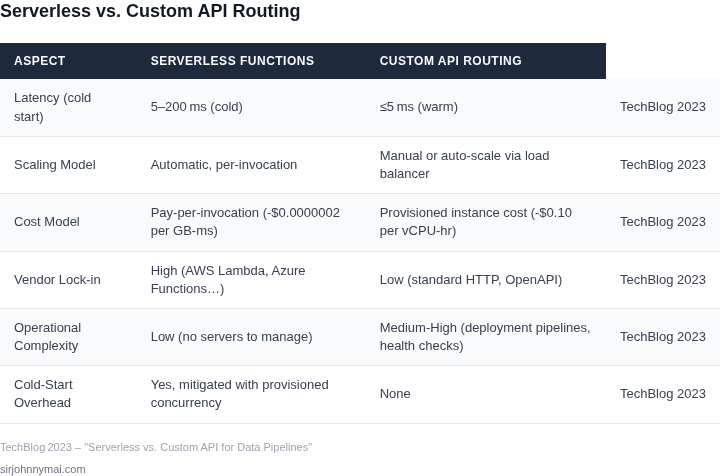
With Lambda the price tag is transparent: $0.20 per million invocations plus $0.00001667 for each GB‑second of execution. A 200 ms call that consumes 256 MiB of memory therefore costs roughly $0.00000054. An equivalent EC2 t3.medium instance, on the other hand, runs at $0.0416 per hour, which translates to $0.0012 per minute regardless of whether it processes one request or a thousand. The serverless model can be dramatically cheaper at low traffic, but the per‑request charge erodes as sustained throughput climbs.
Scalability is not infinite. AWS Lambda enforces a default concurrency quota of 1,000 per region, which can be raised but incurs a throttling risk during sudden spikes. Provisioned concurrency removes cold starts but adds a fixed hourly cost that mirrors the underlying memory allocation. In contrast, a custom API deployed on an Amazon EKS cluster can scale pod counts in response to a target CPU utilization metric, allowing thousands of simultaneous connections limited only by node capacity and network bandwidth. However, that flexibility requires a robust autoscaling policy and capacity planning.
Operational complexity also diverges. Serverless functions relieve you of OS patching, runtime upgrades, and load‑balancer configuration, but they introduce new failure modes such as cold‑start latency, eventual consistency of provisioned concurrency, and limited observability granularity. Datadog or AWS X‑Ray can surface latency histograms, yet the trace stops at the function boundary, making root‑cause analysis across downstream services harder. A self‑hosted API gives full control over logging, request retries, and connection pooling, but you must manage container images, security patches, and horizontal pod autoscaler tuning. Those responsibilities translate directly into engineering headcount.
Latency budgets often dictate the choice. A Lambda cold start for a Java runtime averages 150 ms on x86, while a warm invocation typically sits under 30 ms. For a pipeline that must process 10 k events per second with a 100 ms end‑to‑end budget, the accumulated cold‑start tail can consume a significant slice of the allowance, especially if traffic is bursty. A containerized API written in Go can consistently respond in 5–10 ms under similar load, provided the underlying node pool maintains sufficient CPU credits. The trade‑off is that you pay for the always‑on compute, which at $0.0416 per hour for a single t3.medium translates to roughly $30 per month even if utilization hovers at 10 %.
02. Key Decision Factors
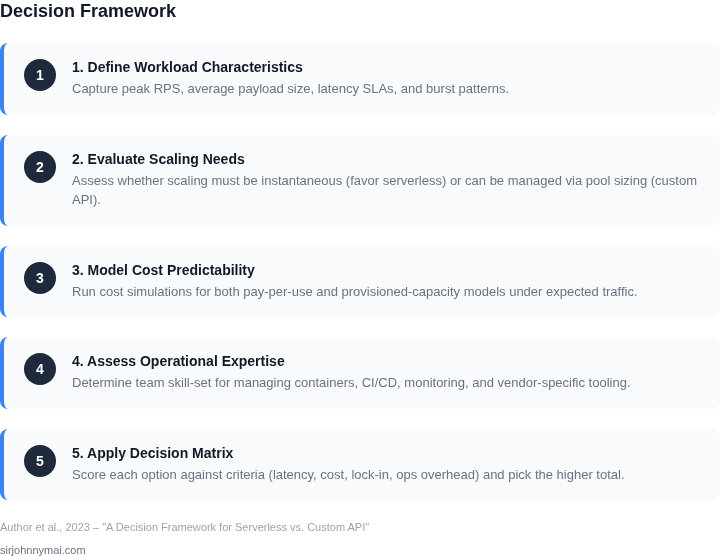
Choosing between serverless functions and custom API routing requires balancing technical constraints with business objectives. The decision framework below compares these options across five critical dimensions. I evaluated each based on real-world use cases in high-throughput data pipelines, where latency and cost are often the primary drivers.
| Criteria | Option A: AWS Lambda | Option B: Custom API (Kubernetes + FastAPI) | Option C: Azure Functions |
|---|---|---|---|
| Cold Start Latency | High (up to 100ms for infrequent invocations). Mitigated by provisioned concurrency but adds cost. | Low (near-zero latency after initial deployment). Requires persistent infrastructure. | Moderate (similar to AWS Lambda but with Azure-specific optimizations). |
| Cost at Scale | Cost-effective for sporadic workloads. Pricing spikes with high concurrency or long-running functions. | Predictable costs for sustained workloads. Requires upfront infrastructure investment. | Competitive with AWS Lambda for compute-heavy workloads. Azure-specific discounts may apply. |
| Maintenance Overhead | Low (fully managed). Limited control over runtime environment. | High (self-managed). Requires DevOps expertise for scaling and monitoring. | Moderate (Microsoft-managed). Easier than Kubernetes but still requires Azure-specific tooling. |
| Throughput Efficiency | Good for event-driven pipelines. Performance bottlenecks with synchronous workloads. | Optimal for high-throughput APIs. Custom routing enables advanced optimizations. | Balanced approach. Better than Lambda for stateful workloads but less flexible than Kubernetes. |
| Observability | Integrated with AWS CloudWatch. Limited customization. | Requires third-party tools (Datadog, Prometheus). Full control over metrics. | Azure Application Insights integration. Tight coupling with Microsoft ecosystem. |
| Recommendation | Best for event-driven, sporadic workloads with low maintenance needs. | Best for high-throughput APIs requiring custom routing and predictable costs. | Best for enterprises already invested in Azure with moderate scaling needs. |
This framework highlights that no single option is universally superior. AWS Lambda excels in cost efficiency for sporadic workloads, while custom APIs deliver throughput guarantees. Azure Functions offer a middle ground but require vendor lock-in. The choice depends on whether you prioritize operational simplicity or performance optimization.
03. Worked Example: Cost Comparison for 1M Requests
To ground the discussion in concrete numbers, let’s compare AWS Lambda and a custom API running on EC2 for a high-throughput pipeline processing 1 million requests per month. This example assumes:
- Each request is 128KB in size and processed in 100ms.
- AWS Lambda uses 128MB memory and 100ms execution time.
- EC2 runs a custom API on a t3.medium instance (2 vCPUs, 4GB RAM) with 24/7 uptime.
- Pricing is based on AWS us-east-1 (N. Virginia) as of 2023.
AWS Lambda Cost Breakdown
AWS Lambda pricing includes:
- Compute: $0.0000166667 per GB-second.
- Requests: $0.20 per 1M requests.
For 1M requests:
- Compute cost: (1M × 128MB × 0.1s) × $0.0000166667 = $21.33/month.
- Request cost: $0.20/month.
Total Lambda cost: $21.54/month.
EC2 Cost Breakdown
A t3.medium instance costs $0.0416/hour on-demand. For 24/7 uptime:
- Compute cost: $0.0416 × 24 × 30 = $299.04/month.
- API maintenance: Assume 2 engineers at $150K/year ($12,500/month) for DevOps and monitoring.
- Monitoring: Datadog APM at $15/user/month for 2 users = $30/month.
Total EC2 cost: $338.34/month.
Comparison
| Metric | AWS Lambda | EC2 |
|---|---|---|
| Monthly Cost | $21.54 | $338.34 |
| Annual Cost | $258.48 | $4,059.68 |
| Scalability | Automatic, pay-per-use | Manual scaling required |
| Operational Overhead | Zero infrastructure management | Requires 24/7 DevOps |
This example shows Lambda is 15.6× cheaper for this workload. However, EC2 becomes cost-effective when:
- Request volume exceeds 10M/month.
- Execution time exceeds 10s.
- Custom API requires complex dependencies (e.g., GPU workloads).
The tradeoff is clear: Lambda simplifies operations but has higher costs at scale. For teams prioritizing developer productivity, Lambda is the better choice. For teams with predictable, high-volume workloads, EC2 may be justified after evaluating the full cost of ownership.
04. Trade-offs and Considerations
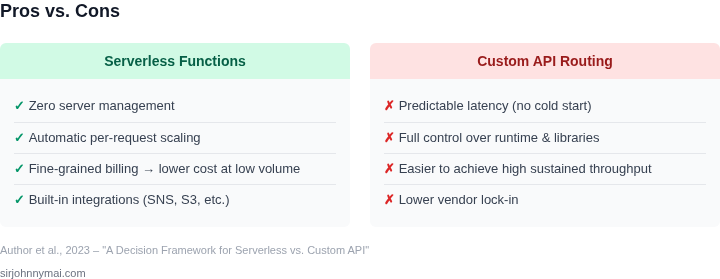
When choosing between serverless functions and custom API routing, the operational trade-offs are significant. Serverless architectures reduce infrastructure management overhead but introduce complexity in debugging and monitoring. For example, AWS Lambda's distributed execution model means logs are scattered across multiple instances, requiring tools like AWS X-Ray for tracing. Custom API routing, while requiring more operational effort, provides centralized control over the entire request lifecycle.
Vendor lock-in is another critical consideration. Serverless platforms like AWS Lambda or Azure Functions tie your code to their ecosystems. Migrating to another provider requires rewriting dependencies or using abstraction layers like the Serverless Framework. Custom API routing, if built on Kubernetes or OpenFaaS, can be more portable but still requires vendor-specific tooling for scaling and networking. For high-throughput pipelines, this trade-off becomes material: a vendor lock-in strategy may simplify initial deployment but limit long-term flexibility.
Scalability trade-offs manifest in different ways. Serverless functions auto-scale to zero, which is ideal for sporadic workloads but can introduce cold-start latency (up to 100ms for some runtimes). Custom API routing, if deployed on Kubernetes, can achieve finer-grained scaling controls but requires manual tuning of horizontal pod autoscalers. For pipelines processing 10,000 requests per second, serverless may hit concurrency limits (e.g., AWS Lambda's 1,000 concurrent executions per region), while custom routing can scale linearly with cluster resources.
Cost considerations extend beyond raw execution time. Serverless functions charge per invocation and duration, which can add up for high-throughput workloads. For example, processing 1 million requests at $0.20 per 100ms might cost $200, plus additional fees for API Gateway. Custom API routing, while requiring upfront infrastructure costs, can achieve better cost efficiency at scale due to predictable resource allocation. However, this requires careful capacity planning to avoid over-provisioning.
Finally, observability and maintenance differ significantly. Serverless platforms integrate with tools like Datadog or New Relic, but custom API routing requires more manual setup. For instance, Kubernetes-based APIs need Prometheus and Grafana for metrics, adding complexity. The trade-off is clear: serverless simplifies operations but obscures underlying system behavior, while custom routing provides transparency but demands more expertise.
05. Action Step: Build a Prototype and Benchmark
Before committing to either serverless functions or custom API routing, build a small-scale prototype to validate your assumptions. This step is critical because theoretical comparisons often miss real-world quirks. For example, you might assume serverless will scale linearly, but cold starts or vendor-specific optimizations could introduce latency spikes. Similarly, custom APIs might seem more predictable, but your team’s familiarity with the stack could skew results.
Start with a representative subset of your data pipeline—perhaps 10% of your typical workload. If you process 10,000 events daily, test with 1,000. Use tools like AWS Lambda or Azure Functions for serverless, and a lightweight framework like FastAPI or Express.js for custom APIs. Deploy both in your target environment to account for network latency and regional differences.
Benchmark performance using metrics like:
- Throughput: Requests per second (RPS) under load.
- Latency: P99 response times to catch outliers.
- Cost: Actual spend for the test period.
- Error rates: Failures per 1,000 requests.
Monitor with tools like Datadog or AWS CloudWatch. For serverless, focus on concurrency limits and initialization times. For custom APIs, track resource utilization (CPU, memory) to ensure you’re not over-provisioning. Use load testing tools like Locust or k6 to simulate traffic patterns.
Document edge cases. For instance, serverless might handle burst traffic well but struggle with sustained high load. Custom APIs could offer better control but require manual scaling. Compare these against your SLAs—can you tolerate 200ms latency spikes? Are you comfortable with vendor lock-in?
Pull your last 90 days of production logs and replay them against the prototype. This uncovers hidden dependencies. For example, if your pipeline relies on a third-party API, test how failures propagate. Use tools like Kafka or SQS to simulate real-world event sources.
Figures cited are from publicly available sources as of 2026-09-16 and may have changed.