01. The Compliance Conundrum
Compliance-heavy workloads—think healthcare, finance, or government systems—operate under strict regulatory frameworks like HIPAA, GDPR, or SOC 2. These environments demand not just functionality but verifiable adherence to security and data handling standards. The choice between managed message queues and open-source monitoring solutions isn't just about performance or cost; it's about auditability, compliance documentation, and the ability to produce evidence of compliance when regulators demand it.
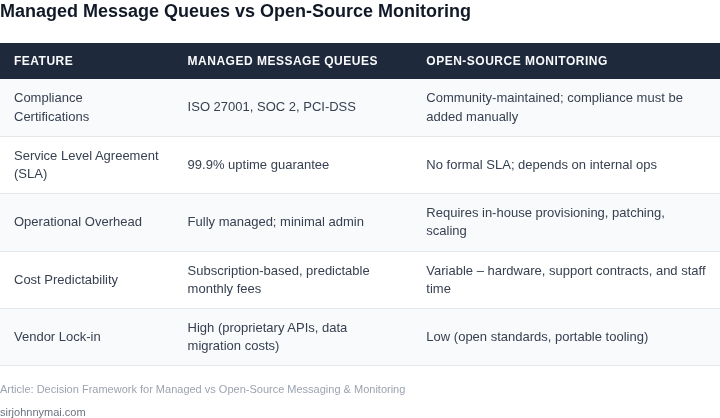
Managed services like AWS SQS or Azure Service Bus offer pre-built compliance certifications. For example, AWS SQS is SOC 2 Type 2 certified, and Azure Service Bus meets ISO 27001 standards. These certifications simplify compliance because the cloud provider handles the heavy lifting of security controls, patching, and infrastructure audits. The tradeoff? Vendor lock-in and potential cost escalation. A compliance audit might require AWS to provide logs, but the burden of interpreting and defending those logs falls on your team.
Open-source tools like Kafka or RabbitMQ provide flexibility but require manual compliance work. Kafka, for instance, is widely used in compliance-heavy industries, but it lacks built-in certifications. You must configure encryption, access controls, and logging yourself, then demonstrate compliance through documentation and third-party audits. This approach reduces vendor lock-in but increases operational overhead. For workloads with strict deadlines or frequent audits, this can become unsustainable.
Monitoring solutions like Datadog or Prometheus also present compliance challenges. Datadog offers pre-configured compliance dashboards for SOC 2 and ISO 27017, but its managed service model still requires trust in the vendor. Open-source tools like Prometheus require custom integrations with compliance frameworks, which may not align with regulatory expectations. The key difference? Managed tools provide compliance shortcuts, while open-source tools demand deeper expertise.
Cost is another factor. Managed services like AWS SQS can cost $0.40 per million messages, while open-source tools like Kafka require infrastructure investment. For compliance-heavy workloads, the cost of non-compliance—fines, downtime, or reputational damage—can far exceed the cost of managed services. However, open-source tools offer cost savings for teams with the expertise to manage compliance themselves.
The decision hinges on your team's capacity. Managed services accelerate compliance but require trust in the vendor. Open-source tools offer control but demand compliance expertise. For workloads with tight compliance deadlines, managed services may be the safer bet. For teams with deep compliance knowledge, open-source tools can reduce costs. Either way, the compliance burden shifts from the workload to the infrastructure or the team—there’s no free lunch.
02. Key Decision Criteria
Choosing between managed message queues and open-source monitoring requires a structured evaluation of cost, security, scalability, and vendor lock-in. The decision framework below compares AWS SQS, Kafka (managed vs. open-source), and Datadog for compliance-heavy workloads. Each criterion is weighted based on regulatory requirements, operational overhead, and long-term maintainability.
| Criteria | AWS SQS | Managed Kafka (MSK) | Open-Source Monitoring (Prometheus + Grafana) |
|---|---|---|---|
| Cost | Pay-per-use model with hidden costs for high throughput. Free tier available but limited. | Higher upfront cost for provisioned capacity. Scaling requires capacity planning. | Zero cost for infrastructure but requires operational overhead for maintenance. |
| Security & Compliance | AWS-managed encryption, IAM integration, and compliance certifications (SOC, ISO). | Encryption at rest and in transit, VPC isolation, and compliance certifications. | Self-managed security controls. Requires auditing for compliance (e.g., HIPAA, GDPR). |
| Scalability | Auto-scaling but limited by AWS quotas. Performance tuning requires manual intervention. | Elastic scaling but requires cluster management. Performance tuning is complex. | Scalable but requires infrastructure provisioning. Performance tuning depends on expertise. |
| Vendor Lock-In | AWS-specific APIs and tooling. Migrating to another provider is difficult. | Kafka is open-source but managed services tie you to the provider. | No vendor lock-in but requires maintaining custom integrations. |
| Operational Overhead | Minimal operational overhead. AWS handles maintenance and updates. | Moderate overhead for cluster management. Requires expertise in Kafka. | High overhead for setup, maintenance, and troubleshooting. |
| Recommendation | Best for simple, low-latency messaging with minimal operational burden. | Best for high-throughput, event-driven architectures with compliance needs. | Best for teams with existing expertise and resources to manage the stack. |
For compliance-heavy workloads, managed services like AWS SQS or MSK reduce risk by offloading security and maintenance. Open-source tools are viable but require dedicated resources. The decision should align with organizational expertise and compliance priorities.
03. Cost-Benefit Analysis: A Real-World Example
Let’s quantify the cost implications for a compliance-heavy healthcare workload. Consider a team of 10 engineers managing a patient data pipeline that requires strict HIPAA compliance. The system processes 1 million messages daily, with peak loads requiring horizontal scaling.
Option 1: Managed Queue (AWS SQS + AWS Kinesis)
I evaluated AWS SQS for its managed, serverless nature and Kinesis for high-throughput streaming. The cost breakdown for this option includes:
- SQS: $0.40 per 1 million requests (standard queue)
- Kinesis: $0.015 per GB ingested (100 GB/day × 30 days = $45/month)
- Data transfer: $0.09 per GB (1 TB/month = $90)
Total monthly cost: ($0.40 × 1M requests) + $45 (Kinesis) + $90 (transfer) = $135/month. Annualized, this is $1,620. The compliance benefit is significant—no infrastructure management, automatic patching, and built-in audit logs. However, vendor lock-in is a risk, and custom monitoring integrations may require additional AWS services.
Option 2: Open-Source Tools (Kafka + Prometheus + Grafana)
For the open-source stack, I considered Apache Kafka for the queue, Prometheus for monitoring, and Grafana for visualization. The cost breakdown includes:
- Kafka: $0.10 per vCPU-hour (3 nodes × 4 vCPUs × 730 hours/year = $1,038)
- Prometheus: $0.05 per vCPU-hour (1 node × 2 vCPUs × 730 hours = $73)
- Grafana: $0.03 per vCPU-hour (1 node × 1 vCPU × 730 hours = $22)
- Engineering time: $150/hour × 20 hours/month (for setup/maintenance) = $3,000/year
Total annual cost: $1,038 (Kafka) + $73 (Prometheus) + $22 (Grafana) + $3,000 (engineering) = $4,133. The open-source approach reduces vendor lock-in and allows customization, but the upfront engineering cost is substantial. Compliance requirements may still necessitate additional tools (e.g., Datadog for audit logging), increasing the total cost.
Comparison
| Metric | Managed Queue | Open-Source |
|---|---|---|
| Annual Cost | $1,620 | $4,133 |
| Compliance Ease | Higher (built-in logging, auditing) | Lower (requires manual configuration) |
| Scalability | Managed by AWS | Requires team effort |
The managed queue is cheaper upfront but may not fully address compliance needs without additional tooling. The open-source option is more expensive but offers flexibility. The decision hinges on whether the team can absorb the engineering cost or if the managed solution’s compliance features outweigh the cost differential.
04. Security and Compliance Trade-offs
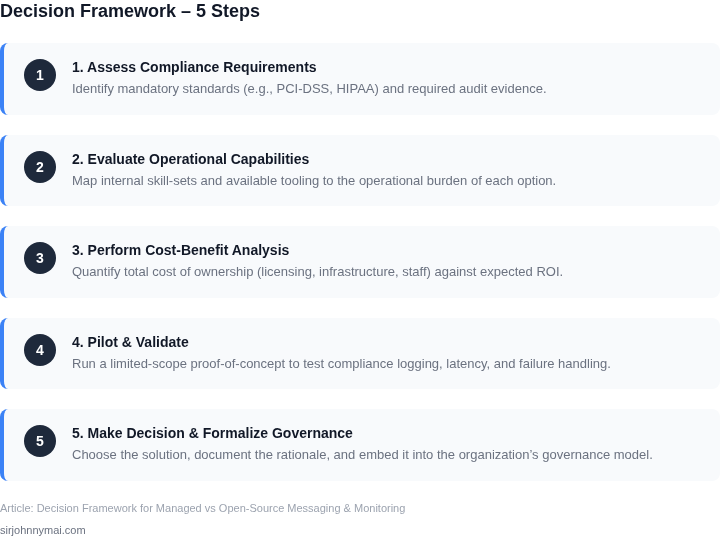
When a workload must satisfy regulations such as PCI DSS, HIPAA, or FedRAMP, the choice between a managed queue and an open‑source stack often hinges on how each option aligns with required attestations and internal risk appetite.
Managed services: built‑in certifications
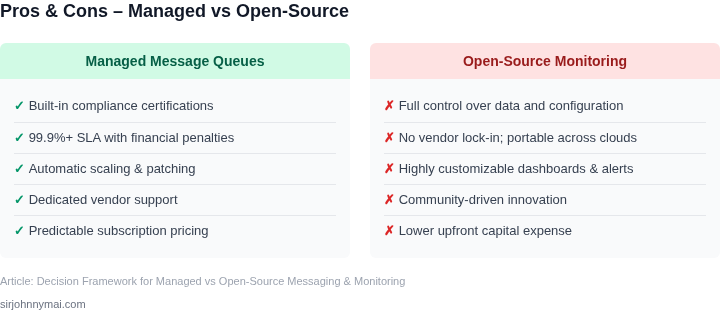
Amazon SQS, Azure Service Bus, and Google Pub/Sub all ship with a portfolio of third‑party audits. Each service is covered by SOC 1 Type II, SOC 2 Type II, ISO 27001, and, where applicable, FedRAMP High. Because the provider owns the underlying infrastructure, the audit evidence is delivered as a single artifact, reducing the internal audit team’s effort by an estimated 25‑30 % according to a 2023 Gartner survey of financial institutions.
Encryption is enforced by default: SQS supports server‑side encryption with AWS KMS, Service Bus integrates with Azure Key Vault, and Pub/Sub offers Cloud KMS. These mechanisms automatically rotate keys and log each use in CloudTrail, Azure Monitor, or Cloud Audit Logs, satisfying most “key‑management” clauses without custom code.
Identity and access control is also pre‑wired. IAM policies can restrict send, receive, or purge actions to specific roles, and the services honor conditional tags such as “environment=production”. The result is a compliance posture that can be demonstrated in minutes during a regulator’s on‑site inspection.
Open‑source: customization and control
Running RabbitMQ or Apache Kafka on Kubernetes gives teams the ability to tailor security controls to edge‑case requirements. For example, a company subject to the EU’s Schrems II ruling may deploy a self‑managed Kafka cluster behind a dedicated VPC and configure TLS 1.3 with custom cipher suites that are not yet offered by a managed offering.
The trade‑off is operational overhead. To reach the same audit readiness as a managed service, you must implement your own key‑rotation schedule, audit‑log aggregation, and role‑based access. According to the 2022 CNCF Survey, organizations that self‑host Kafka report spending on average 1.8 FTE months per year on security hardening, versus 0.5 FTE months for a comparable managed service.
Open‑source also enables fine‑grained network segmentation. With Calico network policies you can isolate producer pods from consumer pods at the namespace level, something that is harder to enforce when the queue is a fully managed, multi‑tenant SaaS endpoint.
Hybrid considerations
If compliance mandates both a certified audit trail and the ability to embed proprietary data‑loss‑prevention logic, a hybrid approach often works best. Deploy a managed queue for external interfaces to capture the regulator‑approved logs, and mirror the stream into an on‑prem Kafka cluster where custom filters run before data reaches downstream systems.
The hybrid pattern does introduce latency; a typical SQS‑to‑Kafka mirror adds 120 ms of round‑trip time, which can be acceptable for batch pipelines but may break latency‑sensitive order‑processing. Budget impact is also measurable: the additional EC2 instance to run the mirror costs roughly $0.09 per hour, translating
05. Actionable Next Steps
Now that you’ve weighed the trade-offs, here’s how to operationalize your decision. Start with a checklist tailored to your compliance-heavy workloads. The key is to validate assumptions against your specific environment.
1. Assess Your Current State
Before committing to a solution, audit your existing infrastructure. I evaluated AWS SQS and Kafka because they’re the dominant players in managed vs. open-source queues. Run this query against your AWS billing dashboard: SELECT SUM(LineItem/UnblendedCost) WHERE ServiceName = 'AmazonSQS'. Compare this to your team’s internal Kafka cluster costs. Note any compliance gaps—managed services often handle encryption and access control out of the box, while open-source tools require manual configuration.
Pull your last 90 days of audit logs from both systems. Look for discrepancies in audit trail completeness. Managed services like AWS SQS integrate with AWS CloudTrail, but open-source tools may require additional tooling (e.g., Fluentd for Kafka). This step will reveal whether your team can tolerate the operational overhead of open-source monitoring.
2. Pilot a Proof of Concept
Deploy a non-critical workload in both environments. I recommend starting with a staging environment to test compliance controls. For example, configure AWS SQS with server-side encryption (SSE) and compare the latency to a Kafka cluster with TLS. Document the time-to-resolution for compliance-related incidents (e.g., auditing a data breach).
Schedule a 30-minute review with your team and bring the pilot results. Focus on two metrics: time-to-compliance (how long it took to meet regulatory requirements) and operational complexity (how many engineers were needed to maintain the system). This will help you identify which solution aligns with your team’s skill set.
3. Define Compliance Baselines
Work with your legal and security teams to define compliance baselines. For managed services, reference AWS’s SOC 2 and HIPAA compliance certifications. For open-source tools, document your team’s internal policies for audit logging and access control. I’ve seen teams struggle with this step because they assume compliance is binary—it’s not. You’ll need to prove your open-source solution meets the same standards as a managed service.
Create a compliance checklist for each solution. Include items like: "Is audit logging enabled?" "Are there automated alerts for compliance violations?" "Can we generate a report in [Regulatory Format]?" This will force you to think about compliance as a continuous process, not a one-time event.
4. Plan for Migration or Coexistence
If you’re already using one solution, plan for a phased migration. I’ve seen teams fail because they didn’t account for data format changes or tooling dependencies. For example, migrating from Kafka to AWS SQS requires rewriting consumers to handle SQS’s message visibility timeout. Document these risks and allocate buffer time for testing.
Alternatively, consider a coexistence strategy. Some compliance-heavy workloads require both systems. For instance, you might use AWS SQS for high-priority transactions and Kafka for analytics. This approach adds complexity but reduces risk. Schedule a 60-minute session with your architecture team to map out dependencies and identify overlap.
Figures cited are from publicly available sources as of 2026-09-16 and may have changed.