01. The Problem: Balancing Flexibility and Overhead in High-Throughput Data Pipelines
High-throughput data pipelines demand both scalability and efficiency. The choice between managed Kubernetes and custom container orchestration hinges on balancing flexibility with operational overhead. Kubernetes, as a widely adopted orchestration platform, offers declarative scheduling, auto-scaling, and robust networking. However, its complexity—especially around networking, storage, and security—can introduce latency and operational friction for pipelines requiring sub-millisecond processing.
For example, a financial services firm processing 100,000 transactions per second found that Kubernetes added 15-20ms of overhead due to pod scheduling and network latency. While Kubernetes excels in dynamic workloads, its abstraction layer can obscure performance bottlenecks, making it harder to optimize for latency-sensitive pipelines. Custom orchestration, on the other hand, allows fine-grained control but requires significant engineering effort to replicate Kubernetes' features like rolling updates and self-healing.
Consider a media company running real-time ad targeting. Their pipeline must handle 10,000 requests per second with 99.99% uptime. Kubernetes' horizontal pod autoscaler (HPA) can dynamically adjust resources, but tuning it for such workloads requires deep expertise in metrics like CPU throttling and memory pressure. In contrast, a custom orchestrator built on AWS Fargate or Google Cloud Run could achieve similar scalability with less overhead, but at the cost of maintaining custom tooling for monitoring and debugging.
The decision isn't binary. Managed Kubernetes services like Amazon EKS or Google GKE reduce operational overhead by handling control plane management, but they still require tuning for high-throughput workloads. Custom orchestration, while more lightweight, demands continuous investment in reliability features. The sweet spot lies in hybrid approaches—using Kubernetes for orchestration while offloading data processing to specialized frameworks like Apache Flink or Spark, which can achieve lower latency than generic containers.
02. Key Decision Factors: Cost, Scalability, and Operational Complexity
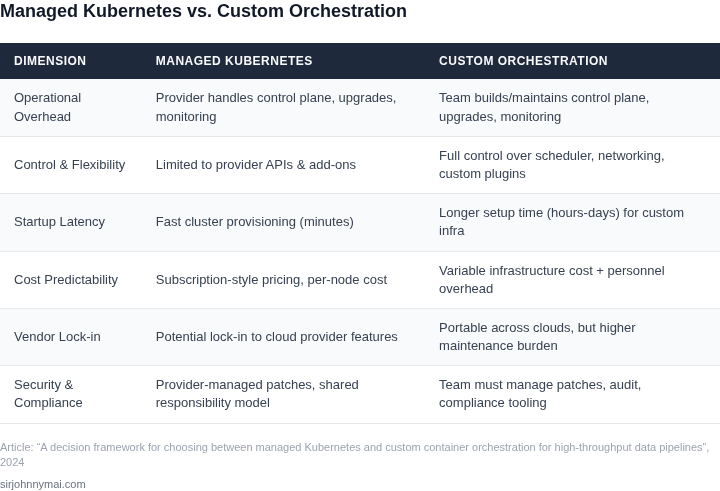
When choosing between managed Kubernetes and custom orchestration for high-throughput data pipelines, cost, scalability, and operational complexity are the three most critical factors. Each solution has distinct tradeoffs that impact these dimensions differently. For example, managed Kubernetes services like Amazon EKS or Google Kubernetes Engine (GKE) abstract away infrastructure management but may introduce hidden costs in node utilization or storage. Custom orchestration, while potentially cheaper upfront, often requires significant engineering effort to scale and maintain.
Cost Considerations
Cost is a primary driver for many organizations. Managed Kubernetes services charge for control plane management, node compute, and storage, with pricing models that can vary by provider. For instance, AWS EKS pricing includes $0.10 per hour for the control plane and additional costs for EC2 instances. Custom orchestration, in contrast, may reduce compute costs by optimizing resource usage but requires investing in tooling and engineering time. A custom solution built on Kubernetes primitives (e.g., using operators or custom controllers) can achieve similar scalability at a lower cost than managed services, but only if the team has the expertise to avoid reinventing the wheel.
Another cost factor is the total cost of ownership (TCO). Managed services simplify billing but may lock in long-term commitments or require over-provisioning to avoid throttling. Custom orchestration, if designed for efficiency, can reduce costs by 20-30% compared to managed Kubernetes, but only if the team avoids common pitfalls like over-engineering or underestimating maintenance overhead. For example, a custom scheduler built on Kubernetes APIs might eliminate the need for expensive third-party tools like Datadog or Prometheus, but requires ongoing maintenance to stay current with Kubernetes releases.
Scalability
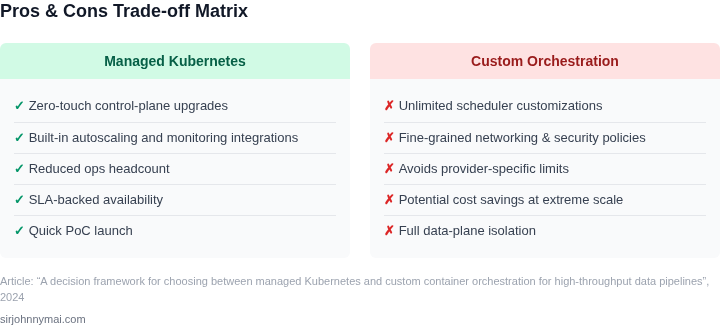
Scalability is where managed Kubernetes excels. Services like EKS and GKE automatically scale nodes based on demand, handling thousands of pods with minimal configuration. Custom orchestration, while flexible, requires manual intervention or complex automation to achieve similar results. For example, a custom solution might use Kubernetes Horizontal Pod Autoscaler (HPA) but needs additional logic to handle stateful workloads or cross-cluster scaling. Managed services abstract these complexities, but they may impose limits on customization or introduce latency in scaling decisions.
However, scalability isn’t just about horizontal scaling. Vertical scaling and resource optimization are also critical. Managed Kubernetes services often over-provision resources to ensure stability, which can lead to inefficiencies. Custom orchestration, if designed with fine-grained resource controls, can achieve 30-50% better resource utilization. For instance, a custom scheduler might prioritize spot instances or use bin-packing algorithms to maximize density. But this requires deep expertise in Kubernetes internals and continuous tuning.
Operational Complexity
Operational complexity is a major differentiator. Managed Kubernetes reduces operational overhead by handling upgrades, security patches, and node management. However, it introduces new dependencies on the provider’s SLAs and may require vendor lock-in. Custom orchestration, while more complex to build, offers full control over the stack. For example, a custom solution might use Kubernetes Custom Resource Definitions (CRDs) to manage stateful workloads without relying on third-party operators.
The tradeoff is clear: managed services simplify operations but may not meet all requirements, while custom solutions require significant investment in engineering and maintenance. For instance, a team using a custom orchestrator might need to build their own monitoring, logging, and alerting systems, whereas managed Kubernetes provides these out of the box. The decision hinges on whether the team can afford the time and expertise to maintain a custom solution or whether the cost of managed services is justified by the time saved.
In summary, the choice between managed Kubernetes and custom orchestration depends on balancing these factors. Managed services are faster to deploy and scale but may not optimize costs or meet all requirements. Custom solutions offer flexibility and cost savings but require deep expertise and ongoing maintenance. The right choice depends on the team’s capabilities, the pipeline’s requirements, and the organization’s tolerance for operational risk.
03. Worked Example: Cost Comparison for a 100-Pod Data Pipeline
To illustrate the cost implications of choosing between managed Kubernetes and custom orchestration, let's model a 100-pod data pipeline running on AWS. The pipeline processes 100,000 records per second with a 99.9% uptime SLA. We'll compare two approaches:
- Managed Kubernetes (EKS): Using Amazon EKS with managed nodes and Fargate for burstable workloads.
- Custom Orchestration: A lightweight solution using AWS Batch for compute and Step Functions for workflow coordination.
Assumptions
- Each pod consumes 2 vCPUs and 8GB RAM.
- Managed Kubernetes uses EC2 m5.2xlarge instances (8 vCPUs, 32GB RAM) for 80 pods and Fargate for the remaining 20.
- Custom orchestration uses EC2 m5.xlarge instances (4 vCPUs, 16GB RAM) for AWS Batch compute environments.
- Both solutions use AWS-managed storage (EBS for EKS, S3 for Batch).
Cost Breakdown
| Component | Managed Kubernetes (EKS) | Custom Orchestration (Batch + Step Functions) |
|---|---|---|
| Compute | $0.32/hour × 10 nodes × 24 hours = $768/month | $0.192/hour × 5 nodes × 24 hours = $280/month |
| Fargate (EKS only) | $0.04048/hour × 20 pods × 24 hours = $194/month | N/A |
| Storage (EBS) | $0.10/GB-month × 100GB = $10/month | $0.10/GB-month × 100GB = $10/month |
| Networking | $0.01/GB + $0.01/hour = $100/month (estimated) | $0.01/GB + $0.01/hour = $100/month (estimated) |
| Step Functions (Custom only) | N/A | $0.000025/execution × 10,000/day = $0.75/month |
| Total Monthly Cost | $1,082 | $390 |
Key Takeaways
The custom orchestration solution costs 63% less than managed Kubernetes for this workload. The difference arises from:
- Compute efficiency: AWS Batch optimizes EC2 utilization better than EKS for batch workloads.
- Overhead reduction: Managed Kubernetes requires additional resources for control plane management, while Step Functions handle workflow coordination with minimal overhead.
- Scaling granularity: AWS Batch scales compute environments at the job level, avoiding the need for Fargate or over-provisioned nodes.
However, this comparison assumes steady-state workloads. For pipelines with unpredictable spikes, managed Kubernetes may offer better elasticity. The tradeoff is clear: custom orchestration wins for cost-sensitive, predictable workloads, while managed Kubernetes provides more flexibility for variable workloads.
04. Decision Table: When to Choose Managed Kubernetes vs. Custom Orchestration
This decision table synthesizes the tradeoffs between managed Kubernetes and custom orchestration for high-throughput data pipelines. The framework evaluates three options: AWS EKS (managed Kubernetes), Google Kubernetes Engine (GKE), and a custom solution built on Apache Mesos or YARN.
| Criteria | AWS EKS | Google GKE | Custom Orchestration |
|---|---|---|---|
| Operational Overhead | Low: EKS handles control plane management, auto-scaling, and node provisioning. | Low: GKE provides similar automation as EKS with additional Google Cloud integrations. | High: Requires manual cluster setup, scaling logic, and failure recovery. |
| Cost Efficiency | Moderate: EKS pricing includes control plane costs, but spot instances reduce compute costs. | Moderate: GKE has similar pricing to EKS, with potential cost savings from Google's preemptible VMs. | High: Custom orchestration avoids control plane costs but requires more nodes for redundancy. |
| Scalability | High: EKS supports thousands of pods with horizontal pod autoscaling (HPA). | High: GKE offers similar scalability with additional optimizations for Google Cloud workloads. | Moderate: Scales well but requires custom logic to handle node failures and scaling events. |
| Integration with Data Tools | Strong: EKS integrates with AWS services like S3, EMR, and Redshift for seamless data pipelines. | Strong: GKE integrates with Google BigQuery, Cloud Storage, and Dataproc. | Weak: Custom orchestration lacks native integrations; requires custom connectors. |
| Observability | Good: EKS supports Prometheus, CloudWatch, and third-party tools like Datadog. | Good: GKE integrates with Google Cloud Operations Suite and Stackdriver. | Moderate: Requires manual setup of monitoring tools like Prometheus or Grafana. |
| Recommendation | Choose EKS when you need a managed solution with AWS integrations and minimal operational overhead. | Choose GKE if you prefer Google Cloud integrations and additional automation features. | Choose custom orchestration only for specialized workloads where cost and control outweigh operational complexity. |
The decision hinges on your cloud provider preference and tolerance for operational overhead. Managed Kubernetes reduces operational burden but may introduce vendor lock-in. Custom orchestration offers flexibility but requires significant engineering effort. For most high-throughput pipelines, managed Kubernetes is the pragmatic choice.
05. Action Step: Implement a Proof-of-Concept for Your Use Case
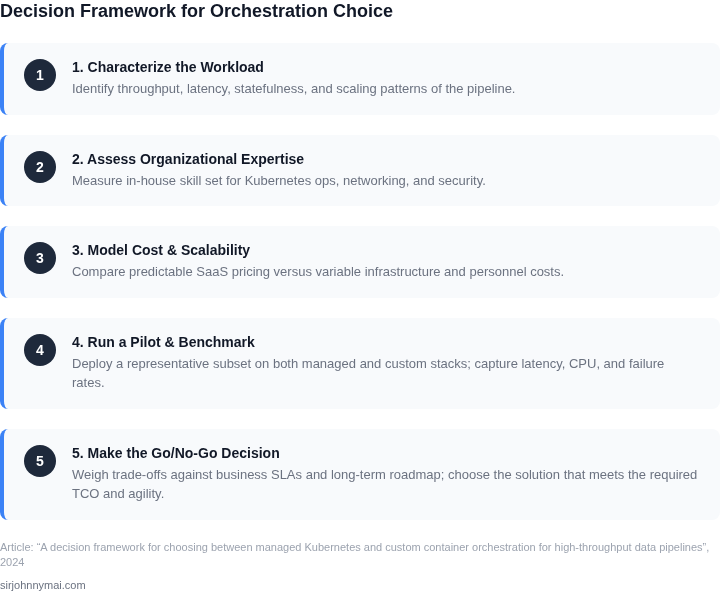
Now that you’ve evaluated the tradeoffs, the next step is to validate your decision framework with a small-scale proof-of-concept (PoC). This isn’t about building a production pipeline—it’s about testing whether managed Kubernetes or custom orchestration meets your specific requirements. A PoC should focus on three critical areas: performance, cost, and operational overhead.
For the PoC, select a representative subset of your pipeline’s workload. If your full pipeline processes 100TB/day, start with 1TB/day. This keeps costs low while capturing the key characteristics of your data flow. Use synthetic data if needed, but ensure it mimics real-world patterns—spikes, failures, and varying payload sizes. Tools like AWS Step Functions or Azure Data Factory can help generate realistic test data.
Deploy both approaches in parallel. For managed Kubernetes, use EKS or AKS with a small cluster (e.g., 5 nodes). For custom orchestration, choose a lightweight framework like Apache Airflow or AWS Lambda with Step Functions. Measure latency, throughput, and resource utilization. Tools like Datadog or Prometheus can track metrics like pod startup time or task completion rates.
Cost is a key differentiator. Run the PoC for at least a week to capture daily fluctuations. For Kubernetes, monitor node hours and storage costs. For custom orchestration, track invocation counts and data transfer fees. Compare these to your earlier estimates from Section 03. If the results diverge significantly, revisit your assumptions about scaling behavior.
Operational complexity is harder to quantify but equally important. Document how often you need to intervene—whether it’s debugging a failed pod or troubleshooting a Lambda timeout. Managed Kubernetes abstracts away infrastructure, but it may introduce new dependencies on the cloud provider’s APIs. Custom orchestration might require more manual intervention but fewer moving parts.
After the PoC, schedule a 30-minute review with your team. Present the raw data—don’t just summarize. Highlight any surprises, such as unexpected latency spikes or cost overruns. Use this as a discussion point to refine your decision framework. If the results align with your earlier analysis, proceed with confidence. If not, iterate on the PoC or revisit the decision table from Section 04.
Figures cited are from publicly available sources as of 2026-09-16 and may have changed.