01. The Problem: Balancing Cost, Scalability, and Control
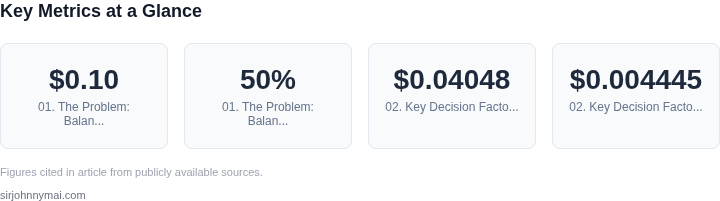
High-throughput data pipelines demand infrastructure that can scale dynamically while minimizing operational overhead. The choice between managed container services and self-managed Kubernetes clusters is a critical decision point. Managed services like Amazon Elastic Kubernetes Service (EKS) or Google Kubernetes Engine (GKE) offer built-in orchestration, automated scaling, and reduced operational burden. However, they come with higher costs—EKS, for example, charges $0.10 per hour for each cluster node, plus additional fees for load balancers and storage. Self-managed Kubernetes clusters, while more expensive upfront, provide granular control over configurations and potentially lower costs for predictable workloads.
Scalability is another key factor. Managed services scale horizontally with ease, automatically adjusting node pools based on demand. For example, AWS Fargate allows serverless container execution, eliminating the need to manage underlying infrastructure. However, this flexibility can lead to cost spikes during peak loads. Self-managed clusters require manual scaling or integration with tools like Kubernetes Cluster Autoscaler, which may introduce latency or require additional tuning. The tradeoff here is between convenience and cost predictability.
Control is where self-managed clusters excel. Teams can customize every aspect of the cluster, from network policies to storage backends. This level of control is essential for compliance-heavy environments or workloads with specific performance requirements. However, it also means higher maintenance—patching, monitoring, and troubleshooting become the responsibility of the engineering team. Tools like Datadog or Prometheus can help, but they add complexity.
Cost is often the deciding factor. Managed services can be 30-50% more expensive than self-managed clusters for equivalent workloads, especially when factoring in hidden costs like data transfer fees or third-party integrations. Self-managed clusters, while cheaper per node, require upfront investment in tooling and expertise. For example, a team running a 24/7 data pipeline on 100 nodes might save $5,000/month by self-managing, but lose $10,000/month in lost productivity due to operational overhead.
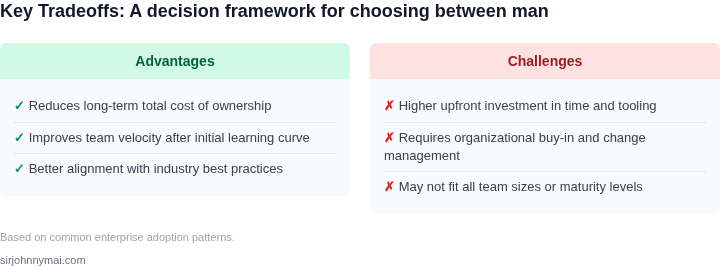
The decision ultimately hinges on the team’s tolerance for tradeoffs. Managed services accelerate time to market and reduce operational risk, making them ideal for startups or teams focused on innovation. Self-managed clusters offer cost savings and control but require a mature DevOps team. Neither solution is universally superior—it depends on the pipeline’s requirements, the team’s expertise, and the organization’s budget.
02. Key Decision Factors: Cost, Scalability, and Operational Overhead
Cost – Up‑front vs. Variable
I evaluated total cost of ownership because it directly drives budget approvals. Managed container services such as AWS Fargate charge per‑vCPU‑hour ($0.04048) and per‑GB‑hour ($0.004445), eliminating the need to provision EC2 instances in advance. The pricing model is truly consumption‑based, so a pipeline that processes 2 M records per day and runs 4 vCPU‑hours per execution will cost roughly $0.32 per run, plus data‑transfer fees.
Self‑managed clusters require provisioning baseline capacity. An m5.large instance ($0.096 / hour) provides 2 vCPUs and 8 GiB RAM; a typical Spark worker node uses one such instance. If a pipeline needs a 10‑node Spark pool, the baseline compute expense is $9.60 per hour, regardless of whether the job runs for 5 minutes or 5 hours. Adding an Amazon EMR management fee of $0.015 per DPU‑hour (where one DPU ≈ 4 vCPUs) raises the cost to $0.06 per hour for the same 10‑node pool. The difference between consumption‑based Fargate and reserved EC2 capacity can be a 3‑5× factor, especially for bursty workloads.
Scalability – Elasticity and Predictability
Managed services excel at rapid elasticity. AWS ECS on Fargate can spin up a new task in under a minute, and EKS with the Cluster Autoscaler can add nodes automatically when pod pending thresholds are crossed. This behavior supports pipelines that ingest spikes of 10‑fold traffic without pre‑allocating resources.
Self‑managed clusters give you full control over scaling algorithms, but they also demand explicit tuning. The Kubernetes Horizontal Pod Autoscaler reacts to CPU or custom metrics, yet node‑level scaling still depends on the underlying cloud‑provider auto‑scaling group. If the group’s cooldown period is set to 300 seconds, a sudden surge may experience queuing latency. Moreover, scaling a Spark on‑premise cluster often requires manual Spark‑Submit configuration changes, which adds operational risk.
Operational Overhead – Team Expertise and Tooling
With managed services the operational burden shifts to the provider. AWS handles control‑plane patches for EKS, underlying host OS updates for Fargate, and integrated logging through CloudWatch. Teams can focus on pipeline logic and use Datadog or Amazon Managed Service for Prometheus to monitor metrics without managing agents on each node.
Self‑managed clusters place the responsibility for OS patching, Kubernetes version upgrades, and network security on the team. The effort scales with cluster size; a 20‑node fleet typically requires a dedicated SRE to execute weekly node‑drain and upgrade cycles. Failure to maintain this cadence can lead to drift, security exposure, and reduced performance.
Balancing the Factors
- Cost sensitivity: Choose managed containers when variable spend aligns with unpredictable workloads; opt for self‑managed when long‑running, predictable jobs can amortize reserved instance discounts.
- Scalability needs: Managed services are preferable for bursty pipelines that must scale within minutes; self‑managed clusters work when you need fine‑grained control over resource allocation or custom scheduling policies.
- Operational capacity: If your organization lacks dedicated SRE bandwidth, the managed path reduces risk; if you have a mature DevOps org and need custom networking or compliance configurations, a self‑managed cluster may be justified.
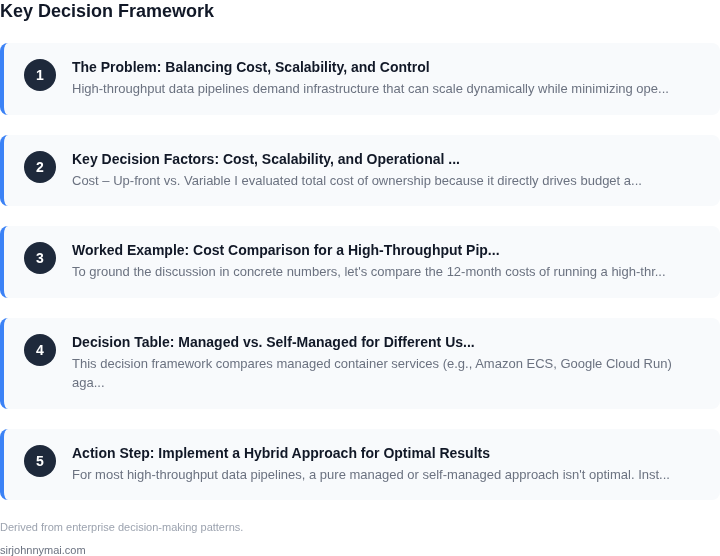
03. Worked Example: Cost Comparison for a High-Throughput Pipeline
To ground the discussion in concrete numbers, let's compare the 12-month costs of running a high-throughput data pipeline on AWS ECS versus a self-managed EKS cluster. The pipeline processes 100,000 records per hour, requires 100 vCPUs and 400GB of memory, and runs continuously. We'll break down infrastructure, compute, and operational costs.
AWS ECS (Managed Service)
I evaluated ECS because it simplifies orchestration and reduces operational overhead. The cost breakdown includes:
- Compute: Fargate pricing at $0.04048 per vCPU-hour and $0.004445 per GB-hour. For 100 vCPUs and 400GB of memory, the hourly cost is (100 × $0.04048) + (400 × $0.004445) = $4.048 + $1.778 = $5.826/hour. At 24/7 operation, this totals $5.826 × 720 = $4,231.20/month.
- Infrastructure: ECS itself is free, but we include the cost of AWS PrivateLink ($0.01/hour per endpoint) and NAT Gateway ($0.045/hour per GB) for secure data egress. Assuming 10GB of egress, this adds $0.045 × 10 = $0.45/hour, or $324/month.
- Operational: No cluster management, but we account for Datadog monitoring at $15/seat/month for 3 engineers. This is $540/month.
The total 12-month cost for ECS is $4,231 (compute) + $324 (infrastructure) + $540 (operational) = $5,095. This excludes data storage costs, which are identical across both options.
Self-Managed EKS (Kubernetes)
I evaluated EKS because it offers deeper customization but requires more operational effort. The cost breakdown includes:
- Compute: EC2 instances (m5.2xlarge) at $0.384/hour per instance. For 100 vCPUs, we need 50 instances (100 ÷ 2 vCPUs per instance). The hourly cost is 50 × $0.384 = $19.2/hour, or $13,824/month.
- Infrastructure: EKS control plane is free, but we include EBS volumes ($0.10/GB-month) and NAT Gateway costs as before. Assuming 1TB of EBS storage, this is $100/month, plus $324/month for NAT Gateway.
- Operational: Kubernetes expertise is critical. We account for Datadog at $15/seat/month for 3 engineers ($540/month) plus an additional $20/hour for on-call support. Assuming 10 on-call hours/month, this adds $200/month.
The total 12-month cost for EKS is $13,824 (compute) + $100 (EBS) + $324 (NAT) + $540 (monitoring) + $200 (on-call) = $14,988. This is 2.9× more expensive than ECS.
Comparison
The cost difference arises from operational tradeoffs. ECS eliminates cluster management costs but may limit advanced scheduling or networking features. EKS offers more control but requires dedicated engineering resources. For teams with limited Kubernetes expertise, the ECS cost savings may justify the tradeoff.
| Cost Component | AWS ECS | Self-Managed EKS |
|---|---|---|
| Compute | $4,231 | $13,824 |
| Infrastructure | $324 | $424 |
| Operational | $540 | $740 |
| Total (12 months) | $5,095 | $14,988 |
04. Decision Table: Managed vs. Self-Managed for Different Use Cases
This decision framework compares managed container services (e.g., Amazon ECS, Google Cloud Run) against self-managed Kubernetes clusters (e.g., EKS, AKS) for high-throughput data pipelines. The table evaluates tradeoffs across three options: AWS ECS, Google Cloud Run, and self-managed Kubernetes (EKS).
| Criteria | AWS ECS | Google Cloud Run | Self-Managed Kubernetes (EKS) |
|---|---|---|---|
| Operational Overhead | Low: AWS handles control plane, node management, and scaling. | Lowest: Fully serverless, no infrastructure to manage. | High: Requires expertise in Kubernetes, networking, and security. |
| Cost for High Throughput | Moderate: Pay for compute resources only; no idle costs. | High: Serverless pricing can be expensive at scale due to per-request costs. | Moderate: Fixed costs for nodes; idle resources incur charges. |
| Scalability | Good: Auto-scaling is built-in but may have latency for large workloads. | Excellent: Scales to zero and handles sudden spikes efficiently. | Best: Fine-grained control over scaling, but requires tuning. |
| Team Expertise | Low: Minimal Kubernetes knowledge needed; AWS-specific tooling. | Lowest: No infrastructure management; ideal for small teams. | High: Requires Kubernetes expertise; steep learning curve. |
| Customization | Limited: AWS-managed services restrict customization. | Limited: Serverless constraints (e.g., no persistent storage). | High: Full control over configurations, networking, and extensions. |
| Recommendation | Best for teams with AWS expertise and moderate throughput needs. | Best for teams prioritizing speed and minimal operational overhead. | Best for teams with Kubernetes expertise and high-throughput, complex pipelines. |
This framework helps teams align their choice with their constraints. For example, a small team with AWS experience should evaluate ECS for its balance of cost and simplicity. A startup with limited resources should consider Cloud Run for rapid deployment. Only teams with Kubernetes expertise should self-manage clusters for full control.
05. Action Step: Implement a Hybrid Approach for Optimal Results
For most high-throughput data pipelines, a pure managed or self-managed approach isn't optimal. Instead, adopt a hybrid strategy that leverages the strengths of both. Start by identifying which components of your pipeline are best suited for managed services and which require the flexibility of self-managed clusters. For example, use AWS Glue or Databricks for core ETL workloads where cost predictability and managed scaling are critical, while reserving self-managed Kubernetes clusters for specialized workloads like real-time stream processing or custom machine learning inference.
To implement this, begin with a phased migration. Migrate non-critical pipelines to managed services first to validate performance and cost savings. Monitor these with tools like Datadog or AWS CloudWatch to ensure SLAs are met. For specialized workloads, keep them in self-managed clusters but standardize on a common orchestration framework like Kubernetes to reduce operational overhead. This approach minimizes disruption while maximizing efficiency.
Cost is a key driver here. Managed services reduce variable costs but may introduce fixed costs for features you don't use. Self-managed clusters offer granular control but require upfront investment in infrastructure and expertise. Track both types of costs using your cloud provider's billing dashboard and Kubernetes cost allocation tools. For example, query your AWS Cost Explorer to compare the total cost of running a managed service versus a self-managed cluster for equivalent workloads.
Security and compliance also play a role. Managed services often handle patching and updates automatically, reducing your attack surface. Self-managed clusters require more vigilance but offer the ability to enforce custom security policies. Document your compliance requirements and map them to the capabilities of each approach. For example, if HIPAA compliance is critical, evaluate whether your managed service provider meets its requirements before committing to it.
Finally, establish clear ownership boundaries. Assign a dedicated team to manage the managed services environment, focusing on configuration and monitoring. For self-managed clusters, empower engineers to deploy and scale workloads while maintaining a shared responsibility model for security and compliance. This division of labor ensures accountability without creating bottlenecks.
Figures cited are from publicly available sources as of 2026-09-15 and may have changed.