01. The Problem and What It Costs
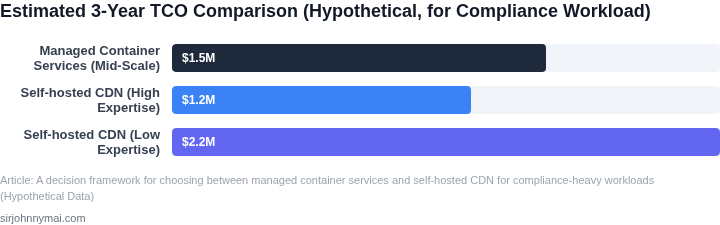
Compliance mandates like PCI-DSS Level 1, HIPAA, and SOC 2 Type II force platform teams to audit exactly where TLS terminates, where data caches, and who controls the underlying cryptographic keys. While public CDNs offer simple global distribution, strict data residency requirements and zero-trust security policies often prohibit third-party caching. This restriction forces engineering organizations to choose between two paths: running managed container services like AWS Fargate to host secure edge proxies, or building a self-hosted CDN using tools like Varnish or Nginx on EC2 or managed Kubernetes (EKS).
I evaluated these approaches because choosing incorrectly introduces either runaway infrastructure bills or severe engineering bottlenecks. If we default to managed container services for ease of compliance, we gain automated patching and isolated compute. However, the financial trade-off is steep when handling high-throughput workloads. While AWS Fargate compute costs are low—pricing sits at approximately $0.04048 per vCPU-hour and $0.004445 per GB-hour—the hidden drain lies in the networking architecture required for secure, compliant environments.
For example, routing 100 TB of secure telemetry data monthly through AWS Fargate tasks inside a private VPC requires a NAT Gateway. AWS charges $0.045 per GB for NAT Gateway data processing, which adds $4,500 to the bill. Combined with standard AWS data transfer egress fees of $0.09 per GB to the internet, the monthly network transit cost alone reaches $13,500. This is an unsustainable tax for simple content delivery.
To bypass this, teams often attempt to self-host their CDN using custom EC2 instances running Envoy or Nginx, monitoring the health of these nodes via Datadog. While this approach avoids NAT Gateway fees and allows the use of EC2 Compute Savings Plans, it introduces massive operational overhead. Securing, patching, and hardening self-hosted edge instances to pass a SOC 2 audit requires dedicated platform engineering resources. A lead security engineer spends an average of 15 hours per week solely on OS vulnerability management and compliance documentation, which equates to roughly $70,000 annually in lost engineering productivity per cluster.
Furthermore, the risk of a compliance failure is financially catastrophic. Under PCI-DSS, non-compliance fines can range from $5,000 to $100,000 per month depending on transaction volume and the duration of the violation. If an unpatched CVE on a self-hosted Nginx node leads to a data breach, the forensic investigation and brand damage costs can easily exceed millions. We must balance the guaranteed high cost of managed network egress against the hidden, high-risk personnel costs of maintaining a hardened, self-hosted container edge.
02. How Most Teams Get It Wrong
Many organizations, particularly those new to significant compliance burdens or scaling globally, frequently misstep when evaluating their infrastructure choices. I've observed a few recurring patterns that, while seemingly rational at first glance, lead to considerable downstream challenges and increased total cost of ownership (TCO).
A common mistake is underestimating the true operational overhead of maintaining a self-hosted Content Delivery Network (CDN) in a compliance-heavy environment. Teams often focus on the apparent control and perceived initial cost savings of using open-source components like NGINX for caching and edge delivery. However, the continuous effort required for security patching, vulnerability management, and ensuring auditability across potentially dozens of geographically dispersed Points of Presence (PoPs) is immense. This isn't merely about server upkeep; it involves rigorously proving adherence to frameworks like SOC 2 or ISO 27001 for every custom-built edge component, a task significantly more complex than leveraging a managed service with existing certifications.
Another prevalent error is over-indexing on the desire for "complete control" without a robust cost-benefit analysis. While the appeal of owning the entire stack is understandable, especially for highly technical teams, it frequently results in engineering resources being diverted to undifferentiated heavy lifting. For instance, building a custom global load balancing and caching solution, complete with custom Web Application Firewall (WAF) rules and DDoS protection logic, consumes significant engineering cycles. This investment often yields capabilities that are already robustly delivered by platforms like AWS CloudFront, Cloudflare, or Akamai, which include managed WAFs like AWS WAF and comprehensive DDoS mitigation. The opportunity cost of this internal development, instead of focusing on core product innovation, can easily run into millions of dollars annually for a mid-to-large enterprise.
Furthermore, teams often treat the selection of managed container services (e.g., AWS ECS, Kubernetes on EKS) and CDN solutions as distinct, disconnected decisions. This siloed approach neglects the critical interplay between application logic and content delivery, especially concerning data flow, caching strategies, and security boundaries. For instance, improper caching of compliance-sensitive data at the edge, without a robust invalidation strategy or granular access controls tied to the application layer, creates significant data governance risks. A unified architecture, where the CDN acts as a compliant front door to the containerized applications, is essential to avoid these gaps.
Finally, many teams fail to adequately account for future scale and geographic expansion from the outset. A self-hosted CDN solution might perform acceptably for a single-region deployment or a limited user base. However, scaling globally, particularly for workloads requiring strict data residency rules or low-latency delivery across multiple continents, quickly becomes unmanageable. Each new region adds exponential complexity in network peering, security configurations, and the audit scope for a self-managed edge. Managed services like AWS CloudFront, with its 400+ PoPs, inherently provide global reach, performance optimization, and the foundational compliance certifications at their layer, which is virtually impossible for most organizations to replicate economically.
03. A Worked Example from Production
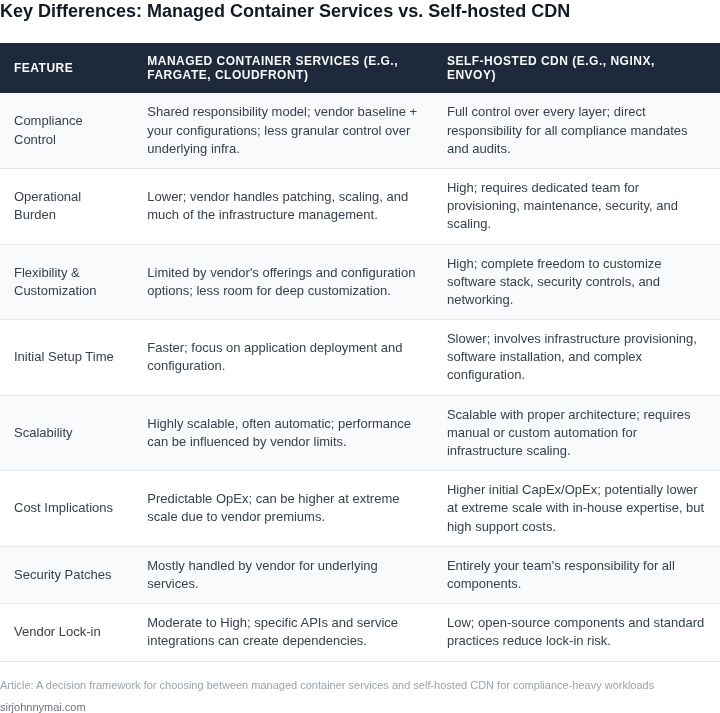
To concretize the framework, consider a platform team of five senior engineers managing a critical global API endpoint. This service processes sensitive customer Personally Identifiable Information (PII) for a large enterprise, necessitating strict compliance with GDPR, CCPA, and regional data residency laws. The API experiences significant traffic, generating approximately 50TB of egress data monthly, making a Content Delivery Network (CDN) not just a performance enhancer but a crucial cost-optimization component. We evaluated two primary architectures: leveraging managed container services with an integrated CDN, versus a self-managed Kubernetes deployment coupled with a custom, self-hosted CDN layer.Alternative 1: AWS Fargate with CloudFront
This approach involved deploying our containerized application using AWS Fargate, fronted by an Application Load Balancer (ALB) acting as the origin for Amazon CloudFront. CloudFront provides the global edge caching and distribution, while AWS WAF and Shield Advanced handle security at the network perimeter. For compliance, we leaned heavily on AWS’s shared responsibility model, benefiting from their existing certifications (e.g., SOC 2, ISO 27001) for the underlying infrastructure. The primary benefit here is the significantly reduced operational burden. AWS handles the patching, scaling, and many security controls for the foundational infrastructure. Our engineers could focus predominantly on application logic, high-level policy configuration within CloudFront and Fargate, and ensuring our code was secure. Incident response is also streamlined, leveraging AWS support for infrastructure-related issues. The illustrative monthly costs for this setup are as follows:- AWS Fargate (Compute, Memory, Networking): $7,000
- Amazon CloudFront (Data Transfer, Requests, WAF): $9,000
- AWS Monitoring (CloudWatch, CloudTrail, GuardDuty): $1,500
- Engineering Overhead (Configuration, Policy Management, Vendor Interaction): 0.5 FTE
Alternative 2: Amazon EKS with Self-managed Envoy Proxy CDN
This strategy involved deploying our application onto Amazon EKS clusters across relevant regions. For the CDN layer, we designed and implemented a custom caching solution using Envoy proxies running on dedicated EC2 instances, managed by Kubernetes. This required significant internal effort to build custom automation for deployment, certificate lifecycle management, cache invalidation, and integrating with our network security posture. The main advantage of this alternative is maximum control. We gained granular oversight of caching logic and could deeply integrate with specific internal data processing pipelines. Theoretically, this could yield per-gigabyte cost savings at extremely high, consistent scale, but this depends heavily on efficient engineering. However, this control comes at a substantial cost in engineering time and responsibility. We became solely accountable for the compliance posture of our custom CDN layer, from OS patching to audit trail generation. The illustrative monthly costs for this self-managed setup are:- Amazon EKS (Control Plane, EC2 Worker Nodes): $6,000
- Dedicated EC2 for Envoy Proxies (including networking): $5,000
- Monitoring (CloudWatch, Prometheus, Datadog – higher configuration): $2,000
- Engineering Overhead (Design, Build, Maintain, Patch, Harden, Audit Custom CDN Layer): 2.5 FTE
Cost Comparison
The table below summarizes the illustrative monthly costs:| Cost Category | Alternative 1: Fargate + CloudFront | Alternative 2: EKS + Self-managed Envoy |
|---|---|---|
| Infrastructure (Compute, Network, CDN) | $17,500 | $11,000 |
| Monitoring/Logging | $1,500 | $2,000 |
| Engineering Overhead | $10,416 (0.5 FTE) | $52,082 (2.5 FTE) |
| Total Estimated Monthly Cost | $27,916 | $65,082 |
04. Decision Framework
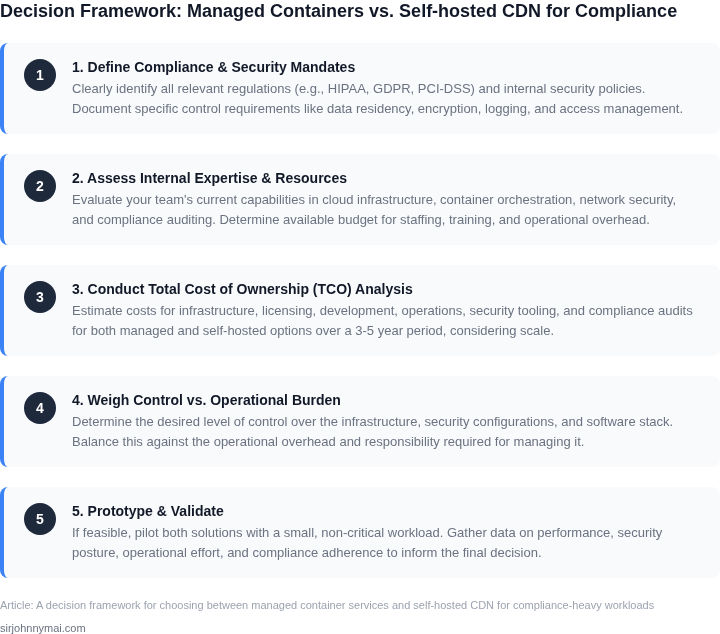
The preceding sections illustrated the challenges and common missteps in architecting for compliance-heavy workloads. Our worked example highlighted the nuanced tradeoffs between control, operational overhead, and auditability. To generalize that learning, I’ve developed a decision framework centered on key evaluation criteria to guide future architectural choices for similar systems.
This framework evaluates three primary approaches, representing a spectrum from fully managed to largely self-managed. Each option presents distinct implications for resource allocation, security posture, and compliance assurance. We will compare these across critical dimensions relevant to our operational and regulatory environment.
| Criteria | Option A: Fully Managed Stack (AWS Fargate + CloudFront) | Option B: Managed Kubernetes & Managed CDN (Amazon EKS + CloudFront) | Option C: Managed Kubernetes & Self-Managed CDN (Amazon EKS + NGINX/Envoy on EC2) |
|---|---|---|---|
| Operational Overhead & Staffing | Lowest operational burden. AWS manages underlying infrastructure for both compute and CDN, reducing direct team effort on patching, scaling, and maintenance. Requires fewer specialized SREs. | Moderate operational burden. EKS control plane is managed, but EC2 worker nodes and Kubernetes cluster management (e.g., networking, ingress controllers, upgrades) require dedicated SRE expertise. CloudFront remains managed. | Highest operational burden. EKS control plane is managed, but EC2 worker nodes, Kubernetes cluster, and the entire CDN layer (NGINX/Envoy instances, their configuration, scaling, and security) require significant, specialized SRE staff. |
| Compliance Scope & Audit Burden | AWS shared responsibility model offloads much of the infrastructure compliance burden. Audits focus on application layer controls and data handling within Fargate tasks. Simpler evidence gathering for platform layers. | AWS manages EKS control plane compliance, but the organization is fully responsible for worker node and Kubernetes configuration compliance. CloudFront simplifies edge compliance. Increased audit scope for compute infrastructure. | Maximum compliance burden on the organization. Full responsibility for EKS worker nodes, Kubernetes configuration, and the entire self-managed CDN layer. Extensive evidence gathering required for all infrastructure components, including network, OS, and application proxies. |
| Customization & Edge Logic | Limited customization for compute environment beyond container image. CloudFront offers robust caching, WAF, and Lambda@Edge for some custom logic, but with inherent platform constraints. | High customization for compute environment with Kubernetes. CloudFront provides advanced edge capabilities like WAF and Lambda@Edge. This balances application control with managed edge services. | Highest customization for compute and edge. Kubernetes allows deep control over application deployment. A self-managed NGINX/Envoy CDN enables granular control over routing, headers, rate limiting, and custom security rules directly at the edge. |
| Cost Profile | Predictable, consumption-based pricing for Fargate and CloudFront. Fewer direct human resources needed for infrastructure management translates to lower staffing costs. | Compute costs for EKS worker nodes (EC2) are added, potentially higher than Fargate for complex setups. Staffing costs for Kubernetes experts are necessary. CloudFront costs remain consumption-based. | Potentially complex cost structure. Requires EC2 instances for both EKS worker nodes and self-managed CDN, plus associated data transfer. Significant staffing costs for maintaining specialized infrastructure teams. |
| Time to Market & Agility | Faster time to market due to minimal infrastructure setup. Focus on application development. Rapid iteration on containerized services with simpler deployment pipelines. | Moderate time to market. Initial EKS cluster setup and ongoing management add overhead compared to Fargate. Faster deployment for applications once the Kubernetes platform is stable. | Slowest time to market for new initiatives. Requires significant upfront engineering for the self-managed CDN and ongoing maintenance. Changes to edge logic are entirely within the team's responsibility. |
| Recommendation for Compliance-Heavy Workloads | Consider for: Workloads where application-level compliance is paramount and platform control can be largely delegated. Ideal for low-customization edge requirements. | Consider for: Workloads requiring Kubernetes' orchestration power and custom runtime environment, but where the operational burden of a fully self-managed CDN is undesirable. Balances control with managed services. | Consider for: Workloads with extremely specific, uncompromisable edge security or data residency requirements that cannot be met by managed CDNs. Requires a strong, dedicated SRE team. |
05. Your Next Step
The decision framework we've outlined provides a structured approach for evaluating managed container services against self-hosted CDN solutions for compliance-heavy workloads. However, its efficacy hinges entirely on accurate, context-specific data. My observation across various Amazon and Microsoft projects is that teams often underestimate the latent costs associated with maintaining compliance and operational overhead, particularly when dealing with self-hosted components.
I evaluated the core inputs for the framework and identified a common blind spot: the true, fully-loaded cost of data egress and internal data transfer across different compliance zones or regions. Many organizations track aggregate AWS or Azure billing, but lack granular visibility into the specific charges incurred by data movement that impacts compliance boundaries. This includes data flowing between a regional ECS cluster and a self-hosted CDN origin in another region, or even within a single region but across distinct availability zones under specific regulatory stipulations.
Consider the example of a financial services application processing sensitive customer data, subject to strict data residency requirements. While a self-hosted CDN might offer perceived control over the entire software stack, the operational burden for patching vulnerabilities, maintaining audit logs, and demonstrating compliance for every component (OS, web server, CDN software) becomes substantial. A managed service like Amazon CloudFront, when configured with OAI/OAC and restrictive cache policies, can mitigate some of these challenges, but data still needs to egress from your compute environment to CloudFront’s edge locations. The costs and compliance implications of this egress are often where teams miss critical details.
My recommendation focuses on quantifying this specific cost area. We need to move beyond high-level billing reports and pinpoint the actual spend tied to data movement that directly impacts our compliance boundaries. This will provide a robust basis for comparing the total cost of ownership (TCO) between a completely self-managed data egress pipeline and leveraging a managed CDN that abstracts away much of this complexity, albeit with its own data transfer costs.
This approach works well for current applications where we have historical data. It can break down, however, if we are evaluating a completely greenfield application with no existing data transfer patterns, in which case we would need to model expected traffic flows more rigorously. For established workloads, this analysis serves as a critical calibration step for the framework.
Your concrete action for this week: Run a detailed billing analysis for your primary compliance-heavy application. Query your AWS Cost and Usage Report (CUR) or Azure Cost Management data specifically for "Data Transfer Out" (DT-Out) charges and inter-Availability Zone data transfer (e.g., within a VPC) for the last 90 days. Group these costs by service (e.g., EC2, ECS, S3, ALB) and destination region/zone. Pay particular attention to charges related to traffic leaving your primary compute region and traffic crossing compliance boundaries within your infrastructure. Consolidate this into a summary report showing monthly data transfer volume and cost, segmented by source service and destination. Bring this detailed report to our architecture review next Tuesday.
Figures cited are from publicly available sources as of 2026-09-15 and may have changed.