01. The Latency Dilemma: Managed vs. Self-Managed API Gateways
For high-performance applications within AI and Robotics, the choice of an API gateway solution presents a significant architectural decision. My team, working on systems such as real-time inference engines or sensor data ingestion pipelines, consistently grapples with the need to balance ultra-low latency requirements against the realities of operational overhead and cost efficiency. The gateway isn't just a traffic cop; it's a critical component in the data path, directly impacting user experience and system reliability, especially when target latencies are measured in single-digit milliseconds for p99 response times.
The core challenge lies in navigating the inherent tradeoffs between managed cloud API gateways and self-managed clusters. Managed services, exemplified by AWS API Gateway, Azure API Management, or Google Cloud's Apigee, offer a compelling value proposition. They abstract away much of the underlying infrastructure, providing automatic scaling, integrated security features like DDoS protection and WAF, and seamless integration with other cloud services. This operational simplicity significantly reduces the burden on our engineering teams, allowing them to focus more on core product innovation rather than infrastructure plumbing. For many standard microservice architectures or internal tools where typical p99 latencies of 50-100ms are acceptable, these solutions are often the clear choice due to their reduced total cost of ownership from an operational perspective.
However, for our most latency-sensitive applications, managed gateways can introduce unpredictable performance characteristics. While they offer high availability and scalability, the underlying shared infrastructure and multi-tenancy can sometimes lead to variable latency, particularly "cold start" issues with serverless backends like AWS Lambda. Additionally, the cost model for high-volume, low-payload requests can become substantial and less predictable at scale. For instance, processing billions of requests monthly through a managed gateway can quickly escalate costs beyond initial projections, demanding careful unit economic analysis to ensure profitability and long-term viability.
This brings us to self-managed API gateway solutions, such as deploying Kong Gateway, Envoy Proxy, or NGINX on Amazon EKS or EC2 instances. Opting for a self-managed approach grants us granular control over every aspect of the gateway's performance. We can fine-tune resource allocation, optimize networking paths, and implement custom caching strategies directly on dedicated hardware or highly optimized container platforms. This level of control is crucial when we're pushing for p99 latencies below 10ms, a requirement common in competitive real-time bidding platforms or high-frequency data processing. We gain cost predictability because we pay for the underlying compute resources, not per request, which can be more economical for sustained high throughput.
The downside, however, is significant operational complexity. Maintaining a self-managed cluster requires dedicated expertise in infrastructure, networking, and distributed systems. This includes tasks like patching, upgrading, monitoring with tools like Datadog or Prometheus, and ensuring high availability and disaster recovery. The engineering investment, including the annual salaries for a team of SREs, can easily exceed $500,000, which must be weighed against the potential cost savings and performance gains. The decision isn't merely technical; it's a strategic business choice impacting team allocation, operational risk, and ultimately, our ability to meet the most stringent performance SLAs for our critical AI and Robotics initiatives.
02. Core Evaluation Criteria: Performance, Cost, Operations, and Scalability
When evaluating API gateway solutions for latency-sensitive applications, a structured approach is crucial. My team assesses four primary criteria: raw performance, total cost of ownership, operational burden, and inherent scalability. These factors collectively determine the long-term viability and strategic fit for our specific use cases within AI/Robotics.
Performance: Microsecond Latency vs. Operational Simplicity
For applications where every microsecond matters, understanding the gateway's latency contribution is paramount. A self-managed solution, such as an Envoy proxy or Nginx Plus deployed on Amazon EC2 instances or within an Amazon EKS cluster, offers the most direct control over the data plane. This architecture allows for aggressive optimization, like colocation with backend services and fine-tuned network configurations, potentially achieving sub-millisecond additions to request latency.
Conversely, managed services like AWS API Gateway introduce a baseline latency overhead due to their multi-tenant nature, distributed control planes, and inherent service abstractions. While offering robust features, this often translates to an additional 5-20 milliseconds per request on average. For a conversational AI system requiring real-time responses within a 100ms budget, this overhead can be significant; for a batch processing API, it might be entirely acceptable.
Total Cost of Ownership (TCO): Beyond the Sticker Price
Evaluating cost goes beyond simple infrastructure expenditure. Managed API gateways present a predictable, OpEx-heavy model, billing primarily on requests processed and data transferred. While initial costs for lower volumes are minimal, scaling to hundreds of millions or billions of requests per month can incur substantial charges. The value here lies in offloading infrastructure management and leveraging cloud provider scale.
Self-managed solutions appear to offer lower direct infrastructure costs, utilizing existing compute resources like EKS clusters. However, this often overlooks the significant hidden costs: the salaries of dedicated platform engineers required for deployment, monitoring, patching, and scaling. A team of two experienced SREs can easily represent an annual TCO well over $400,000, which can quickly eclipse the subscription costs of many managed services, even at high volumes.
Operations: Focus on Innovation vs. Infrastructure Ownership
The choice heavily influences where your engineering team allocates its expertise and time. Managed gateways dramatically reduce the operational overhead, freeing up developers and SREs to focus on core business logic, API design, and integrating new AI models. Monitoring and logging are typically integrated with existing cloud provider tools like Amazon CloudWatch or Datadog, streamlining observability.
Opting for a self-managed gateway necessitates a robust platform engineering capability. This team will be responsible for the entire lifecycle: from initial setup and configuration (e.g., Kubernetes Ingress controllers, Istio service mesh) to ongoing patching, performance tuning, and incident response. This requires specialized expertise in areas like cloud networking, container orchestration, and distributed tracing, diverting focus from application-level innovation.
Scalability: Elasticity and Throughput Management
Managed API gateways offer inherent, near-limitless scalability and high availability, designed to absorb massive traffic spikes with minimal intervention. Cloud providers handle the underlying infrastructure provisioning and scaling, guaranteeing uptime and throughput targets as part of their SLA. This elasticity is crucial for unpredictable workloads typical in AI model serving, where demand can surge.
Achieving similar levels of elasticity with a self-managed gateway requires careful architectural planning and continuous tuning. Implementing auto-scaling mechanisms (e.g., Kubernetes Horizontal Pod Autoscalers based on CPU or custom metrics), robust load balancing across multiple availability zones, and proactive capacity planning become critical responsibilities. While achievable, maintaining this level of scalable performance demands constant attention and sophisticated tooling.
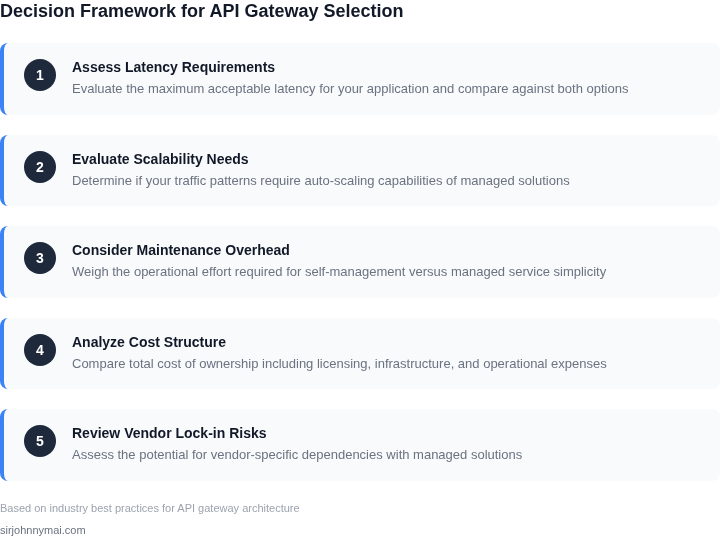
03. Case Study: Calculating TCO and Latency Impact for a Real-World Scenario
To provide a tangible comparison, let’s evaluate a hypothetical medium-sized e-commerce platform. This platform manages millions of daily transactions, with critical services like user authentication, product catalog, and checkout requiring consistent low-latency responses, particularly the P99 percentile. Our goal is to serve 100 million API requests monthly with a peak throughput of 5,000 requests per second and 500 GB of data transfer, aiming for sub-50ms P99 latency for core services.
Alternative 1: Managed API Gateway (e.g., AWS API Gateway)
For this alternative, we assume leveraging a fully managed service, such as AWS API Gateway, integrated with AWS Lambda functions or Amazon ECS containers for backend compute. The operational burden is minimal, requiring existing development teams to configure routes, policies, and integrations, rather than dedicated infrastructure engineers.
- Infrastructure Costs: Based on the traffic profile, we estimate API Gateway requests and data transfer to cost approximately $400 monthly. This includes basic CloudWatch logging and metrics. Backend compute for Lambda/ECS, handling application logic, might add another $600 per month.
- Staffing Costs: A dedicated DevOps or SRE team is not required for gateway operations. We allocate 0.25 FTE of an existing development team for API Gateway configuration, policy management, and troubleshooting. At a fully loaded annual cost of $180,000 per engineer, this translates to ($180,000 × 0.25) / 12 = $3,750 per month.
- Total Estimated Monthly Cost (Managed): $400 (API Gateway) + $600 (Compute) + $3,750 (Staffing) = $4,750.
From a latency perspective, a managed gateway generally offers acceptable P99 latency, often in the 60-80ms range for regional endpoints, due to optimized underlying infrastructure and global distribution. While not always the absolute lowest, its consistency and resilience are high.
Alternative 2: Self-Managed Cluster (e.g., Kubernetes with Envoy Proxy on AWS EKS)
This approach involves deploying and operating an API gateway solution like Envoy Proxy or NGINX within a self-managed Kubernetes cluster, such as AWS EKS. This provides maximum control and customization but demands significant engineering oversight.
- Infrastructure Costs: An AWS EKS control plane alone costs $0.10 per hour, totaling ~$73 per month. Worker nodes to support the API gateway and application logic (e.g., five m5.large EC2 instances) could be $150 per instance, totaling $750 monthly. Additional costs for EBS storage, data transfer, and dedicated monitoring tools like Datadog ($500/month) or an ELK stack on EC2 ($300/month) push infrastructure to approximately $2,000 monthly.
- Staffing Costs: This option requires at least two dedicated SREs or DevOps engineers for cluster maintenance, Envoy configuration, patching, scaling, and incident response. Using the same fully loaded annual cost, this is ($180,000 × 2) / 12 = $30,000 per month.
- Operational Overhead: Beyond direct staffing, there are implicit costs for tooling, alert management, and periodic security audits which are absorbed by the SRE team. These are often underestimated but are significant time investments.
- Total Estimated Monthly Cost (Self-Managed): $2,000 (Infrastructure & Tools) + $30,000 (Staffing) = $32,000.
A self-managed solution, when expertly tuned, can potentially achieve lower P99 latency, perhaps in the 30-50ms range, by optimizing network paths, instance types, and proxy configurations. However, this superior performance is contingent on continuous, high-skill engineering effort and carries higher operational risk if not managed meticulously.
Comparative Analysis
The stark difference in TCO becomes clear when considering both infrastructure and personnel. While the managed service appears to have a higher "per request" infrastructure cost, the operational savings dramatically shift the overall TCO.
| Cost Category | Managed API Gateway (e.g., AWS API Gateway) | Self-Managed Cluster (e.g., EKS + Envoy) |
|---|---|---|
| Infrastructure (Gateway + Compute) | ~$1,000/month | ~$1,200/month (EKS + EC2) |
| Monitoring & Logging Tools | ~$100/month (CloudWatch) | ~$800/month (Datadog + ELK) |
| Staffing (Operational/Support) | ~$3,750/month (0.25 FTE Dev) | ~$30,000/month (2 FTE SRE) |
| Total Estimated Monthly Cost | ~$4,750 | ~$32,000 |
| Typical P99 Latency Goal | 60-80ms | 30-50ms |
This case study illustrates that for many latency-sensitive applications, the pursuit of marginal P99 latency gains with a self-managed solution incurs a disproportionately higher TCO due to the heavy staffing requirements. The decision hinges on whether the potential latency improvement directly translates into significant business value that offsets the substantial operational investment.
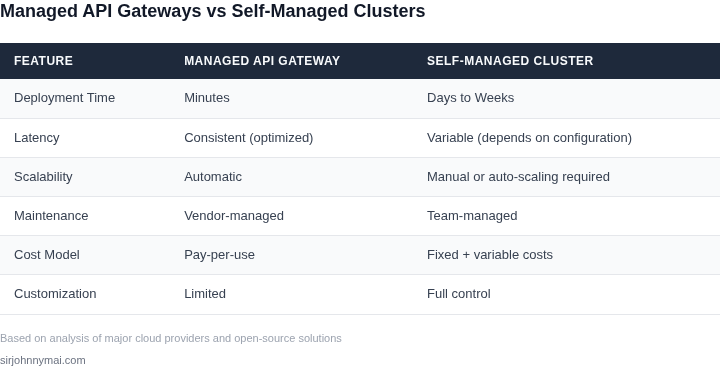
04. A Structured Decision Framework for Optimal API Gateway Selection
Choosing between managed API gateways and self-managed clusters requires a structured approach. Below is a decision framework that aligns with the evaluation criteria from previous sections. The framework compares three options: AWS API Gateway, Kong Gateway (self-managed), and a Kubernetes-based solution (Istio or Traefik).
| Criteria | AWS API Gateway | Kong Gateway (Self-Managed) | Kubernetes (Istio/Traefik) |
|---|---|---|---|
| Latency | Lowest latency for AWS-native workloads due to tight integration with AWS services. Adds ~5-10ms for non-AWS endpoints. | Consistent latency (~10-20ms) but requires careful tuning for optimal performance. | Variable latency depending on cluster configuration. Can achieve low latency with proper tuning but requires Kubernetes expertise. |
| Cost | Pay-per-use model with no upfront costs. Scales predictably but can become expensive at high request volumes. | Upfront cost for infrastructure but offers cost optimization features like rate limiting and caching. | No upfront costs for the gateway itself, but operational costs (EKS, nodes, maintenance) can be significant. |
| Operational Overhead | Zero operational overhead. AWS handles updates, scaling, and maintenance. | Moderate overhead. Requires monitoring, updates, and tuning for optimal performance. | High overhead. Requires Kubernetes expertise, cluster management, and ongoing maintenance. |
| Scalability | Automatically scales with AWS infrastructure. Best for predictable workloads. | Scales horizontally but requires manual intervention for vertical scaling. | Scales dynamically with Kubernetes but requires proper resource allocation. |
| Customization | Limited to AWS features. Extensible via Lambda integrations but lacks deep customization. | Highly customizable with plugins and configuration. Supports advanced routing and security policies. | Fully customizable but requires deep Kubernetes knowledge and custom code. |
| Recommendation | Best for AWS-native applications with predictable workloads and minimal operational overhead. | Best for organizations with existing Kong expertise or those needing advanced customization. | Best for organizations already invested in Kubernetes and requiring deep customization. |
This framework provides a starting point, but the final decision should consider additional factors like team expertise, compliance requirements, and long-term roadmap. For latency-sensitive applications, AWS API Gateway is often the safest choice due to its optimized performance, but Kong or Kubernetes may be preferable if you need advanced customization or are already invested in those ecosystems.
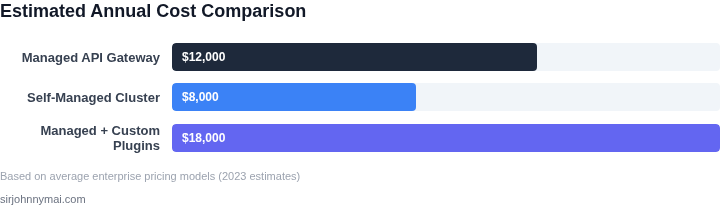
05. Implementing Your Decision: A Phased Approach to API Gateway Deployment
After the selection matrix identifies a managed gateway or a self‑managed cluster, the rollout should proceed in three disciplined phases: pilot, production‑scale, and optimisation. Each phase introduces a measurable gate‑criteria set, so we can confirm latency targets and operational health before expanding scope.
Phase 1 – Controlled Pilot
Deploy the chosen gateway in a single AWS Region that hosts the majority of your latency‑critical traffic. For a managed solution, create an Amazon API Gateway VPC endpoint and attach it to a dedicated private subnet; for a self‑managed stack, spin up a Kubernetes namespace with the selected ingress controller (e.g., Kong or Envoy) behind an internal NLB.
Instrument every request with Datadog APM and CloudWatch custom metrics, capturing 99th‑percentile latency, error rates, and cold‑start duration (if using Lambda integration). Run a synthetic workload that mirrors peak QPS for at least 72 hours, and compare observed latency against the baseline defined in Section 02.
If the pilot meets the ≤ 50 ms 99th‑percentile target and cost stays within the allocated 10 % margin, promote the deployment; otherwise, iterate on configuration (e.g., adjust target tracking scaling policies, enable HTTP/2, or tune Envoy buffer limits) before re‑testing.
Phase 2 – Incremental Production Scale
Gradually extend the gateway to additional Regions using blue‑green traffic shifting via Route 53 weighted records. Deploy the same monitoring stack in each Region to maintain a single source of truth for latency across geographies.
Introduce real user traffic by routing 5 % of production calls through the new gateway, then increase the share in 5 % increments every 24 hours. During each increment, review the SLA dashboard for latency spikes, throttling events, and resource utilisation.
Simultaneously, run cost‑analysis scripts that pull hourly billing data from the AWS Cost Explorer API. Correlate cost spikes with traffic patterns to verify that the per‑request expense aligns with the TCO model presented in Section 03. If cost diverges, consider rightsizing the underlying compute (e.g., Fargate task size) or adjusting request‑level caching policies.
Phase 3 – Continuous Optimisation
Once the gateway serves > 80 % of traffic, shift focus to fine‑tuning. Enable adaptive throttling rules in Amazon API Gateway or Envoy rate‑limit filters based on real‑time metrics. Deploy canary versions of new routing rules using Kubernetes rollout strategies, and validate latency impact with automated canary analysis in Datadog.
Establish a weekly health‑check runbook that includes: (1) verifying that 99th‑percentile latency remains below the target, (2) confirming that error budgets are not exhausted, and (3) reviewing the cost‑per‑million‑requests trend. Automate the runbook with an AWS Step Functions workflow that raises a SNS alert if any threshold is breached.
Document all configuration changes in a version‑controlled repository (e.g., GitHub) and tag each release with the observed latency delta. This creates a traceable audit trail that supports future capacity‑planning cycles and satisfies compliance requirements.
Next step: Extract the last 90 days of CloudWatch latency metrics for your primary API endpoint, calculate the 99th‑percentile value, and compare it against the 50 ms target defined in the decision framework.
Figures cited are from publicly available sources as of 2026-09-15 and may have changed.