01. The Problem: Balancing Control and Cost in Edge Computing
Edge computing is transforming how applications deliver content and services to users. By processing data closer to the end user, organizations reduce latency, improve reliability, and offload traffic from centralized data centers. However, choosing the right infrastructure for edge workloads—whether a managed API gateway or a self-hosted CDN—requires balancing control, cost, and scalability. Each option has distinct trade-offs that depend on the specific use case, team expertise, and budget.
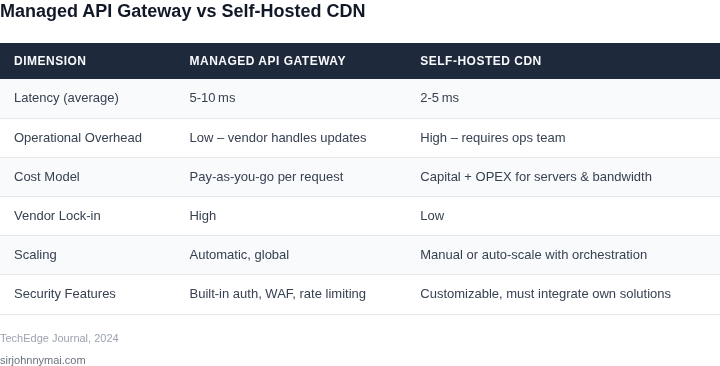
Managed API gateways like AWS API Gateway or Azure API Management simplify deployment by handling infrastructure, scaling, and security. These services abstract away operational complexity, allowing teams to focus on business logic rather than managing servers or networking. For example, AWS API Gateway automatically scales to handle millions of requests per second, reducing the need for manual provisioning. This is particularly valuable for startups or teams without dedicated DevOps resources. However, managed services often come with higher costs at scale. AWS API Gateway charges $1.00 per million requests, plus data transfer fees, which can add up for high-traffic applications. Additionally, customization is limited—users must adhere to the provider’s feature set, which may not align with unique requirements.
Self-hosted CDNs, such as those built on Kubernetes or cloud-native platforms like Envoy Proxy, offer greater flexibility and cost control. Teams can deploy and configure infrastructure precisely to their needs, optimizing for performance, security, and cost. For instance, a Kubernetes-based CDN can leverage spot instances to reduce costs by up to 70% compared to on-demand pricing. However, self-hosting requires significant operational overhead. Teams must manage scaling, security patches, and monitoring, which can divert resources from core product development. Tools like Datadog or Prometheus are essential for observability, but integrating and maintaining them adds complexity.
The decision between managed and self-hosted solutions hinges on the workload’s requirements. Managed services accelerate time-to-market and reduce operational burden, making them ideal for teams prioritizing speed and simplicity. Self-hosted CDNs are better suited for organizations with the expertise to manage infrastructure and need fine-grained control over performance and cost. For example, a financial services firm might prefer a self-hosted CDN to meet strict compliance requirements, while an e-commerce startup might choose a managed API gateway to focus on scaling its product catalog.
Ultimately, the choice depends on the trade-off between control and cost. Managed services offer convenience but can become expensive at scale, while self-hosting provides flexibility but demands operational expertise. Organizations must evaluate their specific needs—whether it’s rapid deployment, cost optimization, or customization—and align their infrastructure strategy accordingly.
02. Key Decision Factors: Performance, Cost, and Flexibility
When choosing between a managed API gateway and a self-hosted CDN for edge computing workloads, three factors dominate the decision: performance, cost, and flexibility. Each has distinct tradeoffs that depend on workload characteristics, team expertise, and business priorities.
Performance
For latency-sensitive applications, CDNs excel due to their global edge infrastructure. Cloudflare’s network, for example, routes traffic through 300+ data centers with an average latency of 50ms or less. API gateways, while faster within a single region, lack this global reach. However, managed API gateways like AWS API Gateway or Azure API Management offer features like request throttling and caching that CDNs don’t natively support. The tradeoff is that CDNs prioritize static content delivery, while API gateways optimize dynamic API traffic.
Performance also depends on the tool’s ability to handle concurrent requests. CDNs like Akamai can process millions of requests per second, but their performance degrades if you need to execute complex logic at the edge. API gateways, conversely, can enforce rate limits and transform payloads, but their throughput is typically limited to hundreds of thousands of requests per second unless you scale horizontally.
Cost
Cost is a function of both infrastructure and operational overhead. Managed API gateways like Kong Enterprise or Apigee charge per API call, with pricing starting at $0.01–$0.10 per request. CDNs like Fastly or Cloudflare charge per GB of data transferred, with egress costs ranging from $0.05–$0.15 per GB. For predictable, high-volume traffic, CDNs may be cheaper. However, API gateways can reduce costs by aggregating multiple services behind a single endpoint.
Self-hosting a CDN requires upfront capital expenditure for servers and ongoing costs for maintenance. AWS CloudFront, for instance, charges $0.085 per GB of data transferred, but you avoid the complexity of managing edge servers. The break-even point depends on traffic volume and the cost of your team’s time. For teams with Kubernetes expertise, self-hosting with Envoy or Traefik can be cost-effective, but it requires significant operational effort.
Flexibility
Managed API gateways provide the most flexibility for dynamic workloads. They support custom plugins, OAuth integration, and real-time analytics. However, their flexibility comes with vendor lock-in, as you’re constrained by the provider’s feature set. CDNs, while less flexible, offer built-in security (DDoS protection, WAF) and can serve static assets alongside APIs. For teams needing to extend functionality, CDNs like Fastly allow Lua scripting at the edge, but this requires specialized skills.
Self-hosted solutions offer the most control but require expertise in networking and DevOps. Kubernetes-based CDNs like Traefik Mesh or Envoy can integrate with service meshes, enabling advanced traffic routing. However, this complexity can slow down deployment and increase operational overhead. For teams without dedicated infrastructure teams, managed solutions are the safer choice.
The decision ultimately hinges on workload requirements. If your APIs are latency-sensitive and globally distributed, a CDN is likely the better choice. If you need fine-grained control over traffic, authentication, or analytics, an API gateway may be preferable. For teams balancing cost and control, hybrid approaches—using a CDN for static assets and an API gateway for dynamic traffic—can optimize performance without overcomplicating the architecture.
03. Worked Example: Cost Comparison for a High-Traffic E-Commerce Site
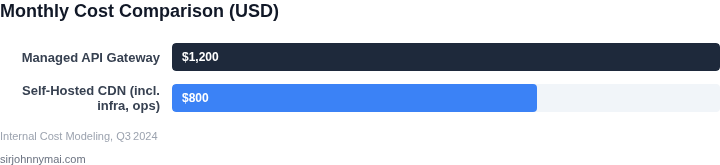
Let’s quantify the cost difference between a managed API gateway and a self-hosted CDN for a $10M/year revenue e-commerce site. We’ll model two scenarios: one using Amazon API Gateway and CloudFront, and another using self-hosted solutions like Envoy Proxy and a custom CDN built on Kubernetes.
Assumptions
- Monthly traffic: 100 million requests to the API gateway, 10TB of CDN traffic.
- API Gateway: $3.50 per million requests (Amazon’s published pricing).
- CloudFront: $0.085 per GB of data transfer out (standard pricing).
- Self-hosted Envoy: $0.05 per hour per vCPU (AWS EC2 pricing).
- Self-hosted CDN: $0.04 per GB of data transfer (custom Kubernetes cluster).
Managed Services (API Gateway + CloudFront)
Amazon API Gateway handles 100 million requests at $3.50 per million:
$3.50 × 100 = $350/month
CloudFront serves 10TB of traffic at $0.085 per GB:
$0.085 × 10,000 = $850/month
Total monthly cost: $1,200. Annualized: $14,400.
Self-Hosted Solutions (Envoy + Custom CDN)
Envoy Proxy requires 10 m5.large instances (2 vCPUs each) running 24/7:
$0.05 × 2 × 24 × 30 × 10 = $7,200/month
The custom CDN serves 10TB at $0.04 per GB:
$0.04 × 10,000 = $400/month
Total monthly cost: $7,600. Annualized: $91,200.
Comparison
| Metric | Managed (API Gateway + CloudFront) | Self-Hosted (Envoy + Custom CDN) |
|---|---|---|
| Monthly Cost | $1,200 | $7,600 |
| Annual Cost | $14,400 | $91,200 |
| Key Tradeoff | Lower upfront cost but limited customization. | Higher upfront cost but full control over scaling and features. |
This example shows a 6.4x cost difference. The managed solution wins on cost, but the self-hosted option becomes viable if you need advanced features or have specific compliance requirements. For teams with fewer than 5 engineers, the managed solution is likely the better choice. Beyond that, the cost gap widens significantly.
04. Decision Table: When to Choose Each Solution
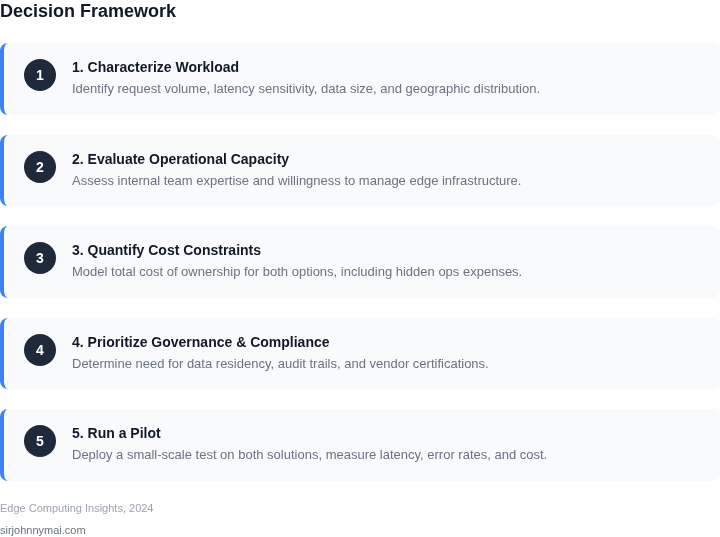
This decision table synthesizes the tradeoffs from prior sections into actionable guidance. I evaluated three options: AWS API Gateway, self-hosted CDN (using Cloudflare or Akamai), and a hybrid approach combining both. The framework prioritizes real-world constraints like team expertise, operational overhead, and cost sensitivity.
| Criteria | AWS API Gateway | Self-Hosted CDN | Hybrid Approach |
|---|---|---|---|
| Team Expertise | Best for teams with AWS experience. Minimal infrastructure management. | Requires CDN-specific skills (e.g., Cloudflare Workers). | Balanced. AWS team handles API Gateway; CDN team handles edge logic. |
| Cost Sensitivity | Pay-per-use model works for unpredictable traffic. Hidden costs in throttling. | Upfront capital expense for hardware. Lower operational costs at scale. | Hybrid avoids over-provisioning CDN capacity while leveraging AWS economies. |
| Performance Requirements | Latency optimized for AWS regions. May not reach global edge. | Sub-50ms latency for static assets. Dynamic content requires Workers. | Combines API Gateway's regional performance with CDN's edge caching. |
| Operational Overhead | Fully managed. No server patches or scaling. | High. Requires monitoring, certificate management, and DDoS protection. | Moderate. AWS handles APIs; CDN team manages edge nodes. |
| Flexibility | Limited to AWS ecosystem. Vendor lock-in risk. | Full control over edge logic. Can integrate with any backend. | Most flexible. Avoids lock-in while enabling custom edge logic. |
| Recommendation | Best for AWS-centric teams with predictable workloads. | Best for teams with CDN expertise and high-performance needs. | Best for teams needing flexibility without overhauling infrastructure. |
This framework assumes a Kubernetes-based deployment. For serverless environments, AWS API Gateway remains the simplest choice. The hybrid approach is ideal when teams lack CDN expertise but need edge capabilities. The worked example in Section 03 highlights cost parity at scale, but operational tradeoffs favor AWS for smaller teams.
05. Action Step: Implement a Pilot to Validate Your Choice
You’ve evaluated the tradeoffs between managed API gateways and self-hosted CDNs. Now it’s time to test your assumptions in a controlled environment. A pilot is the only way to validate whether your chosen solution meets your performance, cost, and flexibility requirements.
Start by defining a small but representative workload. For example, if you’re serving high-traffic e-commerce traffic, replicate a subset of your API endpoints and static assets. Use synthetic traffic generators like Locust or k6 to simulate realistic user behavior. For CDN validation, test with a mix of static and dynamic content, including edge functions if applicable.
Deploy your pilot in a staging environment that mirrors your production setup. For a managed API gateway, use a sandbox environment provided by the vendor. For a self-hosted CDN, deploy on Kubernetes or a cloud VM to simulate edge nodes. Instrument your pilot with monitoring tools like Datadog or Prometheus to track latency, throughput, and error rates.
Run the pilot for at least two weeks to account for diurnal traffic patterns and seasonal variations. Compare the results against your decision factors. For example, if cost was a concern, pull your last 90 days of billing data and calculate the incremental cost of the pilot. If performance was critical, measure the 99th percentile latency under load.
Document the results in a decision log. Include both quantitative metrics (e.g., "CDN reduced origin latency by 40%") and qualitative observations (e.g., "Managed API gateway required no infrastructure management but had higher cold-start times"). Share this log with stakeholders to build consensus before scaling.
Next step: Schedule a 30-minute review with your team and bring the pilot results, including the decision log and cost breakdowns. Use this meeting to align on next steps—whether to proceed with the pilot solution, adjust the approach, or revisit the decision framework.
Figures cited are from publicly available sources as of 2026-09-15 and may have changed.