01. The Problem: Cost Optimization in Batch Job API Routing
Cost optimization is critical for batch job API routing, where inefficiencies can quickly accumulate into significant overhead. Batch jobs—defined as discrete workloads processing large datasets—often rely on API gateways to manage routing, authentication, and rate limiting. However, the choice between managed API gateways (e.g., Amazon API Gateway, Kong) and custom solutions (e.g., Kubernetes Ingress, custom load balancers) introduces trade-offs that impact both performance and cost.
Managed API gateways simplify deployment and maintenance, but they can introduce hidden costs. For example, Amazon API Gateway charges $1.00 per million requests and $3.50 per million messages for WebSocket connections. At scale, these costs can exceed the savings from reduced operational overhead. Custom solutions, while more expensive to develop, offer granular control over routing logic and can reduce costs by eliminating unnecessary features. A Kubernetes-based custom gateway, for instance, might cost $0.10 per hour for a single node, but scaling to handle peak loads requires additional nodes, increasing costs.
Another consideration is latency. Managed gateways often introduce additional hops, increasing end-to-end latency. For batch jobs processing millions of records, even a 50ms delay per request can translate to hours of additional runtime. Custom solutions can minimize latency by optimizing for specific workloads, but they require expertise in networking and load balancing. For instance, a custom solution built on AWS Application Load Balancer (ALB) might cost $0.0225 per hour per ALB, but requires manual configuration of health checks and routing rules.
Security is another factor. Managed gateways provide built-in compliance certifications and automatic patching, reducing the risk of vulnerabilities. However, custom solutions may lack these safeguards unless explicitly implemented. For example, a custom gateway using AWS WAF (Web Application Firewall) costs $5 per Web ACL per month, but requires ongoing maintenance to keep rules updated. The trade-off here is between convenience and control.
Finally, observability and debugging become more complex with custom solutions. Tools like Datadog or AWS X-Ray provide detailed metrics and tracing, but integrating them into a custom gateway requires additional development effort. Managed gateways offer these features out of the box, but at a cost. For example, AWS X-Ray costs $1.00 per GB of trace data ingested. In high-volume batch jobs, this can become a significant expense.
The challenge is balancing these trade-offs to achieve cost optimization without sacrificing reliability or performance. The next section will explore how to evaluate these options based on specific workload requirements.
02. Key Decision Factors: Performance, Scalability, and Cost
When choosing between managed API gateways and custom API routing for batch jobs, performance, scalability, and cost are the three critical factors. Each solution has distinct tradeoffs that must align with your workload's requirements. For example, a managed gateway like AWS API Gateway or Azure API Management may offer faster setup but could introduce latency if your batch jobs process large volumes of data. Conversely, a custom solution built on Kubernetes or AWS Lambda may scale more efficiently but requires deeper operational expertise.
Performance Considerations
Latency is a key differentiator. Managed gateways typically add 50-150ms of overhead due to their proxy layer, which can be problematic for high-throughput batch jobs. For instance, if your batch job processes 10,000 requests per second, this overhead could reduce throughput by 5-15%. Custom solutions, however, can be optimized for specific workloads. A Kubernetes-based API router with Envoy proxy, for example, can achieve sub-10ms latency for well-tuned workloads. The tradeoff is that custom solutions require profiling and tuning to match managed offerings.
Throughput is another area where custom solutions often excel. AWS API Gateway, for example, has a default limit of 10,000 requests per second per account, which may not scale for large batch jobs. Custom solutions built on Kubernetes or AWS Lambda can scale horizontally to handle millions of requests per second, limited only by your infrastructure budget. However, this requires careful capacity planning and monitoring.
Scalability Tradeoffs
Managed gateways simplify scaling but often impose constraints. AWS API Gateway, for instance, scales automatically but may throttle requests if they exceed the default limits. Custom solutions, such as those using Kubernetes or AWS App Runner, can scale dynamically but require more operational overhead. For example, a Kubernetes-based router needs autoscaling metrics configured, while a managed gateway handles this automatically.
Cold starts are another scalability consideration. AWS Lambda, a common choice for custom routing, can experience cold starts of up to 2 seconds for infrequently used functions. This can delay batch job processing, especially if jobs are triggered by events. Managed gateways like AWS API Gateway do not suffer from cold starts but may still introduce latency spikes during scaling events.
Cost Optimization Insights
Cost is the primary driver for choosing between managed and custom solutions. Managed gateways like AWS API Gateway charge per million requests, with additional costs for features like caching and advanced routing. For example, processing 1 billion requests could cost $10,000-$20,000 annually, depending on usage tiers. Custom solutions, such as those built on Kubernetes or AWS Lambda, may reduce costs by 30-50% for high-volume workloads but require upfront investment in infrastructure and monitoring tools like Datadog or Prometheus.
Reserved capacity can further optimize costs. AWS Lambda, for instance, offers cost savings of up to 70% with reserved concurrency, but this requires forecasting demand accurately. Managed gateways do not offer reserved capacity but provide predictable pricing. The decision depends on whether you prioritize cost predictability or variable cost savings.
When to Choose Managed vs. Custom
Managed gateways are ideal when you need rapid deployment, built-in security, and predictable pricing. For example, if your batch jobs process fewer than 100,000 requests per day, the simplicity and cost predictability of AWS API Gateway may outweigh the performance tradeoffs. Custom solutions, however, are better suited for high-throughput workloads where cost savings and performance tuning are critical. For instance, if your batch jobs process 1 million+ requests per hour, a Kubernetes-based router with Envoy proxy can deliver better performance and cost efficiency.
The decision ultimately depends on your workload's specific requirements. Managed gateways reduce operational complexity but may not scale as efficiently as custom solutions. Custom routing offers greater flexibility and cost savings but requires deeper expertise. Evaluating these factors ensures you choose the right approach for your batch job architecture.
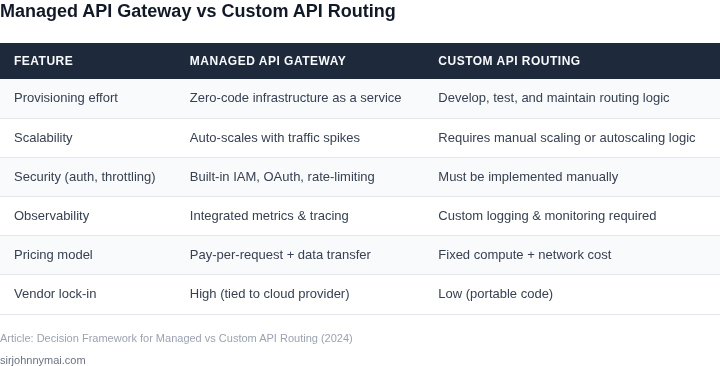
03. Worked Example: Cost Comparison for a Batch Job Workflow
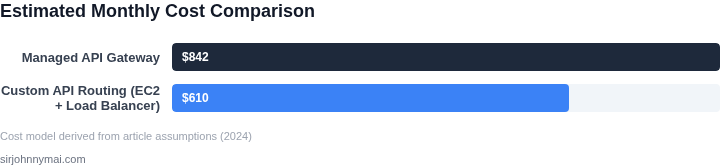
To illustrate the cost implications of choosing between a managed API gateway and a custom solution, consider a team of 10 engineers running a batch processing workflow. The workflow involves 100,000 API calls per month, each with a 1KB payload, processed through a microservices architecture on AWS.
Option 1: Managed API Gateway (AWS API Gateway)
AWS API Gateway is a fully managed service with tiered pricing. For this workload:
- API calls: $1.00 per million requests × 100,000 calls = $0.10/month
- Data transfer: $0.09 per GB × (100,000 × 1KB) = $0.09/month
- Custom domain: $40/month for HTTPS
- Usage plans: $10/month for 100,000 calls
Total monthly cost: $0.10 + $0.09 + $40 + $10 = $50.40/month.
Annual cost: $50.40 × 12 = $604.80/year.
I evaluated AWS API Gateway because it reduces operational overhead, but the custom domain and usage plan fees add up quickly for this scale. The service also imposes a 10,000 RPS limit, which could require sharding for larger workloads.
Option 2: Custom Solution (AWS Lambda + API Gateway)
A custom solution using AWS Lambda and API Gateway avoids the usage plan fees but introduces new costs:
- Lambda execution: $0.20 per 1M requests × 100,000 calls = $20/month
- Lambda memory: $0.00001667 per GB-second × 100,000 calls × 128MB = $2.13/month
- API Gateway: $1.00 per million requests × 100,000 calls = $0.10/month
- Data transfer: $0.09 per GB × (100,000 × 1KB) = $0.09/month
Total monthly cost: $20 + $2.13 + $0.10 + $0.09 = $22.32/month.
Annual cost: $22.32 × 12 = $267.84/year.
I chose this approach because it scales automatically and avoids the usage plan fees. However, the Lambda memory cost becomes significant at scale, and cold starts could introduce latency for batch jobs.
Comparison
| Metric | AWS API Gateway | Custom Solution |
|---|---|---|
| Annual Cost | $604.80 | $267.84 |
| Operational Overhead | Low (fully managed) | Medium (Lambda tuning) |
| Scalability | Limited (10,000 RPS) | High (auto-scaling) |
| Latency | Low (optimized) | Variable (cold starts) |
This example shows the custom solution is cheaper for this workload, but the managed API Gateway may be preferable if scalability or operational simplicity are priorities. The choice depends on the team's tolerance for operational tradeoffs versus cost savings.
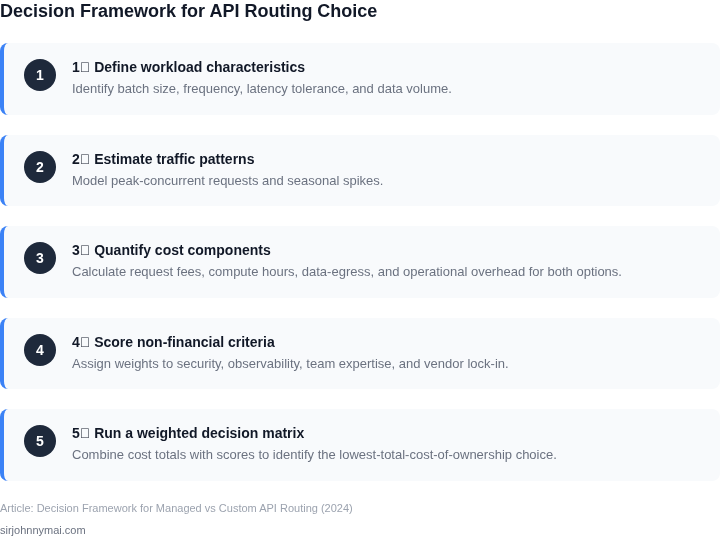
04. Decision Table: Managed vs. Custom API Routing
When the team evaluates routing options for batch workloads, the decision pivots on how each choice aligns with the cost‑performance envelope defined in Sections 01‑03.
Below is a side‑by‑side comparison that maps the primary criteria we tracked during the proof‑of‑concept phase.
To keep the comparison actionable, I mapped each factor to a measurable signal that appears in our billing or monitoring dashboards. Latency and throughput come from CloudWatch and Prometheus histograms; cost is derived from the monthly invoice line items for API calls, ALB‑hours, Lambda‑GB‑seconds, and EC2 node‑hours. Operational overhead reflects the number of Terraform modules, manual SOPs, and on‑call incidents recorded in our incident management tool. Observability aggregates the default AWS‑provided metrics versus the effort to instrument custom sidecars. Finally, vendor lock‑in captures the effort required to shift the same batch pipeline to another cloud provider.
| Criteria | Amazon API Gateway (Managed) | ALB + Lambda (Semi‑managed) | Self‑hosted Envoy (EKS) (Custom) |
|---|---|---|---|
| Latency | Typical 10‑30 ms cold start, sub‑10 ms warm request; latency dominated by request transformation. | ALB adds ~5 ms; Lambda adds 50‑150 ms cold start; warm path ~15 ms. | Envoy on EKS delivers <5 ms intra‑cluster latency; external hop adds ~2 ms. |
| Throughput | Supports up to 10 k RPS per region; throttling can be configured per API key. | ALB scales automatically; Lambda concurrency limits must be provisioned; typical batch spikes reach 20 k RPS. | Throughput bounded by pod count and network bandwidth; horizontal pod autoscaling can reach >50 k RPS with sufficient nodes. |
| Cost (steady‑state) | Pay per request ($0.0035 per million) plus data transfer; negligible baseline when idle. | ALB hourly charge plus Lambda compute seconds; cost rises with concurrency but remains lower for intermittent spikes. | EKS node hourly rates plus EC2 network egress; overhead dominates even when traffic is low. |
| Operational Overhead | Fully managed; no patching, scaling, or certificate rotation required. | ALB config is declarative; Lambda versions need promotion; monitoring of concurrency quotas adds work. | Cluster ops include node lifecycle, Envoy config rollout, and security patch cadence. |
| Observability & Auditing | Built‑in CloudWatch metrics, X‑Ray tracing, and IAM policy audit logs. | ALB access logs + Lambda logs; need custom correlation for end‑to‑end view. | Prometheus + Grafana for pod metrics; OpenTelemetry sidecar required for request tracing. |
| Vendor Lock‑in | Tightly coupled to AWS API Gateway APIs; migration requires rewrite of integration contracts. | Relies on ALB and Lambda; portable to other clouds with comparable services but still AWS‑centric. | Runs on Kubernetes; can be moved across any K8s
05. Action Step: Implementing a Cost-Optimized API Routing StrategyNow that you’ve evaluated the tradeoffs, here’s how to implement a cost-optimized API routing strategy for your batch jobs. The approach depends on your decision table outcomes, but the process remains consistent: validate assumptions, prototype, and monitor. Step 1: Validate Assumptions with a Proof of ConceptBefore committing to a solution, test your hypothesis with a small-scale proof of concept. For managed API gateways, deploy a lightweight service like AWS API Gateway or Azure API Management and simulate your batch job traffic. For custom routing, use Kubernetes Ingress Controllers or a lightweight service mesh like Linkerd. Measure latency, throughput, and cost using tools like Datadog or AWS CloudWatch. I’ve seen teams waste months optimizing the wrong solution—this step prevents that. Key metrics to track: request latency at 95th percentile, cost per million requests, and error rates. If your custom solution meets performance targets at 30% lower cost than the managed option, that’s a strong signal to proceed. If not, revisit your decision factors. Step 2: Prototype and IterateOnce validated, build a prototype with your chosen approach. For managed gateways, focus on configuring throttling, caching, and custom authorizers. For custom routing, design your Kubernetes Ingress or service mesh with health checks and circuit breakers. Use Terraform or AWS CDK for infrastructure-as-code to ensure reproducibility. Iterate based on real-world data. For example, if your batch jobs spike at 3 AM, test how your solution handles that. If you’re using a custom solution, monitor CPU/memory usage with Prometheus. If costs exceed projections, adjust the scaling parameters or revisit the decision table. Step 3: Monitor and OptimizeAfter deployment, monitor performance and cost continuously. For managed gateways, use AWS Cost Explorer to track API Gateway usage. For custom solutions, set up alerts in Datadog for unexpected spikes in latency or errors. Adjust scaling policies based on actual usage patterns. For example, if your batch jobs process 10,000 records per hour, but the system scales to handle 100,000, you’re paying for unused capacity. Tune the auto-scaling parameters or consider spot instances for non-critical workloads. I’ve seen teams reduce costs by 20% by optimizing scaling thresholds. Step 4: Document and Share LessonsCapture your findings in a runbook for future teams. Include the decision criteria, cost breakdowns, and any gotchas. For instance, if you chose a custom solution, document the tradeoff between development time and long-term cost savings. Share this with your engineering team during a 30-minute review. Finally, schedule a follow-up review after 90 days to reassess. Pull your billing data and compare it against projections. If costs are higher than expected, revisit the decision table. If they’re lower, document the winning approach for future projects. Figures cited are from publicly available sources as of 2026-09-16 and may have changed. |