01. The Evolving API Landscape and Our Strategic Imperative
As Amazon's AI/Robotics initiatives scale, the architectural decisions we make today will fundamentally shape our operational efficiency, developer velocity, and ultimately, our competitive edge in 2026 and beyond. A critical aspect of this strategy involves our choice of API communication styles. The landscape is dynamic, with REST, GraphQL, and gRPC each presenting distinct advantages and trade-offs.
This document outlines a decision framework to guide our teams in selecting the most appropriate API paradigm for new services. Our goal is to move beyond tribal knowledge, establishing a reasoned approach that aligns technology choices with business objectives and technical requirements. This framework aims to optimize for performance, developer experience, and long-term maintainability.
02. Deconstructing RESTful APIs – The Established Standard
REST (Representational State Transfer) has been the dominant architectural style for web services for over two decades. Its ubiquity, simplicity for resource-oriented interactions, and widespread tooling continue to make it a strong contender for many use cases. RESTful APIs are stateless, relying on standard HTTP methods (GET, POST, PUT, DELETE) to manipulate resources identified by URLs.
The primary strengths of REST lie in its discoverability and cacheability, leveraging existing web infrastructure like CDNs. Its declarative nature and clear resource boundaries make it relatively easy for new developers to understand and integrate. Furthermore, the extensive ecosystem of tools, from Postman for testing to OpenAPI for documentation, lowers the barrier to entry for both producers and consumers.
However, REST's limitations often become apparent with complex UIs or highly interconnected data. Clients frequently encounter over-fetching (receiving more data than needed) or under-fetching (needing multiple round trips to gather all necessary data). This can lead to increased latency and bandwidth consumption, particularly on mobile networks. Managing API versioning and ensuring backward compatibility also presents ongoing challenges for evolving services.
We typically find REST to be the optimal choice for public-facing APIs where broad accessibility and simple, well-defined resource access are paramount. It also excels for services with stable data models and straightforward CRUD (Create, Read, Update, Delete) operations, where the overhead of more complex API styles is unwarranted.
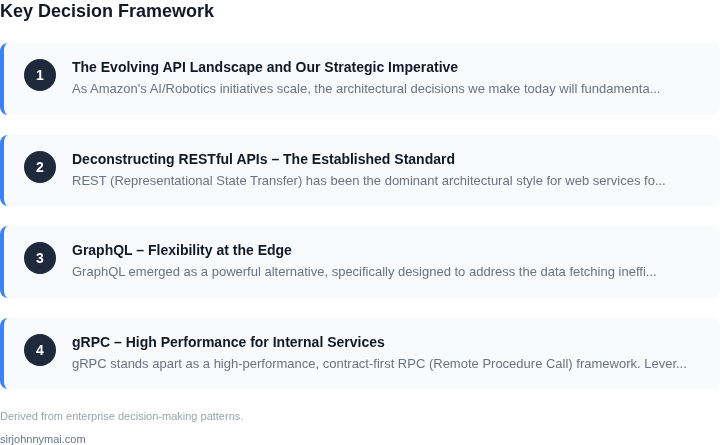
03. GraphQL – Flexibility at the Edge
GraphQL emerged as a powerful alternative, specifically designed to address the data fetching inefficiencies inherent in many RESTful implementations. Its core value proposition is client-driven data fetching, allowing clients to precisely specify the data they need, reducing over-fetching and the number of round trips. A single GraphQL endpoint can serve queries for complex, interconnected data graphs.
This flexibility significantly enhances developer velocity on the client side, particularly for applications with diverse UIs or those integrating data from multiple backend services. Tools like Apollo Client and AWS AppSync provide robust frameworks for building and consuming GraphQL APIs, offering features such as subscriptions for real-time data and schema introspection for easy discovery.
Despite its advantages, GraphQL introduces its own set of complexities. The "N+1 problem," where a single query can result in many backend data source calls, requires careful attention to resolver optimization, often through solutions like DataLoader. Caching at the CDN level is also more challenging than with REST due to the dynamic nature of queries. Operational overhead for robust GraphQL implementations, including security, rate limiting, and performance monitoring, is higher than for basic REST services.
GraphQL is ideally suited for complex frontend applications, such as internal dashboards for robotics fleet management or rich customer-facing applications, where data requirements are diverse and evolve rapidly. It shines when aggregating data from disparate microservices or when optimizing for mobile client performance by minimizing network round trips.
04. gRPC – High Performance for Internal Services
gRPC stands apart as a high-performance, contract-first RPC (Remote Procedure Call) framework. Leveraging Protocol Buffers (Protobuf) for efficient message serialization and HTTP/2 for multiplexing, header compression, and streaming, gRPC is engineered for speed and efficiency. It facilitates strong type enforcement through schema definition, generating client and server code in multiple languages.
The core benefits of gRPC include significantly reduced payload sizes compared to JSON-based APIs, leading to lower bandwidth consumption. HTTP/2's bi-directional streaming capabilities are particularly powerful for real-time communication patterns, such as streaming telemetry data or push notifications to connected devices. The strong typing provided by Protobuf improves code quality and reduces integration errors across services, fostering better consistency in a microservices architecture.
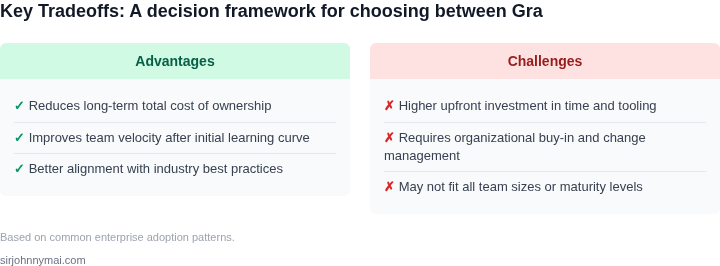
However, gRPC's strengths in performance and strict contracts come with trade-offs. Its reliance on Protobuf and binary serialization makes it less human-readable than REST or GraphQL's JSON responses, complicating debugging without specialized tools. Client-side tooling for browsers is also less mature compared to REST, often requiring a gRPC-web proxy (like Envoy) to bridge the gap. The learning curve for teams unfamiliar with Protobuf or HTTP/2 concepts can be steeper, requiring upfront investment in training and tooling.
gRPC is the preferred choice for high-throughput, low-latency inter-service communication within our microservices ecosystem. It's particularly well-suited for streaming data from IoT devices (like our robots), real-time internal APIs, and any performance-critical backbone service where efficiency and strict contracts are non-negotiable. Its capabilities for long-lived connections and bi-directional communication make it invaluable for command and control systems