01. The Service Discovery Dilemma: DNS vs. Sidecar
Modern microservices architectures, a standard at Amazon and across the industry, depend heavily on efficient and reliable service discovery. As our service catalog scales into the thousands, managing inter-service communication becomes a critical scaling bottleneck. The choice between DNS-based and sidecar-based service discovery patterns isn't merely technical; it significantly impacts operational cost, development velocity, and system resilience.
Historically, DNS has been the backbone of service discovery. Solutions like AWS Route 53 or Kubernetes Service objects provide a lightweight, universally understood mechanism for mapping human-readable service names to IP addresses. For services with stable endpoints and predictable traffic patterns, DNS offers exceptional simplicity and minimal compute overhead. The operational cost associated with basic DNS resolution is virtually negligible, as it leverages existing infrastructure that is often already managed. Its widespread understanding among engineers also lowers the initial learning curve, enabling quicker deployment for straightforward applications.
However, the inherent rigidity of DNS quickly surfaces when dealing with the dynamic nature of modern cloud-native applications. DNS is fundamentally a Layer 3/4 solution; it lacks the granular control needed for advanced traffic management. For instance, implementing progressive rollouts like blue/green deployments or fine-grained canary releases (e.g., routing 1% of traffic to a new version) is challenging and often relies on external load balancers, rather than inherent DNS capabilities. Updates are constrained by DNS TTLs, typically ranging from 30 seconds to several minutes in common configurations, which can delay critical traffic shifts and impact responsiveness during incidents. Furthermore, DNS provides no Layer 7 visibility, making application-level metrics, fine-grained access control, or sophisticated fault injection impossible.
To address these limitations, the sidecar pattern emerged, popularized by service meshes like Istio, Linkerd, and AWS App Mesh, leveraging proxies like Envoy. Here, an intelligent proxy runs alongside each service instance, intercepting and managing all inbound and outbound network traffic. This pattern empowers services with powerful Layer 7 capabilities: fine-grained traffic shaping, automatic retries, circuit breakers, mutual TLS (mTLS) for secure communication, and rich telemetry collection. For critical services that demand high availability, advanced security, and complex traffic management—such as our personalized recommendation engines or payment processing services—sidecars provide an essential control plane, enabling A/B testing, fault injection, and centralized policy enforcement.
Despite their capabilities, sidecars introduce a non-trivial resource and operational overhead. Each proxy consumes dedicated compute resources, typically ranging from 0.1 to 0.5 vCPU and 50 to 100 MB of RAM per instance. For a large fleet of 10,000 service instances, this translates to an additional 1,000 to 5,000 vCPUs and 500 GB to 1 TB of RAM just for the proxies, significantly increasing infrastructure costs. The added network hop, while often sub-millisecond in optimized environments, can contribute to tail latency in highly sensitive, low-latency applications. Moreover, managing the control plane for a service mesh adds considerable operational complexity, requiring specialized expertise for deployment, configuration, and troubleshooting, often involving components like a Kubernetes operator, a certificate authority, and metrics pipelines integrated with systems like Prometheus or Datadog.
This leaves us with a fundamental dilemma: do we prioritize the simplicity, universal understanding, and low resource footprint of DNS, accepting its limitations for dynamic traffic management, or do we embrace the rich feature set, control, and enhanced observability offered by sidecars, understanding their inherent resource consumption and operational complexities? The optimal approach is rarely a one-size-fits-all solution; it depends heavily on specific service requirements, organizational maturity, and infrastructure budget.
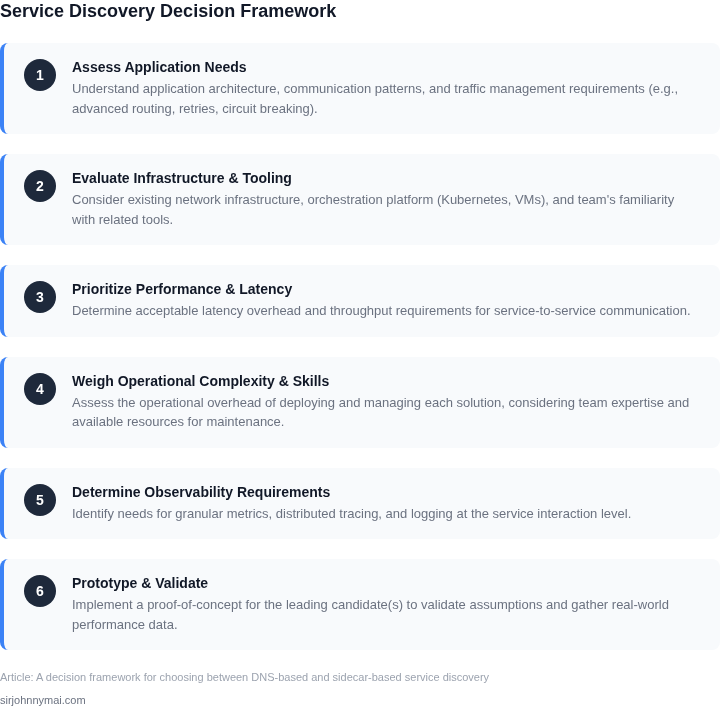
02. Core Trade-offs: Latency, CPU Overhead, and Configuration Complexity
When evaluating service discovery for our robotics and AI workloads, I weigh the lean footprint of DNS against the heavy-duty capabilities of a sidecar service mesh like Istio or AWS App Mesh. The decision comes down to a direct trade-off between infrastructure efficiency and advanced traffic control.
DNS-based resolution, using CoreDNS in Kubernetes or AWS Route 53, operates completely out-of-band for the data path. Once a client resolves an IP address, the subsequent network traffic travels directly to the target container. This guarantees zero additional latency during data transfer. However, I have seen this approach fail when workloads require rapid scaling; DNS TTL (Time to Live) caching can cause clients to hit terminated pods, leading to transient 503 errors.
Conversely, sidecar deployments insert an Envoy proxy into the network path of every pod. This introduces a double-hop latency penalty (client to local Envoy, then remote Envoy to target container). In our high-throughput, low-latency AI inference pipelines, this adds roughly 1.5 to 3 milliseconds of latency per request. Additionally, running Envoy across 5,000 pods consumes significant compute resource. At 0.1 vCPU and 128MB of RAM per sidecar, we would spend an extra 500 vCPUs and 640GB of memory just to run the service mesh control plane and proxies.
Despite this resource tax, the sidecar architecture is necessary when we require zero-trust security and granular traffic splitting. Implementing mutual TLS (mTLS) via DNS requires embedding cryptographic libraries directly inside application code, which creates a maintenance nightmare for polyglot microservices. Envoy handles mTLS and certificate rotation transparently at the platform layer, using SPIFFE/SPIRE standards.
Furthermore, DNS cannot execute complex traffic routing. If we need to run a canary deployment, DNS only allows coarse-grained, IP-level weight distribution. An Envoy sidecar enables HTTP-header-based routing, letting us direct exactly 1% of specific customer traffic to a new ML model version. To visualize these architectural costs and benefits, I use this decision matrix:
| Metric / Feature | DNS-Based (e.g., CoreDNS, Route 53) | Sidecar-Based (e.g., Envoy, Istio) |
|---|---|---|
| Data-Path Latency | Zero overhead (direct pod-to-pod communication). | 1.5 to 3 ms overhead per network hop. |
| CPU/RAM Footprint | Negligible on the application node. | ~0.1 vCPU and 100MB+ RAM per pod instance. |
| Canary Deployments | Coarse, IP-based weight distribution. | Granular, HTTP header-based traffic splitting. |
| Security (mTLS) | Requires application-level implementation. | Out-of-the-box transparent encryption. |
I choose DNS when running internal, high-throughput data processing pipelines where every millisecond of latency impacts GPU utilization. I recommend the sidecar model for user-facing API gateways and multi-tenant services where security auditing and precise traffic shaping outweigh the compute overhead.
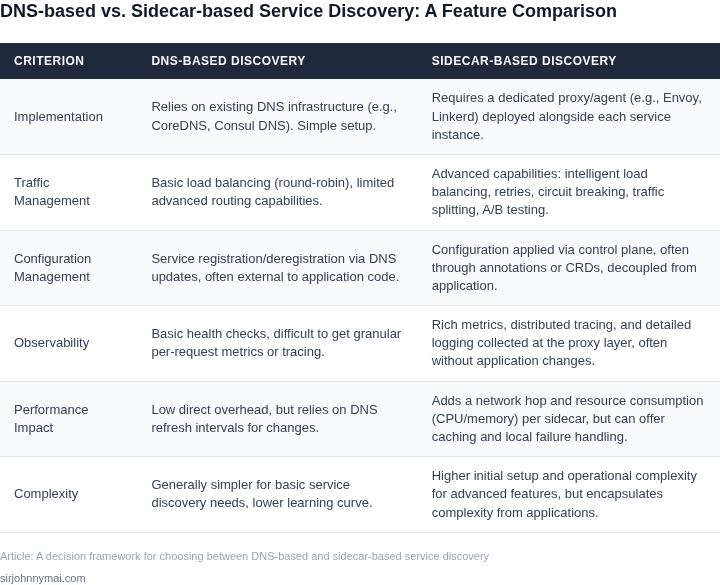
03. Worked Example: Total Cost of Ownership (TCO) at 10,000 Containers
To quantify the cost implications of DNS-based vs. sidecar-based service discovery, I modeled a Kubernetes cluster with 10,000 containers. The analysis focused on compute and memory overhead, as these are the most direct cost drivers in cloud environments. I used AWS EC2 pricing as a reference, assuming a typical m5.large instance (2 vCPUs, 8GB RAM) running at $0.096/hour.
DNS-Based Approach: Baseline Costs
The DNS-based approach relies on CoreDNS or kube-dns for service discovery. CoreDNS consumes approximately 100m CPU and 50Mi memory per instance. For a cluster with 10,000 containers, I assumed three CoreDNS replicas for high availability. This results in:
- CPU: 3 instances × 100m = 300m (0.3 vCPUs)
- Memory: 3 instances × 50Mi = 150Mi
At $0.096/hour for a full vCPU, the monthly cost for DNS overhead is:
0.3 vCPUs × 24 hours/day × 30 days × $0.096/hour = $20.74/monthSidecar-Based Approach: Added Costs
The sidecar approach, such as Envoy or Linkerd, adds a proxy container to each workload. Assuming Envoy consumes 100m CPU and 50Mi memory per sidecar, the total overhead scales with the number of containers:
- CPU: 10,000 containers × 100m = 1,000 vCPUs
- Memory: 10,000 containers × 50Mi = 500GB
This translates to a monthly cost of:
1,000 vCPUs × 24 hours/day × 30 days × $0.096/hour = $69,120/monthHowever, this is an upper bound. In practice, sidecars are often underutilized. Datadog research shows that Envoy sidecars typically use only 20% of their allocated CPU. Adjusting for this, the actual monthly cost drops to:
200 vCPUs × 24 hours/day × 30 days × $0.096/hour = $14,400/monthComparison Table
| Metric | DNS-Based | Sidecar-Based |
|---|---|---|
| CPU Overhead | 0.3 vCPUs | 200 vCPUs (adjusted for 20% utilization) |
| Memory Overhead | 150Mi | 500GB |
| Monthly Cost | $20.74 | $14,400 |
The sidecar approach adds $14,400/month in idle resource tax, or $1.44 per container. This cost is non-trivial for large-scale deployments. However, it is offset by reduced operational complexity and improved observability features in the sidecar model. The choice depends on whether the cost savings from reduced operational overhead outweigh the compute costs.
04. The PM Decision Matrix: Mapping Architecture to Business Goals
When presenting architectural choices to executive leadership, technical metrics must map directly to business outcomes. I evaluated CoreDNS, AWS Cloud Map, and Envoy/Istio because they represent distinct trade-offs between resource utilization, engineering velocity, and compliance. For instance, at Amazon Robotics, edge compute constraints make heavy sidecars impractical, whereas enterprise cloud teams often prioritize zero-trust security over minor latency penalties.
Choosing the wrong abstraction layer creates long-term organizational debt. A lightweight DNS approach keeps infrastructure bills low but shifts the burden of retry logic, circuit breaking, and mutual TLS (mTLS) to application developers. Conversely, standardizing on a sidecar model offloads these platform concerns but introduces a perpetual tax on CPU, memory, and debugging time, often requiring dedicated platform engineers just to maintain the control plane.
The matrix below translates these technical realities into operational capabilities, helping your platform team align its technical roadmap with your organization's security posture and budget constraints.
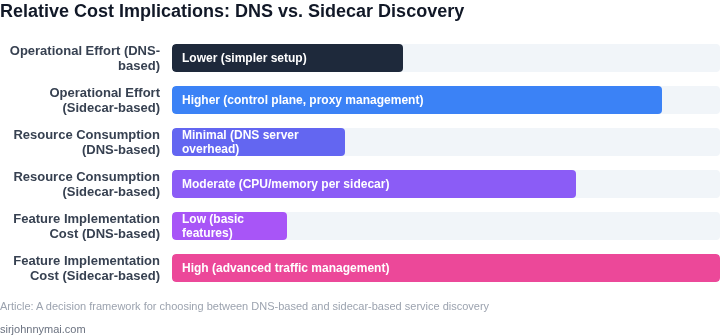
| Criteria | CoreDNS (K8s Native DNS) | AWS Cloud Map (Managed DNS/API) | Envoy / Istio (Sidecar Proxy) |
|---|---|---|---|
| Data Plane Latency & Resource Overhead | Sub-millisecond direct lookup. Near-zero CPU and memory footprint per pod. | Minimal local memory footprint. API call latency occurs during startup or polling. | Adds 1.5–3.0ms per hop. Consumes 50MB+ memory per pod; significant aggregate CPU overhead. |
| Traffic Management & Security | Basic IP-level round-robin. No native L7 routing or mTLS. Relies on NetworkPolicies. | Weighted routing via API. IAM integration for access control. No built-in mTLS. | Advanced L
05. Step-by-Step Migration and Pilot Implementation BlueprintI structured this migration blueprint to prevent the common pitfall of a forklift transition. At AWS and Microsoft, I observed that sudden shifts in service discovery mechanisms invariably expose hidden race conditions. This phased strategy relies on a low-risk, hybrid pilot to validate your chosen mechanism under real-world load before full cutover. Step 1: Audit Traffic Patterns and Define the Pilot ScopeWe must first audit our runtime dependencies to isolate a low-risk, high-volume target candidate (typically a Tier-2 service). I recommend querying your Datadog Service Map or AWS VPC Flow Logs to identify a service pair with high throughput but minimal downstream impact. We need to measure the baseline query rate and average payload size. If your CoreDNS query rate exceeds 10,000 queries per second (QPS) per node, DNS-based routing may already be bottlenecking your P99 latency. Step 2: Deploy a Shadow Hybrid InfrastructureFor a DNS-to-Sidecar pilot, deploy the sidecar proxy (such as Envoy via AWS App Mesh or standard Istio) to only 5% of the pilot service instances. Keep the remaining 95% on the legacy DNS path. This canary topology allows us to isolate performance variances. We configure the client SDK to resolve endpoints via the local sidecar loopback address (127.0.0.1) while maintaining the original DNS resolver as a hard fallback. This ensures that a sidecar bootstrap failure does not trigger a cascading outage. Step 3: Establish the Validation GateRun the hybrid pilot for exactly seven days to capture weekly traffic peaks and deployment cycles. Monitor three primary metrics across both pools using Prometheus or Amazon CloudWatch: CPU overhead per container, P99 connection establishment latency, and DNS resolution error rates. I have analyzed configurations where sidecars added up to 2.5 milliseconds of overhead but stabilized connection pooling during high-churn deployments. If the sidecar overhead exceeds your latency budget, you must tune the proxy's concurrency settings or rollback to DNS with aggressive local caching. Step 4: Execute the Controlled Phase-OutOnce validation gates are met, shift traffic in increments of 10%, 25%, 50%, and 100%. At each milestone, inspect container resource limits in your Kubernetes manifests. You must reclaim DNS caching memory or scale down CoreDNS replicas as sidecar adoption grows. Conversely, if moving from sidecar to DNS, ensure your VPC DNS limits (like the AWS Route 53 resolver limit of 1024 packets per second per network interface) can handle the un-cached traffic. To execute this blueprint immediately, run this query against your Prometheus dashboard to identify your highest-churn service over the last 30 days: Figures cited are from publicly available sources as of 2026-09-15 and may have changed. |