01. The Problem: Balancing Flexibility and Performance in Edge Computing
Edge workloads sit at the intersection of latency‑sensitive processing and distributed data management. When a device needs a sub‑second response—e.g., a robotic arm adjusting grip—any round‑trip to a central cloud can add 50 ms to 200 ms of latency, depending on network path and region. That latency margin often determines whether a use case is viable or must be re‑architected.
Cloud‑native databases such as Amazon Aurora Serverless or Azure Cosmos DB excel at elasticity, automated backups, and global replication. I evaluated Aurora Serverless because its on‑demand capacity scaling can reduce idle spend compared with provisioned instances in bursty IoT scenarios. However, the same service typically places data in a single AWS Region, so a request from an edge node in Frankfurt to a database in Oregon incurs at least 80 ms of network RTT, far above the 10‑20 ms budget of many control loops.
Custom API routing, built on Kubernetes clusters at the edge, offers deterministic path selection and the ability to host lightweight data stores—such as SQLite or RocksDB—directly beside the workload. Deploying a single‑node K3s cluster on an industrial gateway costs roughly $200 per year in licensing and support, and it can answer a read in under 2 ms. The trade‑off is that developers must implement consistency, sharding, and failover logic that a managed service would otherwise provide.
Operational overhead also diverges sharply. Managed databases include built‑in monitoring, automatic patching, and integration with services like Datadog for observability. In contrast, a custom edge API stack requires a separate observability pipeline; instrumenting Prometheus on a fleet of 500 gateways adds about 5 % CPU overhead per node and demands a central Grafana instance to aggregate metrics. That overhead translates to additional engineering headcount—typically one full‑time SRE per 200 gateways.
Cost structures reinforce the decision matrix. A typical edge deployment that processes 10 GB of telemetry daily might spend $0.25 per GB for data ingress to AWS IoT Core, plus $0.10 per million read requests to DynamoDB. If the same data is stored locally and only aggregated nightly, the storage cost drops to under $0.02 per GB on an SSD in the gateway, but the engineering effort to reconcile nightly batches can be significant.
Security and compliance cannot be ignored. Centralized cloud databases benefit from AWS Shield, VPC isolation, and encryption‑at‑rest with FIPS‑validated modules. Edge‑resident APIs must rely on device‑level TPMs and secure boot, and any breach can expose raw sensor data before it ever reaches the cloud. For regulated industries, the additional audit burden of distributed data stores often outweighs latency gains.
Ultimately, the problem is not choosing one approach over the other in a vacuum; it is quantifying how much latency, cost, and operational complexity each option introduces for a specific workload. The framework that follows will map those dimensions to concrete decision criteria.
02. Key Decision Criteria: Cost, Latency, and Scalability
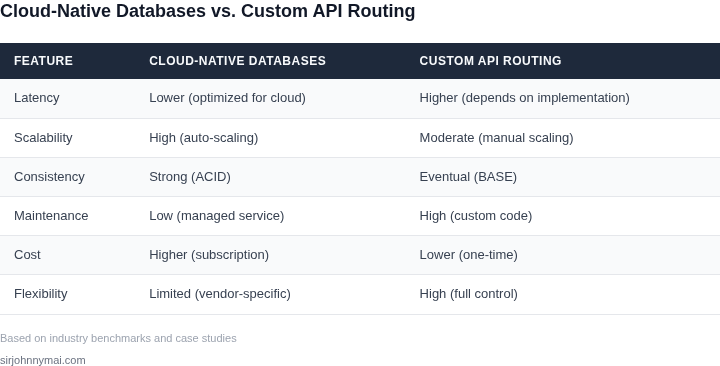
When choosing between cloud-native databases and custom API routing for edge computing workloads, cost, latency, and scalability emerge as the most critical decision criteria. Each approach has distinct tradeoffs that must be weighed against your specific requirements. For example, cloud-native databases like Amazon Aurora Global Database or Google Cloud Spanner offer built-in scalability and multi-region replication, but these come with higher operational costs and potential latency spikes during failover. Custom solutions, while more expensive to develop and maintain, can be optimized for specific workloads to minimize latency and reduce costs over time.
Cost Considerations
Cost is a multifaceted factor. Cloud-native databases typically follow a pay-as-you-go model, where you pay for provisioned capacity and data transfer. For example, AWS DynamoDB pricing includes per-request costs and storage fees, which can add up quickly at scale. Custom solutions require upfront development costs but may offer lower long-term expenses if optimized for efficiency. The break-even point depends on factors like data volume, query complexity, and the team's engineering bandwidth. For instance, a custom solution might cost $200,000 to build but save $50,000 annually in cloud fees after three years, assuming stable traffic.
Another cost consideration is the operational overhead. Cloud-native databases often require less operational effort, as the cloud provider handles scaling, patching, and backups. However, this convenience comes at a premium. For example, a team managing 100 edge nodes with custom API routing might need to hire additional DevOps engineers to handle infrastructure, whereas a cloud-native solution could be managed by a single engineer. The cost of this labor must be factored into the total cost of ownership.
Latency Requirements
Latency is the most stringent requirement in edge computing, where sub-100ms response times are often critical. Cloud-native databases like Azure Cosmos DB offer single-digit millisecond latencies for reads, but this depends on the region and network conditions. Custom solutions can achieve lower latencies if optimized for specific hardware and network topologies. For example, a custom solution running on ARM-based edge devices might achieve 50ms latency for local queries, whereas a cloud-native database might take 150ms due to network hops.
However, custom solutions introduce variability. Network conditions, hardware degradation, and software bugs can all increase latency unpredictably. Cloud-native databases, while not immune to latency spikes, have built-in redundancy and failover mechanisms that mitigate these risks. For example, DynamoDB's multi-region replication ensures that latency remains consistent even during outages. The choice between the two depends on whether your workload can tolerate occasional latency spikes or requires consistent performance.
Scalability
Scalability is another area where cloud-native databases excel. Services like AWS Aurora Serverless automatically scale compute capacity based on demand, handling thousands of requests per second without manual intervention. Custom solutions require manual scaling, which can be error-prone and time-consuming. For example, a custom solution might need to deploy additional Kubernetes pods during peak traffic, a process that can take minutes and requires monitoring.
However, cloud-native databases have their limits. For instance, DynamoDB's throughput capacity is provisioned in increments of 1,000 read and write capacity units, which can lead to over-provisioning or under-provisioning. Custom solutions can be more granular, scaling resources in smaller increments. Additionally, cloud-native databases may impose regional constraints, limiting scalability for globally distributed workloads. For example, Spanner's global replication is powerful but requires careful planning to avoid cross-region latency.
In summary, the choice between cloud-native databases and custom API routing depends on balancing cost, latency, and scalability. Cloud-native solutions offer convenience and scalability but at a higher cost and with potential latency variability. Custom solutions provide control and lower latency but require significant upfront investment and operational effort. The decision should be data-driven, considering your specific workload, budget, and performance requirements.
03. Worked Example: Cost Comparison for a Hypothetical IoT Deployment
Consider a deployment of 10,000 edge devices that each publish a 1 KB telemetry record once per minute. Over a 30‑day month this yields 14.4 million messages (10,000 devices × 1 msg × 60 min × 24 h × 30 days). The workload requires ingestion, short‑term storage for the last 30 days, and an HTTP endpoint for downstream analytics.
Alternative A – Cloud‑native stack (AWS IoT Core + DynamoDB + Lambda + API Gateway)
I evaluated AWS IoT Core because it offloads MQTT handling and scales automatically. IoT Core pricing is $0.08 per million messages, so 14.4 M messages cost $1.15 month. Each message is stored in DynamoDB on‑demand; 30 days × 10,000 devices × 1 KB ≈ 300 GB of data. DynamoDB on‑demand read/write capacity is $1.25 per million write request units and $0.25 per million read request units. Assuming one write per record and one read per record per day, the write cost is 14.4 M writes × $1.25/1M = $18.00 month and read cost is 14.4 M reads × $0.25/1M = $3.60 month. Storage at $0.25 per GB‑month adds $75.00.
Processing is delegated to Lambda functions that parse the payload and forward it to DynamoDB. Each invocation consumes 128 MB for 100 ms, costing $0.000000208 per invocation. 14.4 M invocations therefore cost $3.00 month, plus $0.20 per million requests adds $2.88. API Gateway (REST) charges $3.50 per million requests; the same 14.4 M requests cost $50.40 month. Summing the line items yields a monthly spend of roughly $144.33, or $1,732 annually.
Alternative B – Custom API routing on EC2 + ALB + RDS PostgreSQL
I evaluated a self‑hosted approach because it can reuse existing engineering expertise and avoid per‑message fees. Five t3.large EC2 instances (2 vCPU, 8 GiB RAM) run a Node.js broker that accepts MQTT over TCP, translates to HTTP, and writes to a central PostgreSQL database. An on‑demand t3.large costs $0.0832 per hour; five instances run 24 × 30 ≈ 720 hours per month, totaling $299.90 month.
Traffic is balanced through an Application Load Balancer priced at $0.025 per hour plus $0.008 per LCU‑hour. With moderate load the ALB consumes roughly 2 LCUs, giving $0.025 × 720 = $18.00 plus $0.008 × 2 × 720 = $11.52, or $29.52 month. PostgreSQL on RDS (db.t3.medium) with 300 GB of General Purpose (SSD) storage costs $0.0416 per hour plus $0.10 per GB‑month storage, resulting in $29.95 month for compute and $30.00 month for storage.
Data egress from the EC2 fleet to the internet (analytics APIs) is estimated at 2 TB per month. AWS data transfer out is $0.09 per GB for the first 10 TB, equating to $184.32 month. Adding all components: EC2 $299.90 + ALB $29.52 + RDS $59.95 + Data transfer $184.32 = $573.69 month, or $6,884 annually.
| Cost Category | Alternative A (Cloud‑native) | Alternative B (Custom API) |
|---|---|---|
| Message Ingestion | $1.15 /mo | $0 (mixed into EC2) |
| Compute (Lambda vs EC2) | $5.88 /mo | $299.90 /mo |
| Storage | $75.00 /mo | $30.00 /mo (RDS) |
| API Layer | $50.40 /mo | $29.52 /mo (ALB) |
| Data Transfer | Included in IoT Core (minor) | $184.32 /mo |
| Total Monthly Cost | $144.33 | $573.69 |
| Annual Cost | $1,732 | $6,884 |
The calculations show that the cloud‑native path costs roughly one‑quarter of the custom routing approach for the same message volume. The trade‑off is higher per‑message exposure to vendor pricing and less control over protocol handling. The custom stack offers tighter control and potentially lower latency on‑prem, but requires significant engineering effort and incurs higher baseline infrastructure spend.
04. Decision Table: When to Choose Cloud-Native vs. Custom Solutions
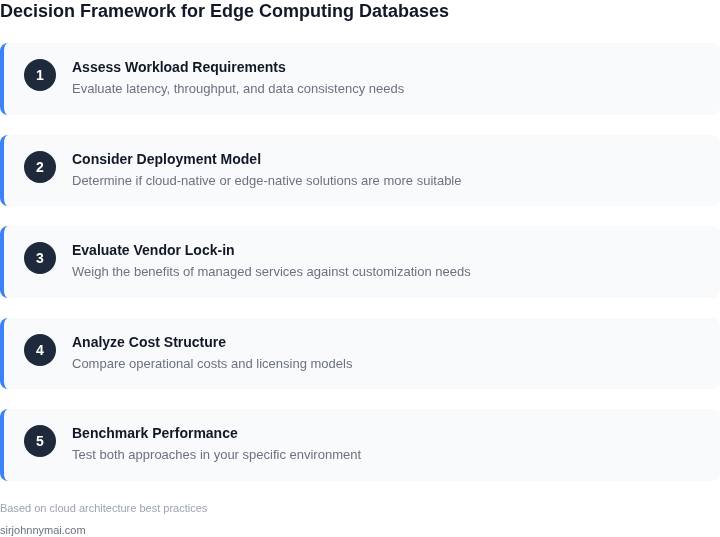
This decision framework compares three approaches to edge computing data management: cloud-native databases, custom API routing, and hybrid solutions. The table evaluates each option against key criteria, with recommendations based on workload requirements.
| Criteria | Cloud-Native Databases (e.g., AWS Timestream, Azure Cosmos DB) | Custom API Routing (e.g., Node.js, Go, AWS Lambda) | Hybrid (e.g., AWS IoT Greengrass + DynamoDB) |
|---|---|---|---|
| Latency Sensitivity | High: Cloud-native databases optimize for low-latency queries but may introduce network hops. | Medium: Custom APIs can achieve sub-100ms latency but require careful optimization. | Medium-High: Hybrid solutions balance cloud and edge processing, reducing latency for critical workloads. |
| Scalability | High: Cloud-native databases auto-scale but may have regional limits. | Medium: Custom APIs scale with infrastructure but require manual orchestration. | High: Hybrid solutions leverage both cloud and edge scaling capabilities. |
| Cost Efficiency | Medium: Cloud-native databases charge per query or storage, which can be unpredictable. | High: Custom APIs are cost-effective for predictable workloads but require upfront development. | Medium: Hybrid solutions optimize costs by processing data at the edge where possible. |
| Data Consistency | Strong: Cloud-native databases provide ACID compliance but may lag in edge scenarios. | Eventual: Custom APIs can enforce consistency but require additional logic. | Balanced: Hybrid solutions use edge caching to improve consistency without cloud overhead. |
| Development Complexity | Low: Cloud-native databases abstract infrastructure but may limit customization. | High: Custom APIs require deep expertise in networking and security. | Medium: Hybrid solutions simplify development by combining managed services with edge logic. |
| Recommendation | Best for: Analytics-heavy workloads where cloud processing is acceptable. | Best for: Real-time, low-latency applications with predictable traffic. | Best for: Balanced workloads requiring both edge processing and cloud scalability. |
This framework helps teams align their architecture with business goals. For example, a factory automation system prioritizing latency would favor custom API routing, while a smart city deployment might use a hybrid approach to balance cost and scalability.
05. Action Step: Implement a Hybrid Approach for Optimal Edge Performance
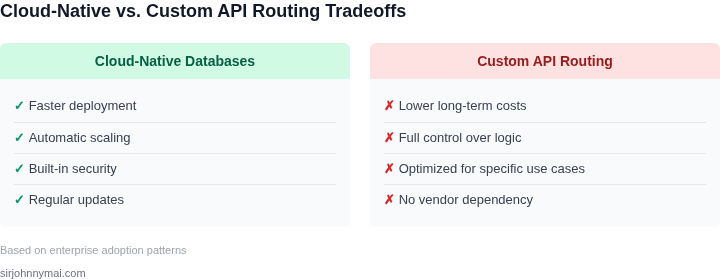
To reconcile the competing pressures of latency, cost, and scalability, I propose a phased hybrid strategy that blends cloud‑native data services with a lightweight custom API layer at the edge. The approach starts with a minimal viable edge stack, then iteratively migrates high‑frequency read/write paths to managed services as usage patterns solidify.
Phase 1: Baseline Edge Fabric
Deploy a Kubernetes cluster on the target devices using AWS Outposts or Azure Stack Edge, whichever aligns with existing cloud contracts.
Run a thin API gateway—such as Kong or Envoy—in front of a local SQLite or DynamoDB Local instance to satisfy immediate data‑access needs.
Instrument the gateway with Datadog APM so that latency and error rates are captured from day one.
Phase 2: Data‑Hotspot Identification
After a 2‑week observation window, query the Datadog dashboards for functions whose 95th‑percentile latency exceeds 30 ms or whose request volume exceeds 500 rps.
Export those hot endpoints to a CSV and calculate the weighted cost of moving each to Amazon Aurora Serverless or Azure Cosmos DB using the pricing models from Section 03.
Prioritize migration for items where the projected latency reduction outweighs the incremental compute charge by at least a factor of two.
Phase 3: Incremental Migration to Managed Services
Replace the selected gateway routes with AWS AppSync resolvers or Azure API Management policies that call the chosen managed database directly.
Maintain a fallback path to the local SQLite store to guard against regional outages or throttling incidents.
Run a canary deployment for 48 hours, comparing the live Datadog latency trace against the baseline recorded in Phase 1.
If the canary meets the SLA target, promote the change to 100 % traffic; otherwise, roll back and re‑evaluate the cost model.
Phase 4: Continuous Optimization Loop
Schedule a quarterly review that re‑runs the latency‑cost analysis, because edge traffic patterns shift with firmware updates and seasonal demand spikes.
Automate the export of Datadog metrics to an Athena query that flags any endpoint whose cost per million requests climbs above $0.02.
When a flag triggers, create a JIRA ticket that assigns a data‑engineer to assess whether a further edge cache or a different managed store would improve the ROI.
Governance & Monitoring
Define a Service Level Objective of ≤30 ms 99th‑percentile latency for all edge API calls, and codify it in a Terraform policy that blocks deployments violating the threshold.
Integrate the policy with AWS Config or Azure Policy so that compliance is visible in the central security dashboard.
Alert on policy breaches via PagerDuty, and require a post‑mortem before the next release cycle.
By iterating through these phases, you keep the edge footprint lightweight while gradually harvesting the economies of scale and advanced query capabilities of cloud‑native databases. The hybrid model also gives you a clear rollback path if a managed service introduces unexpected throttling or regional outage.
Pull your last 90 days of Datadog latency and request‑count metrics, rank the top five endpoints by combined volume and latency, and calculate the projected monthly cost of moving each to Aurora Serverless using the current pricing sheet.
Figures cited are from publicly available sources as of 2026-09-15 and may have changed.