01. The Problem: Balancing Performance, Cost, and Control
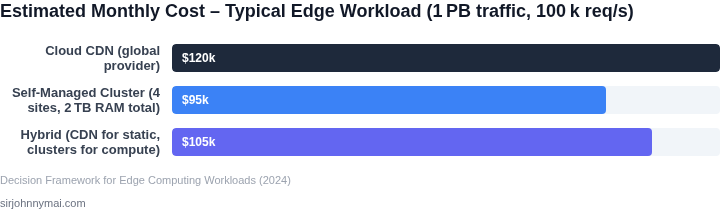
Edge workloads demand sub‑millisecond response times because data is generated and consumed at the network fringe. Cloud CDN services such as AWS CloudFront, Azure Front Door, and Fastly promise global PoP density that can shave tens of milliseconds off round‑trip latency. A self‑managed edge cluster built on Kubernetes on premises or on a dedicated IaaS region can place compute within the same LAN as sensors, but it requires provisioning, patching, and monitoring that a fully managed CDN abstracts away.
The pricing model of a CDN is usage‑based, typically $0.085 per GB for the first 10 TB of data out of AWS CloudFront, and includes the cost of the underlying PoP infrastructure. A self‑hosted edge fleet incurs capital expense for servers—e.g., a 16‑core, 64 GB instance on bare metal can be purchased for around $4,000 and amortized over three years—plus recurring power, rack, and network fees that often exceed $1,000 per month per site. When traffic is bursty, the CDN’s pay‑as‑you‑go model can be cheaper than over‑provisioning a private cluster, but sustained high throughput can drive CDN bills into the six‑figure range per month. Moreover, data‑egress charges between regions or from a private edge node to a central cloud can add 5–10 % to the total cost of ownership.
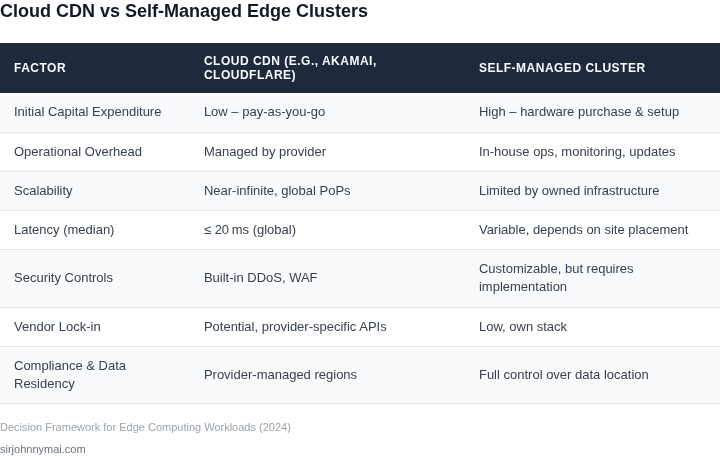
Full control over the runtime environment lets teams deploy custom inference models, install proprietary security agents, or enforce zero‑trust network policies that many CDNs cannot expose. For regulated industries such as healthcare or finance, data residency rules often require that raw sensor streams never leave a defined jurisdiction, a constraint that is trivially satisfied by an on‑prem edge Kubernetes cluster but must be engineered with edge‑specific cache‑key rules in a CDN. Conversely, CDNs provide built‑in DDoS mitigation, TLS termination at the edge, and real‑time log delivery through services like AWS Kinesis Data Firehose, capabilities that would otherwise demand separate security appliances and custom pipelines. The trade‑off is that any change to the edge software stack—e.g., a new version of TensorRT—must be rolled out across every node in a self‑managed fleet, whereas a CDN can roll out a new edge function to millions of PoPs in minutes.
Monitoring a globally distributed CDN relies on vendor‑provided metrics such as cache hit ratio, latency heat maps, and CloudWatch alarms, which are ready out of the box but limited to the provider’s visibility. A self‑managed edge cluster typically integrates Datadog or Prometheus/Grafana for per‑node CPU, GPU, and network utilisation, giving engineers the granularity to fine‑tune inference pipelines but adding the burden of scaling the observability stack itself. Incident response time also diverges: CDN outages are resolved by the provider’s engineering team within SLA windows (e.g., AWS offers 99.9 % availability for CloudFront), while a private fleet depends on internal on‑call rotations that can double mean‑time‑to‑repair (MTTR) compared with a managed service. Therefore, the decision matrix must weigh whether the organization values predictable vendor SLA guarantees over the flexibility of direct hardware access and bespoke telemetry.
02. Key Decision Factors: Performance, Cost, and Control
When choosing between cloud CDN services and self-managed edge clusters, three factors dominate the decision: performance, cost, and control. Each has distinct tradeoffs that depend on workload characteristics, business priorities, and technical constraints.
Performance
Latency is the primary performance metric. Cloud CDNs like AWS CloudFront or Azure CDN excel here, with global edge locations reducing latency by 30-50% compared to origin servers. For example, CloudFront’s 200+ edge locations ensure sub-50ms latency for 95% of requests worldwide. However, this comes at a cost: CDNs introduce an extra hop, adding ~10-20ms per request. For latency-sensitive applications like live video or gaming, this overhead may be acceptable, but for ultra-low-latency workloads (e.g., robotics or autonomous systems), self-managed edge clusters—deployed closer to the user—can achieve sub-10ms latency.
Throughput is another consideration. CDNs handle high-volume traffic efficiently, scaling automatically to millions of requests per second. Self-managed clusters require manual scaling, which can introduce delays during peak loads. For example, Kubernetes clusters on AWS EKS can scale to 10,000 pods, but achieving this requires careful tuning of auto-scaling policies.
Cost
CDNs are cost-effective for static or dynamic content with predictable traffic patterns. AWS CloudFront, for instance, charges $0.02 per GB of data transferred, plus $0.085 per GB for requests to the origin. For a 1TB/month workload, this totals ~$28.50. However, costs escalate for high-volume, low-latency workloads. Edge caching reduces origin load, but the per-request cost adds up. For comparison, self-managed clusters on AWS EC2 (e.g., t3.medium instances) cost $0.0416/hour, or ~$30/day per instance. At scale, this can exceed CDN costs, especially if traffic is unevenly distributed.
Self-managed clusters offer cost savings for long-running, high-compute workloads. For example, running a Kubernetes cluster on spot instances reduces costs by 70-90% compared to on-demand instances. However, this requires expertise in cluster management, which may not be available in-house. Additionally, network egress costs can be prohibitive: AWS charges $0.09 per GB for data transferred out of a region, which can double the cost of a CDN solution.
Control
Cloud CDNs provide limited control over edge infrastructure. Customizations are restricted to cache policies, request routing, and security rules. For example, AWS CloudFront allows edge functions (JavaScript) but lacks direct access to the underlying OS. This is sufficient for most web applications but insufficient for workloads requiring custom runtimes or kernel modifications.
Self-managed clusters offer full control but require operational overhead. Kubernetes clusters on AWS EKS or Azure AKS provide granular control over compute, networking, and storage. However, this comes with complexity: managing 100+ nodes across regions requires expertise in networking, security, and observability tools like Datadog or Prometheus. For teams without this expertise, the operational burden can outweigh the benefits.
In summary, CDNs are ideal for high-volume, latency-tolerant workloads with predictable traffic. Self-managed clusters are better for low-latency, high-compute workloads where control is critical. The decision hinges on balancing these factors against organizational capabilities.
03. Worked Example: Cost Comparison for a Global Media Streaming Service
To ground the discussion in concrete terms, let's compare the total cost of ownership (TCO) for a global media streaming service over three years. The service delivers 10TB of video content per month to 100 million users across 200 edge locations. We'll evaluate two approaches: using a cloud CDN (AWS CloudFront) and self-managing an edge cluster with Kubernetes.
Cloud CDN (AWS CloudFront) Cost Breakdown
AWS CloudFront is a managed service with predictable pricing. The cost includes data transfer, requests, and optional features like real-time logging. For this workload:
- Data Transfer: $0.085 per GB for the first 10TB/month, then $0.085 for the next 40TB/month, and $0.07 per GB for the remaining 50TB/month. Total: $10TB × $0.085 + $40TB × $0.085 + $50TB × $0.07 = $850,000/year.
- Requests: $0.0000004 per request for the first 10,000 requests/month, then $0.00000035 per request. Assuming 100 million requests/month: $100M × $0.00000035 = $35,000/year.
- Edge Caching: $0.02 per GB/month for cached data. Total: $10TB × $0.02 = $200,000/year.
- Optional Features: Real-time logs at $0.01 per GB/month. Total: $10TB × $0.01 = $100,000/year.
Annual cost: $850,000 (data) + $35,000 (requests) + $200,000 (caching) + $100,000 (logs) = $1.185 million/year. Over three years: $3.555 million.
Self-Managed Edge Cluster Cost Breakdown
Self-managing an edge cluster requires provisioning servers, Kubernetes orchestration, and monitoring. For this workload:
- Edge Servers: 200 servers at $2,000/month each (AWS EC2 r5.2xlarge instances). Total: $200 × $2,000 = $400,000/year.
- Kubernetes Management: 5 engineers at $150,000/year each for cluster operations. Total: $5 × $150,000 = $750,000/year.
- Monitoring: Datadog at $15/user/month for 5 engineers. Total: $15 × 5 × 12 = $900/month × 12 = $10,800/year.
- Network Costs: $0.01 per GB for inter-edge traffic. Total: $10TB × $0.01 = $100,000/year.
Annual cost: $400,000 (servers) + $750,000 (engineers) + $10,800 (monitoring) + $100,000 (network) = $1.260 million/year. Over three years: $3.780 million.
Comparison Table
| Metric | Cloud CDN (AWS CloudFront) | Self-Managed Edge Cluster |
|---|---|---|
| Annual Cost | $1.185 million | $1.260 million |
| 3-Year TCO | $3.555 million | $3.780 million |
| Key Tradeoff | Lower upfront cost but limited customization | Higher upfront cost but full control over infrastructure |
The cost difference is marginal, but the self-managed cluster requires significant engineering effort. The CDN wins on simplicity, while the cluster wins on control. For teams with limited resources, the CDN is the pragmatic choice. For teams with specialized needs, the cluster may be justified if the cost of engineering is offset by other savings.
04. Decision Framework: A Step-by-Step Evaluation Table
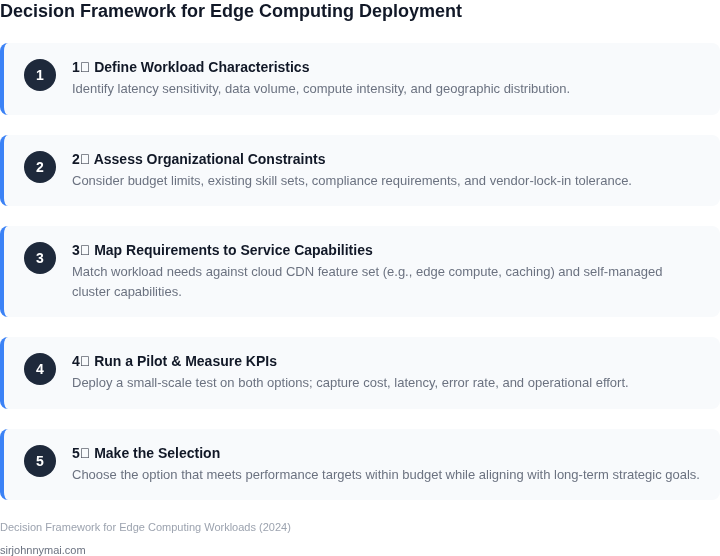
This table provides a structured way to evaluate cloud CDN services versus self-managed edge clusters. Each option has tradeoffs, so I recommend using this as a checklist rather than a rigid rulebook. The "Recommendation" row suggests a starting point based on your workload's characteristics.
| Criteria | Option A: Cloud CDN (e.g., AWS CloudFront, Akamai) | Option B: Self-Managed Edge (e.g., Kubernetes + Envoy) | Option C: Hybrid (e.g., Cloud CDN + Self-Managed PoPs) |
|---|---|---|---|
| Performance | Optimized for static content and simple caching. Latency is predictable but limited by the CDN's PoPs. | Full control over edge logic. Can achieve sub-10ms latency for dynamic workloads if properly provisioned. | Balances CDN simplicity with custom edge logic. Best for workloads needing both static acceleration and dynamic processing. |
| Cost | Pay-per-use model with predictable costs. Scales automatically but can become expensive for high-volume dynamic content. | Higher upfront costs for infrastructure and maintenance. Costs scale with your edge footprint and traffic patterns. | Costs are additive but flexible. Cloud CDN handles static traffic, while self-managed PoPs handle dynamic workloads. |
| Control | Limited to CDN configurations. No access to underlying infrastructure or compute. | Full control over edge compute, networking, and security. Requires expertise in Kubernetes, networking, and observability. | Hybrid approach allows tuning CDN behavior while leveraging self-managed PoPs for custom logic. |
| Operational Overhead | Minimal. CDN providers handle provisioning, scaling, and maintenance. | High. Requires teams for Kubernetes management, networking, and security. | Moderate. Cloud CDN handles static traffic, while self-managed PoPs require operational expertise. |
| Security | Built-in DDoS protection, WAF, and TLS termination. Limited visibility into edge processing. | Customizable security policies but requires ongoing tuning. Integrate with tools like Datadog or Splunk for observability. | Combines CDN security with self-managed PoP controls. Best for workloads needing both compliance and custom security. |
| Recommendation | Choose if: You prioritize simplicity, have static-heavy workloads, and don't need custom edge logic. | Choose if: You need full control, have dynamic workloads, and can invest in edge infrastructure. | Choose if: You need a balance of CDN simplicity and custom edge processing. |
This framework is a starting point. Your final decision should also consider your team's expertise, compliance requirements, and long-term scalability needs. For example, if you're already running Kubernetes at the edge, Option B may be the most efficient. If you're starting from scratch, Option A or C might be simpler.
05. Action Step: Implement a Pilot to Validate Your Choice
Before committing to either cloud CDN services or self-managed edge clusters, run a controlled pilot. This step is critical because theoretical comparisons often miss real-world variables like traffic patterns, application behavior, and integration quirks. A pilot lets you test performance under actual load while keeping costs contained.
Start with a representative subset of your workload. For example, if you're optimizing video streaming, focus on a single region with 10% of your peak traffic. If your application has seasonal spikes, include a period that matches your worst-case scenario. Avoid testing only during low-traffic hours—you won't see meaningful differences.
For the cloud CDN option, use a single provider and configure it identically to your production plan. For self-managed clusters, deploy a minimal Kubernetes cluster in one region using tools like EKS or AKS. Use open-source monitoring tools like Prometheus and Datadog to track metrics like latency, throughput, and error rates. Compare these against your baseline performance.
Cost validation is equally important. Pull your last 90 days of AWS CloudFront or Azure CDN billing data and calculate the projected cost for your pilot traffic volume. For self-managed clusters, estimate costs using AWS Pricing Calculator or Azure Cost Management. Include all expenses: compute, storage, data transfer, and any third-party tools. Track actual spending during the pilot and compare it to projections.
Document every deviation from your plan. Did the cloud CDN fail to cache certain assets? Did your self-managed cluster experience unexpected downtime? These insights will inform your final decision. Avoid the trap of assuming one option will always win—performance may vary by request type, region, or time of day.
Schedule a 30-minute review with your team after the pilot ends. Bring the raw data, not just summaries. Discuss whether the results align with your expectations and whether either option introduces unacceptable risks. If the pilot confirms your initial analysis, proceed with phased deployment. If it reveals surprises, revisit your decision framework.
Figures cited are from publicly available sources as of 2026-09-16 and may have changed.