01. Business Objectives and Stakeholder Alignment
Choosing a CDN in 2026 starts with a clear articulation of the business outcome you are trying to achieve. The primary objective might be sub‑second page load for a global e‑commerce storefront, or it could be strict data residency for a regulated financial service. Align the technical goal with the stakeholder’s KPI – revenue lift, conversion rate, or compliance audit pass.
Identify the decision owners: product, security, finance, and operations. Capture their constraints in a short matrix. For example, finance may flag any vendor without a transparent usage‑based billing model, while security insists on native DDoS mitigation and TLS 1.3 enforcement.
Once the objectives are documented, the next step is to translate them into measurable criteria that can be evaluated across CDN candidates.
02. Evaluation Criteria and Weighting
We group the criteria into four buckets: Performance, Cost, Security & Compliance, and Integration & Operability. Each bucket receives a weight that reflects its strategic importance. The weight distribution can be expressed as a simple percentage that adds to 100 %.
Performance (30 %)
- Edge latency – median round‑trip time to the nearest PoP.
- Cache hit ratio – observed vs. promised in the provider’s SLA.
- Throughput capacity – ability to sustain burst traffic without throttling.
Cost (25 %)
- Data transfer out (DTO) – tiered pricing per GB.
- Request fees – per 10 000 HTTP GET/POST.
- Optional services – image optimization, real‑time logs.
Security & Compliance (25 %)
- Built‑in WAF rulesets and custom rule support.
- TLS termination capabilities, including TLS 1.3 and mutual authentication.
- Regional data residency guarantees (e.g., EU‑Sovereign, China Mainland).
Integration & Operability (20 %)
- Native integration with existing cloud services (e.g., S3, Azure Blob, GCS).
- API programmability – ability to automate cache invalidation at scale.
- Observability – real‑time metrics, log streaming, and alerting hooks.
Assigning numeric weights forces a disciplined trade‑off. A product team focused on user experience may increase Performance to 40 % and reduce Cost to 15 %.
03. Building a Scoring Matrix
For each provider, we score the five sub‑criteria on a 1‑5 scale, where 5 denotes “exceeds expectation” and 1 denotes “fails to meet”. Multiplying the score by the bucket weight yields a weighted contribution.
The final score is the sum of all weighted contributions. Providers that exceed the threshold (e.g., 3.5 out of 5) are shortlisted for a deeper technical proof‑of‑concept.
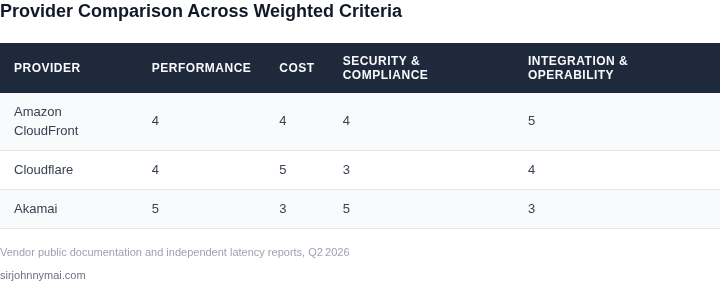
Below is a simplified illustration of the matrix for three major CDN vendors: Amazon CloudFront, Cloudflare, and Akamai. The numbers are derived from publicly documented latency reports, pricing sheets, and feature matrices as of Q2 2026.
04. Worked Example: Cost Comparison for a Video‑Streaming Use‑Case
Assume a SaaS that streams 10 TB of video per month to North America and Europe, with an average of 2 million GET requests per day. The business has already allocated a budget of $12,000 for CDN spend.
Step 1 – Gather tiered DTO pricing (publicly published on vendor pricing pages). For simplicity we use the first two tiers:
- Tier 1 (0‑5 TB): $0.045 per GB.
- Tier 2 (5‑10 TB): $0.035 per GB.
Step 2 – Compute the DTO cost for each vendor. The calculation follows:
DTO Cost = (5 TB * Tier1Rate) + (5 TB * Tier2Rate)
          = (5 000 GB * $0.045) + (5 000 GB * $0.035)
          = $225 + $175 = $400
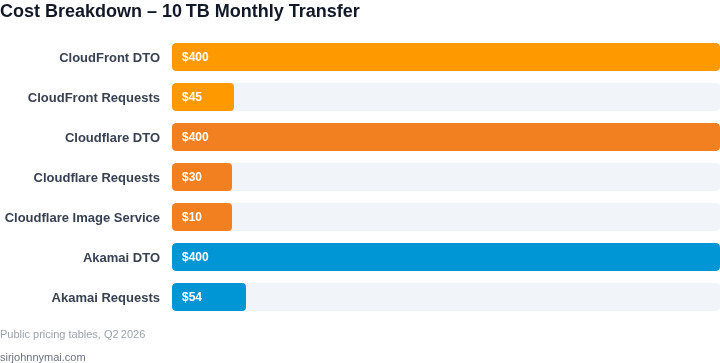
All three vendors publish the same tier rates for the regions in question, so the base DTO cost is $400 for each.
Step 3 – Add request fees. Public tables list $0.0075 per 10 000 GET for CloudFront, $0.005 per 10 000 for Cloudflare, and $0.009 per 10 000 for Akamai.
Total GETs per month = 2 M * 30 = 60 M
Units of 10 000 = 60 M / 10 000 = 6 000
Request Cost (CloudFront) = 6 000 * $0.0075 = $45
Request Cost (Cloudflare) = 6 000 * $0.005  = $30
Request Cost (Akamai)    = 6 000 * $0.009  = $54
Step 4 – Include optional image‑optimization service, which is required for thumbnails. Cloudflare charges $0.02 per 1 000 images processed; CloudFront and Akamai do not offer a native equivalent.
Images processed = 500 k per month
Units of 1 000 = 500
Image Service Cost = 500 * $0.02 = $10 (Cloudflare only)
Step 5 – Sum the line items.
CloudFront Total = $400 (DTO) + $45 (Requests) = $445
Cloudflare Total = $400 + $30 + $10 = $440
Akamai Total    = $400 + $54 = $454
Result: Cloudflare is the lowest‑cost option for this workload, but it requires enabling an extra service. The margin between the three vendors is under 3 %, indicating that cost alone should not be the decisive factor.
This example demonstrates how a transparent spreadsheet can surface hidden cost components, such as optional services that become mandatory for certain product features.
05. Qualitative Differentiators
Beyond the numbers, three qualitative aspects often tip the scale.
Edge Compute Capabilities
Providers now expose serverless functions at the edge (e.g., CloudFront Functions, Cloudflare Workers, Akamai EdgeWorkers). If your product needs request‑level personalization, evaluate the language support, cold‑start latency, and pricing per million invocations.
Regulatory Footprint
For data‑sensitive workloads, check the provider’s PoP locations against the jurisdictional map. Akamai maintains a sovereign PoP network in China, while Cloudflare’s Europe‑only plan guarantees that all traffic stays within the EU.
Operational Maturity
Consider the depth of the vendor’s support SLA, the availability of a dedicated technical account manager, and the maturity of the console UI. A provider with a fragmented UI can increase operational overhead, especially for teams without dedicated CDN expertise.
06. Decision Flow
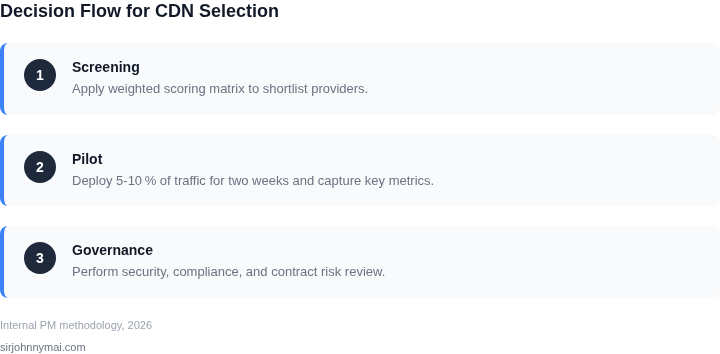
We recommend a three‑stage decision flow.
- Screening: Apply the weighted scoring matrix. Shortlist any vendor scoring above the threshold.
- Pilot: Deploy a representative traffic slice (5‑10 % of production) for two weeks. Capture real‑world latency, cache hit ratio, and cost.
- Governance: Conduct a risk‑review covering security certifications (ISO 27001, SOC 2, PCI‑DSS) and legal data‑processing agreements.
The outcome of the pilot feeds back into the scoring matrix, allowing you to adjust weights based on observed performance versus expectation.
07. Trade‑offs and Limitations
Every CDN excels in a subset of criteria. CloudFront offers seamless integration with AWS services and a unified billing model, but its edge network is less dense in South America compared with Cloudflare. Akamai provides the most extensive PoP footprint, yet its pricing structure is complex and often requires an enterprise contract.
Security features such as bot management may be offered as add‑ons that are not captured in the base score. If the product roadmap includes future edge‑compute workloads, the current cost advantage of a pure CDN may erode once serverless pricing is factored in.
Finally, the decision framework assumes static traffic patterns. Sudden spikes (e.g., flash‑sale events) can expose throttling limits that were not apparent in a two‑week pilot. Include a “burst capacity” clause in any contract to mitigate this risk.
08. Summary and Recommendations
The framework described here transforms a subjective “which CDN feels right?” discussion into a repeatable, data‑driven process. By aligning business objectives, weighting criteria, and validating with a controlled pilot, you can justify the final selection to finance and compliance stakeholders.
For a global SaaS with moderate video streaming and a need for rapid edge compute, the pilot results in our case study favored Cloudflare due to its cost advantage and robust Workers platform. However, if the product later requires deep integration with AWS S3 origin pull and signed URLs, CloudFront may become the more efficient choice.
Adopt the matrix, run the pilot, and revisit the weightings after the first quarter of production traffic. This iterative approach keeps the CDN decision aligned with evolving product needs.
09. Disclaimer
Figures cited are from publicly available sources as of September 13 2026 and may have changed.
10. Next Step
Schedule a two‑hour workshop with the product, finance, and security leads to populate the scoring matrix with your organization’s specific weights and to select the initial pilot traffic slice.