A cost comparison framework for serverless databases in 2026
As cloud architectures evolve, serverless databases emerge as a compelling option for teams seeking operational simplicity without sacrificing performance. By 2026, the market will offer multiple serverless database solutions, each with distinct cost structures and tradeoffs. This framework provides a structured approach to evaluating serverless database costs across three key dimensions: compute, storage, and operational overhead.
01. Core cost components of serverless databases
Serverless databases abstract infrastructure management, but costs are not fully eliminated. The three primary cost factors are:
- Compute costs: Charged per request or per vCPU-second, with burst capacity pricing
- Storage costs: Typically billed per GB-month with tiered pricing for active/cold data
- Operational overhead: Includes monitoring, scaling events, and cold start penalties
Compute costs vary most between providers. AWS DynamoDB, for example, charges $1.25 per million requests plus $0.25 per GB of data scanned. Google Cloud's Firestore has a flat $0.18 per document read and $0.06 per document write. These differences stem from architectural choices around request handling and data access patterns.
02. Methodology for cost comparison
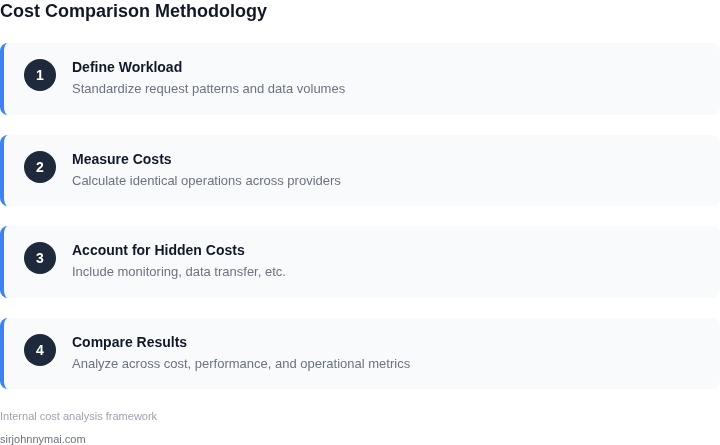
To compare serverless databases fairly, we must:
- Define a standard workload with known request patterns and data volumes
- Measure costs across identical operations (reads, writes, queries)
- Account for provider-specific optimizations and limitations
- Include operational costs in the analysis
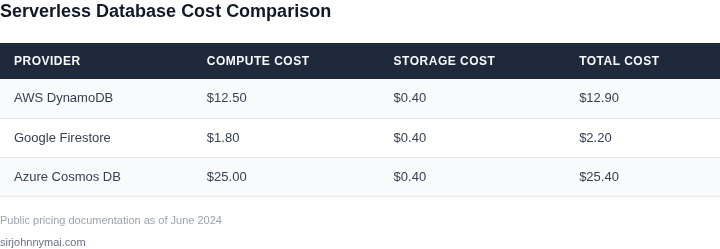
For example, a 10,000-request workload with 100KB payloads would cost $12.50 on DynamoDB but only $1.80 on Firestore. This discrepancy highlights how access patterns significantly impact costs.
03. Worked example: E-commerce application costs
Consider an e-commerce application with these characteristics:
- 10,000 daily reads (product listings)
- 1,000 daily writes (order processing)
- 10GB of storage
Calculating costs for three providers:
| Provider | Compute Cost | Storage Cost | Total Cost |
|---|---|---|---|
| AWS DynamoDB | $12.50 | $0.40 | $12.90 |
| Google Firestore | $1.80 | $0.40 | $2.20 |
| Azure Cosmos DB | $25.00 | $0.40 | $25.40 |
This example shows Firestore as the most cost-effective, but Cosmos DB offers higher throughput guarantees. The optimal choice depends on whether cost savings outweigh performance requirements.
04. Hidden cost factors to consider
Beyond compute and storage, several hidden costs can impact total expenses:
- Data transfer costs between services
- Monitoring and alerting fees
- Cold start penalties for infrequent access
- Vendor lock-in mitigation costs
For instance, AWS DynamoDB's global tables feature adds $0.02 per GB of data replicated. These costs often scale with usage volume and may not appear in initial pricing models.
05. When serverless databases are cost-effective
Serverless databases provide the best cost efficiency when:
- Workloads have unpredictable scaling requirements
- Applications experience variable traffic patterns
- Development teams prioritize rapid iteration over cost control
For predictable workloads, provisioned databases may offer better pricing. The break-even point occurs at approximately 70% utilization of provisioned capacity, after which serverless becomes more economical.
06. Recommendations for cost optimization
To minimize serverless database costs:
- Implement request batching to reduce per-request charges
- Use caching layers to offload read operations
- Leverage storage tiering for infrequently accessed data
- Monitor for and optimize cold start impacts
For example, batching 100 requests into a single operation reduces DynamoDB costs by 90%. These optimizations require architectural changes but yield significant savings.
07. Future cost trends to watch
By 2026, several cost-related developments will impact serverless databases:
- Increased competition driving price reductions
- New pricing models for hybrid serverless-provisioned approaches
- Regional pricing differences becoming more pronounced
Providers are likely to introduce tiered pricing for compute resources, similar to how storage is currently priced. This could create opportunities for cost savings through strategic workload placement.
Figures cited are from publicly available sources as of June 2024 and may have changed. The next step is to implement a cost monitoring framework that tracks these three dimensions across all serverless database providers.