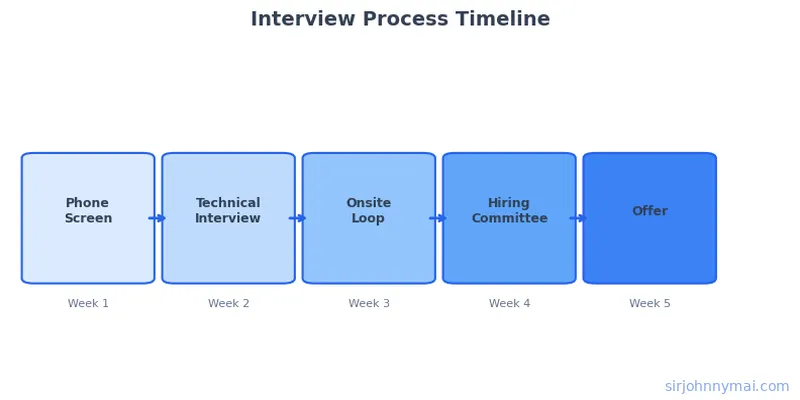
Career changers win 1on1s when they sound like they understand the job, not when they sound grateful for the chance to interview. The people who move forward can explain why the switch is rational, how their past work already contains PM judgment, and what they will own in the first 90 days. If you cannot say that cleanly before a 4-to-6-round PM loop starts, the committee will read you as enthusiastic but unproven.
What should I say in a 1on1 with a PM hiring manager?
A strong 1on1 is not a pitch. It is a calibration test.
In a Q3 debrief I sat through, the hiring manager pushed back hard on a career changer because the candidate spent the whole conversation describing their background like a biography. The room’s read was simple: friendly, but not useful. Another candidate used the same 30 minutes to ask how the team defined product failure in the first 60 days, then tied their own switch story to that metric. That one moved forward.
The judgment here is cold. Not networking, but evidence collection. Not asking to be liked, but showing that your thinking reduces hiring risk. The committee is not buying your ambition. It is buying a lower probability of regret.
That is why the best 1on1s have a narrow shape. You ask one question about how the team wins, one question about where PMs get blocked, and one question about what a strong first 90 days looks like. Then you stop talking and listen for the organizational fault lines. If the answer is vague, that is not a neutral outcome. Vague answers are often the interview equivalent of a warning label.
The mistake is to treat every 1on1 as a relationship event. It is not. It is an information event. In practice, a good 1on1 tells you whether the role is real, whether the manager can evaluate PMs, and whether your background can be translated into product language without strain. If those three things are not visible, the conversation is decorative.
How do I explain a career change without sounding defensive?
Your switch story should be a constraint story, not a passion story.
In hiring manager conversations, the phrase “I’ve always wanted to be a PM” usually lands flat unless it is backed by evidence. I have watched that line get nodded at in the moment and then marked down in debrief because it answered desire, not judgment. The stronger frame is more specific: “I kept getting pulled into decisions where tradeoffs mattered, and I realized I was already doing part of the job.”
That is the difference between narrative and proof. Not “I love users,” but “I saw repeated decision failures around users, so I started collecting evidence.” Not “I want strategy,” but “I was already sitting in the meetings where strategy was being translated into execution, and I kept noticing the same blind spots.” Not “I’m passionate about product,” but “I am changing because my current function keeps exposing the exact kind of problem PMs are paid to solve.”
The best switch stories have four parts: the context, the recurring problem, the action you took, and the result. They do not try to cover your entire life. They show one clean pattern of judgment. If you are coming from engineering, talk about prioritization calls, technical debt tradeoffs, or moments when you had to explain why one user path mattered more than another. If you are coming from sales or customer success, talk about patterns across accounts, recurring objections, and the product gaps you had to keep working around. If you are coming from consulting or operations, talk about how you framed ambiguous problems and pushed a decision to land.
The insight layer is organizational psychology. People trust candidates who make a transition feel inevitable. They distrust candidates who make it feel aspirational. A career change is not a confession. It is a case for fit. If your story sounds like a late discovery, it will be treated like a risk. If it sounds like the next logical step in a chain of decisions, it becomes credible.
What questions make me sound like a PM candidate instead of a job seeker?
The best questions expose how the company ranks PMs.
In one hiring loop, two career changers had similar backgrounds on paper. The one who moved forward asked, “What does a PM do here that the manager would notice in the first 90 days?” The one who stalled asked, “What is the culture like?” The first question surfaced the rubric. The second invited a brochure answer.
That is the point. Not friendly curiosity, but diagnostic intent. Not broad interest, but a probe for decision rights. Not “Do you like the team?”, but “Who gets blocked, what gets escalated, and what do strong PMs do differently when the room disagrees?” If you ask that kind of question, the other side starts revealing how work really moves.
A serious 1on1 question should do one of three things. It should show you understand the product surface. It should expose the team’s failure mode. Or it should clarify what earns trust in that org. Questions about launch cadence, customer segmentation, metric ownership, and how PMs are evaluated after a disagreement are useful because they force precision. Questions about “growth opportunities” or “work-life balance” too early are weak because they tell the manager nothing about your judgment.
I have seen committees react strongly to this. When a candidate asks where PMs lose influence, the room hears someone who understands power. When a candidate asks what the team is “looking for,” the room hears someone who wants to be selected rather than someone who wants to do the work. The difference is subtle on the surface and decisive in debrief.
A 30-minute 1on1 usually gives you space for three good questions if you want the conversation to stay sharp. Use the first one to learn the product problem, the second to learn the organizational problem, and the third to learn the evaluation problem. That sequence tells the hiring manager you are already thinking like someone who will have to operate inside constraints.
How do I turn my current background into product evidence?
Transferability is not title overlap; it is repeated ownership under ambiguity.
In an HC meeting, I watched a well-spoken consultant get rejected because they had a polished story but no shipped decisions. The panel’s line was blunt: the candidate knew how to present a problem, not how to own one. In the same week, an operations candidate with no PM title got traction because they could describe one metric they moved, one conflict they resolved, and one tradeoff they documented when the answer was not obvious.
That is the standard. Not breadth, but repetition. Not a clean resume, but a pattern of judgment. One anecdote is decoration. Three comparable examples are evidence. If you want to move into product management, your current background has to be translated into decision history, not just responsibility history.
The translation looks different by function. An engineer should show moments where they changed priorities after seeing user impact, technical cost, or edge-case risk. A designer should show where they balanced user friction against business constraints and got a decision to land. A sales or customer success candidate should show how they turned recurring objections into product insight rather than just workarounds. An analyst or operator should show how they turned data into an action, not a dashboard.
The real test is whether you can point to ownership without hiding behind your old title. If your only evidence is that you were “involved,” the committee will not count it. If you can describe what you noticed, what you changed, and what happened next, you are no longer selling a career pivot. You are demonstrating PM-grade behavior in adjacent work.
This is where many career changers misread the room. They think the interview is asking, “Do you know product?” It is not. It is asking, “Have you already behaved like someone who can take responsibility for a product outcome?” That is a different standard, and it is much harder to fake.
When should I ask for the referral, level, or salary?
Ask only after you have made the role feel real.
In a hiring manager 1on1, I have seen candidates jump to compensation before the manager had a reason to believe their transition story. That usually ends the useful part of the conversation. Not because salary is rude, but because it is premature. The room has not yet agreed on scope, and scope is what sets level, title, and pay.
The right order is simple. First, establish that you understand the problem. Second, establish that your background maps to the job. Third, ask what would need to be true for the manager to advocate for you. Only then do you talk about referral, level, or compensation. That is not politeness. It is sequencing.
Not leading with salary, but leading with scope. Not asking for a referral, but earning a tailored one. Not trying to force a title, but proving the shape of work you can own. When the conversation is mature, a manager can tell you whether you belong at associate PM, PM, or a hybrid entry point. In U.S. large tech, I have seen career-change PM offers discussed across a broad band, from roughly the mid-$100k base range into the low-$200k base range depending on level and location, but the number only matters after the scope is believable.
There is a psychological reason for this. Managers do not risk their credibility on ambiguous candidates. They will sponsor someone when they can explain the person in one sentence to the next room. Your job in the 1on1 is to make that sentence easy to say.
Where Candidates Should Invest Time
- Write a one-minute transition narrative that explains why the switch is rational, not just desirable.
- Collect three proof stories showing product judgment, not simply cross-functional exposure.
- Prepare five diagnostic questions that reveal product ownership, failure modes, and decision rights.
- Run two mock 1on1s and force the other person to interrupt when you start sounding vague.
- Map the likely 4-to-6 interview rounds so you know where your story will be tested and where it will collapse.
- Work through a structured preparation system. The PM Interview Playbook covers transition narratives, product sense, and debrief examples from career-change loops, which is the part people usually avoid until too late.
- Decide in advance when you will discuss level or compensation, so you do not make that move before the room is ready.
Patterns That Signal Weak Preparation
The same three errors keep career changers out of PM. They sound apologetic, they ask sterile questions, and they treat chemistry as progress.
- Turning the 1on1 into your autobiography.
BAD: “I’ve always loved product and want a strategic role.”
GOOD: “I keep getting pulled into decisions about tradeoffs, and I want the job where that judgment is the work.”
- Asking questions that reveal nothing.
BAD: “What is the culture like?”
GOOD: “Where do PMs lose influence here, and what does a strong PM do differently when that happens?”
- Asking for the favor before the framing is done.
BAD: “Can you refer me?” after five minutes.
GOOD: “If my background is credible, what would you want to verify before putting my name forward?”
FAQ
- Do I need previous PM experience to have useful 1on1s?
No. You need a believable judgment story, not a past title. If you can explain why the switch makes sense and what evidence supports it, the 1on1 can do real work.
- How many 1on1s should I do before applying?
Enough to hear the same objections more than once. In practice, that is often 5 to 10 conversations, not 50. You are looking for repeated patterns, not volume.
- Should I say upfront that I am changing careers?
Yes. Hiding the switch creates avoidable ambiguity. The committee will notice the gap anyway, and they will punish candidates who force others to infer the story.
Ready to build a real interview prep system?
Get the full PM Interview Prep System →
The book is also available on Amazon Kindle.