A skip-level 1on1 at Amazon is a judgment audit, not a networking slot. The senior leader is checking whether you can explain scope, tradeoffs, and failure without hiding behind your manager. If you show up with status noise, vague praise, or a request for rescue, you have already told the room you are not ready for larger ownership.
What is the real job of a skip-level 1on1 at Amazon?
The real job is to reconcile the senior leader’s view of you with your manager’s view of you. In a Q3 talent review I sat in on, the director did not ask for a project recap first. He asked, “What do you actually own, and where have you made a hard call?” That was not curiosity. It was calibration.
Amazon uses skip-levels as an information override. Leaders want to know whether the person below the manager can speak in facts, not vibes. They want to see whether you can handle ambiguity without turning it into drama. That is why the meeting feels small and consequential at the same time.
The problem is not that people are unprepared. The problem is that they prepare the wrong thing. They build a polished update, but the room is looking for evidence of Ownership and Dive Deep. Not a status report, but a trust test. Not a courtesy meeting, but a risk screen. Not a chance to be liked, but a chance to be legible.
There is also a manager psychology layer here. If the senior leader hears a coherent story from you that matches the manager’s framing, the organization feels stable. If the stories diverge, the leader starts asking whether the manager is coaching, whether the scope is real, and whether the team can survive without constant intervention. The meeting is about you, but it is also about the system around you.
What should you prepare before the meeting?
Prepare one operating narrative, two evidence stories, and one concrete ask. That is enough for a 30-minute skip-level. Anything more usually signals panic, not rigor.
In practice, I would prep for the meeting in three passes. First, write a 60-second summary of what you own, what changed in the last 30 days, and what decision is currently blocked. Second, write one story about a conflict or tradeoff and one story about a miss or recovery. Third, write one sentence on what support, visibility, or decision path you need next. That is the use case. Not a binder, not a slide deck, not a memory dump.
The mistake is thinking the leader wants volume. They do not. They want compression. In Amazon rooms, compressed answers read as operational maturity. Long answers often read as uncertainty disguised as detail. The best preparation is not to memorize more facts. It is to decide which facts prove your judgment.
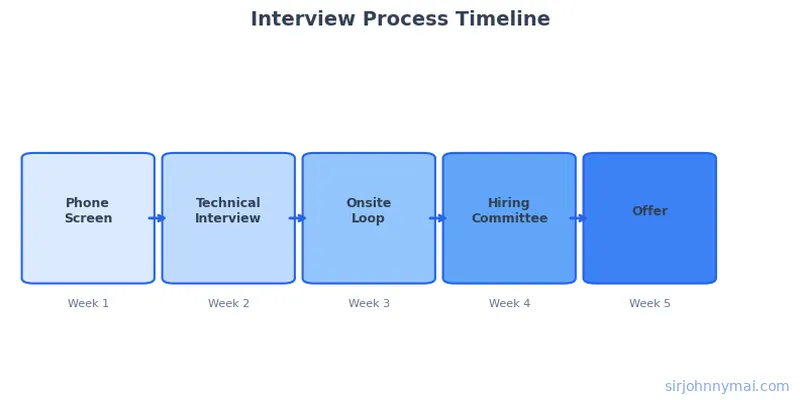
If this skip-level is attached to an internal transfer or promotion packet, expect one manager conversation, one skip-level, and then 3 to 5 calibration touchpoints elsewhere in the process. That means your stories need to survive repetition. If you cannot tell the same story cleanly three times, it is not a ready story.
What should you say in the first two minutes?
Open with the operating thesis, not the biography. In one director skip-level I watched, the strongest employee started with, “I own X, the key risk is Y, and the tradeoff I made was Z.” The room settled immediately because the answer sounded like an owner, not a narrator.
The first two minutes are a sorting mechanism. Senior leaders decide fast whether you think in scopes, dependencies, and decisions, or whether you think in activity and effort. At Amazon, that distinction matters more than charm. The person who can state the current operating problem in one minute usually gets more trust than the person who spends five minutes proving they are hardworking.
Use a structure that sounds like a field report. State the scope. State the outcome. State the current constraint. State the next decision. If you need a sentence template, use this: “I own this area, the most important change in the last 30 days was this, the current risk is this, and the decision I need next is this.” That is enough.
Not your whole career, but the current slice. Not a humble introduction, but a high-signal summary. Not confidence theater, but specific ownership. If you cannot give the leader a clean picture in 60 seconds, you are asking them to do the synthesis work for you, and that is exactly the work they are judging.
How do you answer Amazon-level probing without getting defensive?
Answer directly, then own the edge. In a calibration meeting I sat through, a director asked why a launch slipped by 7 days. The weak answer blamed an upstream team, a dependency, and “process friction.” The strong answer named the decision, the missing signal, and what changed the same week. Only the second answer survived the room.
At Amazon, defensiveness is read as a hidden ownership gap. Leaders do not expect perfection. They expect clean causality. If something failed, they want to know what you saw, what you decided, what you missed, and what you changed afterward. That is not a moral exercise. It is an operating one.
There is a psychological principle at work here. People trust uncertainty that is labeled faster than certainty that is fake. Saying “I do not know yet, but here is what I have ruled out and what I will verify by tomorrow” is stronger than bluffing through the answer. A skip-level is one of the few rooms where calibrated uncertainty can increase trust if it is honest and time-bound.
Not blame, but causality. Not polished reassurance, but precise accountability. Not “we did our best,” but “I made this decision and here is the consequence.” If the issue is genuinely cross-functional, say that clearly. If it was your call, own it clearly. The room can tolerate bad news. It does not tolerate fog.
What should you do after the meeting?
Your follow-up is part of the answer. In one promotion debrief I saw, the candidate who won support was not the one with the best meeting presence. It was the one who sent a 3-line recap within 24 hours, named the two signals that mattered, and came back 7 days later with evidence that the concern had been addressed.
Do not treat the follow-up as politeness. Treat it as a control loop. The skip-level is where the leader forms a belief. The follow-up is where you either reinforce that belief or let it decay into generic memory. Organizations remember what gets closed, not what gets said.
Write back with three things only. What you heard. What you will change. When they will see evidence. That is enough. If you received a concern, align with your manager the same day or next morning. Do not let the signal drift for a week. In Amazon systems, silence is usually interpreted as weak follow-through.
Not a thank-you note, but a control signal. Not a recap of everything discussed, but a summary of the decision-relevant points. Not a promise to improve someday, but a dated commitment. If you can do that cleanly, the skip-level starts to look like leadership material rather than a one-off conversation.
Building Your Interview Toolkit
- Write a 60-second operating summary of what you own, what changed in the last 30 days, and what decision is blocked now.
- Pick two stories only: one conflict story and one recovery story. If you bring five stories, you do not have a point.
- Map each story to the Amazon leadership principles it actually proves, especially Ownership, Dive Deep, and Are Right, A Lot.
- Prepare one direct answer to “What would you do differently?” Leaders listen hard to that question because it separates learning from self-protection.
- Work through a structured preparation system, the PM Interview Playbook covers Amazon LP stories, Dive Deep answers, and real debrief examples from leadership-style interviews.
- Align with your manager on boundaries before the meeting. Know what you can share, what you should frame carefully, and what stays out of scope.
- Draft the 24-hour follow-up note before the meeting happens. If the conversation goes poorly, you will not want to write from scratch.
Where Candidates Lose Points
- Turning the meeting into status theater.
BAD: “We shipped three things this quarter and the roadmap is on track.”
GOOD: “I made the call to defer X by 7 days because Y was the higher-risk dependency, and that decision reduced launch risk.”
The problem is not lack of updates. The problem is that updates do not equal judgment. The leader is not grading activity.
- Using the meeting to complain upward.
BAD: “My manager does not give me enough visibility.”
GOOD: “I own the metric, the blocker is cross-team decision latency, and here is the exact path I am using to move it.”
The room does not reward venting. It rewards ownership under constraint. If you want rescue, you sound junior. If you want leverage, you sound senior.
- Over-rehearsing language and under-rehearsing judgment.
BAD: polished stories with no tradeoff, no consequence, and no lesson.
GOOD: one clean story with the decision, the cost, and what changed afterward.
If the story does not contain a cost, it is probably cosmetic. Amazon leaders are trained to ignore cosmetic answers.
FAQ
- Should I bring a doc to an Amazon skip-level 1on1?
Yes, if it sharpens the conversation. A one-page note with scope, risk, and one decision point is enough. A long doc usually signals that you do not trust your own judgment to hold in real time.
- Is this the right place to ask for promotion or transfer?
Only if the leader opens that door. The skip-level is usually for proving range, not requesting a reward. If you earn trust in the meeting, the promotion or transfer conversation lands better later.
- What if the skip-level feels cold or skeptical?
Treat that as normal. Senior leaders often reserve warmth for people they already trust. Stay direct, avoid self-defense, and follow up with one concrete result within 7 days. Skepticism is not rejection. It is a signal that the room wants evidence.
Ready to build a real interview prep system?
Get the full PM Interview Prep System →
The book is also available on Amazon Kindle.