An MBA does not make you a product manager; it makes you an expensive generalist until you prove specific execution skills. Hiring committees reject MBA candidates who lean on brand prestige rather than demonstrating hands-on product judgment in real-world scenarios. Your degree buys you an interview, but only a portfolio of shipped decisions gets you the offer.
This analysis targets current MBA students and recent graduates from top-tier programs attempting to pivot into product management without prior technical or product experience. It is specifically for those realizing that their campus recruiting pipeline is drying up and that generic "strategy" projects are failing to convert into offers. If you believe your case study competition wins equate to product sense, you are the exact candidate hiring managers debate rejecting in closed-door debriefs.
Why Do MBA Graduates Struggle to Get PM Interviews Despite Prestigious Degrees?
The market rejects MBA candidates because they present as strategists who lack the tactical grit required to ship code and manage engineering trade-offs. In a Q3 debrief I led for a hyperscaler, we passed on a candidate from a top-10 business school because she spent forty minutes discussing market sizing and zero minutes on how she would prioritize a backlog with limited engineering bandwidth. The problem isn't your lack of intelligence; it is your signaling of high-level abstraction over low-level execution.
Engineering leaders do not trust MBAs to understand the cost of delay or the complexity of technical debt. They fear you will treat the product roadmap as a PowerPoint slide rather than a series of painful compromises. You are not being rejected for your background; you are being rejected for your inability to translate business school frameworks into engineering constraints. The degree signals potential, but the interview reveals a lack of grounded reality.
> 📖 Related: Meta SDE career path levels and salary 2026
How Can I Translate My MBA Skills Into Concrete Product Management Evidence?
You must stop listing "leadership" and "strategy" and start documenting specific decisions where you traded off scope for speed or killed a feature due to lack of user signal. During a hiring manager calibration session, a candidate with a strong operations background succeeded only after he described a time he halted a launch because the data showed a 5% drop in retention, ignoring pressure from sales. That is the evidence we need: a moment where you used data to make an unpopular call.
Your resume likely lists projects you led; it needs to list hypotheses you tested and failed. We do not hire for what you planned; we hire for how you reacted when reality diverged from your plan. An MBA teaches you to optimize for the perfect answer; product management requires optimizing for the best available action under uncertainty. Your translation task is to reframe every class project as a product bet with a clear outcome metric.
What Specific Product Sense Gaps Do Hiring Managers Find in MBA Candidates?
Hiring managers consistently identify a lack of user empathy and an over-reliance on second-hand market research as the primary deficit in MBA applicants. I recall a debrief where a candidate from a prestigious program suggested solving a user friction issue by adding a premium tier, completely missing that the core problem was a broken onboarding flow that caused 40% drop-off. The gap is not analytical ability; it is the instinct to look at the user interface before looking at the spreadsheet.
MBAs often assume users behave rationally according to economic models, whereas real users are chaotic and emotional. You likely know how to calculate TAM (Total Addressable Market), but you struggle to articulate why a user would click a specific button. The judgment signal we look for is whether you can simulate the user experience without needing a research team to tell you what is obvious. If your solution requires a six-month study, you have already failed the product sense test.
> 📖 Related: 1on1 for New Grad Engineers at Microsoft: How to Build a Strong Manager Relationship
Is an MBA Actually Necessary for Breaking Into Product Management Roles?
An MBA is not a prerequisite for product management, serving mostly as a career switch mechanism for those lacking direct industry exposure or network access. In numerous intake meetings, I have seen candidates with no advanced degrees outperform MBAs because they had shipped actual features in previous roles, even in non-tech industries. The degree acts as a proxy for general aptitude and communication skills, but it does not grant immunity from the rigorous product sense bar.
Many hiring managers view the MBA as a neutral factor; it gets your foot in the door but adds no weight to the final hiring decision. The real value is the network and the structured time to build a portfolio, not the credential itself. If you are using the MBA as a crutch to avoid building real things, it is a liability. The market rewards output, not input credentials.
How Long Does the MBA to PM Transition Typically Take and What Is the Timeline?
The transition typically spans six to eighteen months post-graduation, depending on whether you secure a rotational program or must lateral from an adjacent role. I have seen candidates land roles immediately through on-campus recruiting, but these are outliers who treated the job hunt as a full-time product launch starting day one of their program. For most, the path involves a six-month stint in business operations, strategy, or analyst roles before transferring internally to a product team.
The timeline extends if you spend your MBA years focusing solely on grades and networking events rather than building side projects or interning in product. Time to offer is directly correlated with the depth of your practical portfolio, not the prestige of your school. Do not expect the degree to automate the process; it merely changes the entry point.
What Salary Should MBA Graduates Expect When Transitioning to Entry-Level PM Roles?
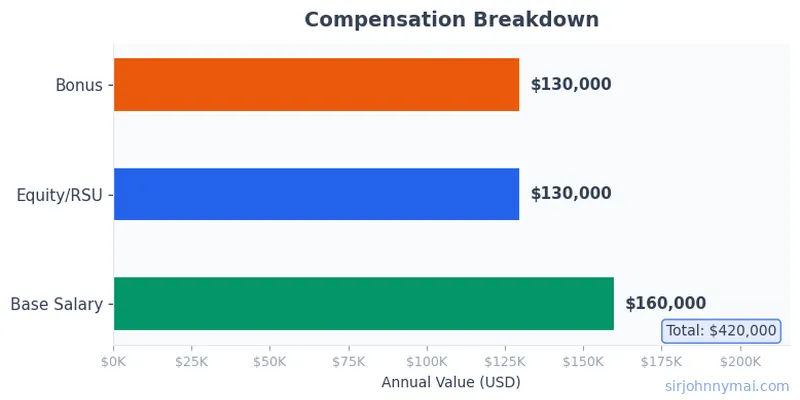
MBA graduates entering product management can expect total compensation packages ranging significantly based on company tier, with base salaries often between $130,000 and $160,000 plus equity and bonuses. However, in a recent compensation calibration, we adjusted an offer down because the candidate's lack of specific product experience meant they would require significant ramp-up time compared to a peer with two years of direct PM work. The "MBA premium" is shrinking as companies realize that theoretical knowledge does not accelerate time-to-impact.
You are not paid for your tuition costs; you are paid for the value you generate from day one. Expect your offer to reflect your actual ability to drive product metrics, not your student loan burden. High compensation is tied to high leverage, and leverage comes from proven execution, not academic pedigree.
Focused Preparation Guide
- Build a tangible portfolio piece where you identified a user problem, proposed a solution, and measured a result, even if it is a mock project.
- Conduct at least ten mock interviews with current product managers who will challenge your assumptions, not just friends from your MBA cohort.
- Rewrite your resume to remove all generic business jargon and replace it with specific product metrics, trade-offs, and shipping outcomes.
- Study the specific product culture of your target company; do not use a Google-style framework for an Amazon-style leadership principle interview.
- Work through a structured preparation system (the PM Interview Playbook covers MBA-specific gap analysis with real debrief examples) to align your business background with product execution standards.
What Separates Passes from Near-Misses
Mistake 1: Leading with Strategy Instead of Execution
BAD: Starting an interview answer by drawing a massive market map and discussing five-year vision without addressing how to build the first version.
GOOD: Immediately defining the user pain point, proposing a minimum viable product (MVP), and explaining how you would measure success in the first two weeks.
Judgment: Strategy without execution is hallucination; hiring managers want to know you can ship, not just dream.
Mistake 2: Ignoring Technical Constraints
BAD: Proposing features that require rebuilding the entire backend architecture or assuming engineering resources are infinite.
GOOD: Acknowledging technical debt, asking about the current tech stack, and prioritizing features that deliver value within existing constraints.
Judgment: A product manager who cannot talk to engineers is a liability; you must understand the cost of code.
Mistake 3: Relying on Authority Instead of Data
BAD: Saying "I think this is right because it worked at my last company" or "The professor said this is the trend."
GOOD: Saying "The data shows a correlation here, but I would run an A/B test to validate causality before scaling."
Judgment: Opinions are cheap; data-backed hypotheses are the currency of product management.
FAQ
Do I need a technical background to transition from an MBA to PM?
No, but you need technical fluency. You do not need to code, but you must understand system architecture, APIs, and the concept of technical debt. Hiring managers will reject you if you cannot discuss trade-offs between speed and scalability. Your job is to bridge business goals and technical reality, not to write the code yourself.
Can I transition to PM directly after graduation without prior tech experience?
It is possible but increasingly difficult without a targeted portfolio. Most successful transitions happen through rotational programs or internal transfers after proving value in adjacent roles like operations or analytics. Do not expect the MBA brand alone to open the door; you must demonstrate product intuition through concrete examples of problem-solving.
How do I explain my lack of direct PM experience in an interview?
Frame your past experiences as product problems you solved, focusing on the decision-making process rather than the job title. Highlight moments where you used data to drive decisions, managed stakeholders, and prioritized conflicting requirements. The title matters less than the mindset; prove you think like a product manager, and the lack of a specific title becomes irrelevant.
Ready to build a real interview prep system?
Get the full PM Interview Prep System →
The book is also available on Amazon Kindle.