Hardware PM interviews reject candidates who treat physical products like software because atoms do not patch overnight. You must demonstrate mastery over supply chain latency, manufacturing yield curves, and the irreversible cost of tooling before writing a single line of code. The hiring committee votes no on anyone who cannot articulate the trade-off between unit economics and time-to-market in a debrief setting.
Why do hardware PM interviews focus so much on supply chain and manufacturing?
The interview focuses on supply chain because a single component shortage can halt a billion-dollar revenue line, making logistics a core product competency rather than a back-office function. In a recent debrief for a senior PM role at a consumer electronics giant, the hiring manager killed a candidate who had excellent user intuition but could not explain how a 12-week lead time on a specific chipset would impact the holiday launch window. The committee realized that in hardware, your product roadmap is held hostage by your vendor's capacity, not your engineering velocity.
This is not about memorizing Incoterms; it is about understanding that your design decisions today dictate your manufacturing reality 18 months from now. The problem isn't your ability to define features, but your failure to recognize that feature complexity exponentially increases assembly failure rates. A software bug can be fixed with a push; a design flaw in a molded part requires scrapping inventory and re-cutting steel tools.
How should I answer system design questions for physical products versus software?
System design for physical products requires you to account for thermal limits, power budgets, and mechanical tolerances that simply do not exist in the cloud. During a loop for a robotics company, a candidate designed a beautiful sensor fusion architecture but forgot to allocate space for the battery and heat sink, rendering the device impossible to assemble. The judge's note stated clearly that the candidate treated the enclosure as infinite space rather than a scarce resource governed by cubic centimeters.
You must demonstrate that you design within a "box" where every gram and millimeter has a cost and a consequence. The constraint is not bandwidth, but the physical laws governing heat dissipation and structural integrity. Unlike software where you can scale horizontally, hardware scales linearly with factory floor space and capital expenditure.
What specific metrics matter most when discussing hardware product success?
Unit economics and yield rates are the primary metrics because they determine whether your product can ever be profitable at scale. In a compensation committee meeting, we debated a candidate who boasted about user engagement but admitted the Bill of Materials (BOM) cost was 85% of the retail price, leaving no margin for R&D amortization or marketing. The consensus was that a hardware PM who cannot drive down BOM or improve yield is a liability, regardless of their vision.
Gross margin is not an afterthought; it is a design constraint you must optimize from day one. The metric that matters is not just adoption, but the contribution margin per unit after accounting for scrap and warranty returns. Software metrics focus on retention; hardware metrics focus on the efficiency of converting raw materials into sellable goods.
How do I demonstrate knowledge of the hardware development lifecycle (HDLC)?
You demonstrate knowledge by mapping your decisions to specific phases like EVT, DVT, and PVT, showing you understand the increasing cost of change over time. I recall a candidate who suggested adding a new color variant during the Design Verification Test phase, unaware that the tooling for the外壳 (housing) was already cut and locked. The hiring manager stopped the interview immediately, noting that the candidate viewed the timeline as flexible rather than a rigid sequence of gate reviews.
You must show that you respect the phase-gate process because skipping a validation step can result in field failures that trigger massive recalls. The lifecycle is not iterative in the same way software is; it is a funnel where options narrow and costs skyrocket with each phase. Mistaking the Prototype phase for Mass Production readiness is a fatal error in judgment.
What are the biggest red flags that cause hiring committees to reject hardware PM candidates?
The biggest red flag is treating hardware iterations as cheap and fast, revealing a fundamental misunderstanding of tooling costs and lead times. In a debrief for a wearable tech firm, a candidate proposed a "beta test" with 10,000 units to gather data, not realizing the cash flow impact and the impossibility of spinning up that volume without validated tooling. The committee viewed this as dangerous naivety that could bankrupt a startup or waste millions in a large corp.
You cannot A/B test physical form factors with the same ease as UI buttons. The assumption that hardware can pivot quickly is a signal that you will burn capital on unusable inventory. Real hardware leaders plan for the worst-case yield and the longest lead time, not the ideal scenario.
Where Candidates Should Invest Time
- Analyze three recent product recalls or delays in your target industry and map the failure back to a specific design or supply chain decision.
- Calculate the rough BOM and target retail price for a simple consumer device to understand the margin pressures inherent in the category.
- Review the differences between EVT, DVT, and PVT phases and prepare a story where you managed a trade-off during one of these gates.
- Study the geopolitical and logistical risks associated with key components like semiconductors, batteries, or rare earth metals for your target sector.
- Work through a structured preparation system (the PM Interview Playbook covers hardware-specific case frameworks with real debrief examples) to ensure your mental models align with physical constraints.
- Practice explaining a technical compromise you made due to thermal, power, or mechanical limitations, focusing on the business impact.
- Prepare to discuss how you would handle a scenario where a key supplier doubles their price or halts production two months before launch.
The Gaps That Kill Strong Applications
Mistake 1: Assuming Software Agility Applies to Hardware
- BAD: "We can just release a patch or iterate on the next batch if users don't like the button placement."
- GOOD: "We need to validate the ergonomic placement with 3D printed prototypes before cutting the injection mold tooling, as changes post-tooling cost $50k and add eight weeks."
Judgment: Treating hardware iterations as low-cost events signals a lack of respect for capital efficiency and timeline reality.
Mistake 2: Ignoring the Supply Chain in Product Design
- BAD: "I designed the ideal feature set based on user needs; the engineering team can figure out how to source the parts."
- GOOD: "I selected these components based on a multi-sourcing strategy to mitigate single-point-of-failure risks, even though it slightly increased the BOM."
Judgment: Separating product design from sourcing strategy is a dereliction of duty in hardware product management.
Mistake 3: Overlooking Unit Economics and Yield
- BAD: "Our goal is to capture market share, so we can worry about profitability once we scale to millions of units."
- GOOD: "We must achieve a 60% gross margin at 10,000 units to sustain operations, requiring a BOM under $45 and a yield rate above 92%."
Judgment: Deferring profitability discussions until scale is achieved is a fast track to running out of cash in capital-intensive industries.
FAQ
Can a software PM transition to hardware PM without an engineering degree?
Yes, but only if you aggressively self-educate on manufacturing constraints and supply chain dynamics to compensate for the lack of formal training. The interview will not test your coding ability but will ruthlessly probe your understanding of why hardware is hard. You must prove you respect the physics and economics of atoms more than the average engineer.
What is the most critical skill gap for software PMs entering hardware?
The inability to plan for long lead times and the high cost of failure is the most critical gap. Software PMs are used to rapid iteration, whereas hardware requires precise upfront definition because changes become exponentially expensive over time. You must demonstrate the discipline to freeze requirements and stick to a rigid schedule.
How many interview rounds should I expect for a hardware PM role?
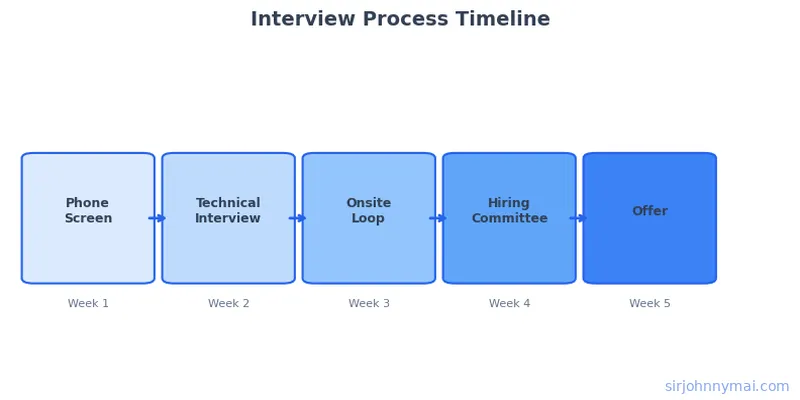
Expect five to seven rounds, including specific deep dives into system design, supply chain scenario planning, and technical feasibility with engineering leaders. The process is longer because the cost of a bad hire in hardware is significantly higher due to the long product cycles. Each round acts as a gate to filter for candidates who understand the weight of physical commitments.
Ready to build a real interview prep system?
Get the full PM Interview Prep System →
The book is also available on Amazon Kindle.