The Rise of EV PMs: Career Paths in the Electric Vehicle Industry: Here is a direct, actionable answer based on real interview data and hiring patterns from top tech companies.
The EV industry does not want generalist product managers; it demands hybrid leaders who can bridge the gap between fast-cycle software and slow-cycle hardware. Success in this sector is determined by your ability to manage the tension between safety-critical engineering and consumer-grade UX. The verdict is simple: if you cannot navigate a hardware dependency map, you are a liability, not an asset.
Do I need a mechanical engineering degree to be an EV Product Manager?
No, but you must possess technical fluency in the hardware-software interface or you will lose the lack of respect from the engineering org. In a recent debrief for a Battery Management System (BMS) role, I saw a candidate with a stellar MBA from Stanford fail because they treated the battery as a black box. The hiring manager stopped the interview when the candidate could not explain the trade-off between energy density and thermal runaway risks.
The problem is not a lack of a degree, but a lack of systemic thinking. In automotive, you are not managing a feature; you are managing a physical constraint. Software PMs are used to infinite scalability, but in an EV, you are fighting for every milliwatt of power and every gram of weight. This is not an exercise in user stories, but an exercise in physics.
The organizational psychology of an OEM is rooted in risk aversion because a software bug in a car can be fatal, whereas a bug in a social app is a nuisance. If you approach an EV role with a move-fast-and-break-things mentality, the safety engineers will isolate you. You must prove you understand the V-Model of development—where verification and validation are not afterthoughts, but the core of the product lifecycle.
> 📖 Related: Lightspeed product manager career path and levels 2026
What are the most high-growth specializations for PMs in the automotive sector?
The highest leverage roles are currently in Charging Infrastructure, Software Defined Vehicle (SDV) Architecture, and Autonomous Driving (ADAS) UX. I recently sat in a headcount planning session where the VP of Product shifted three roles from Interior Trim to Charging Ecosystems. The reasoning was cold: the vehicle is a commodity, but the energy ecosystem is the moat.
Charging PMs are not managing a plug; they are managing a complex orchestration of grid loads, payment gateways, and latency. This is not a logistics problem, but a platform problem. If you can solve the anxiety of range through predictive routing and API integrations with third-party chargers, you become indispensable to the C-suite.
SDV PMs are the most critical for the long-term survival of legacy OEMs. They are tasked with decoupling hardware from software so that a car can receive an Over-the-Air (OTA) update that improves braking distance or adds a new entertainment feature. In these roles, the challenge is not the code, but the organizational inertia of teams that have spent 50 years building cars in 5-year cycles.
ADAS PMs are moving away from the race for Level 5 autonomy and toward the reality of Level 2+ safety. The industry has realized that the gap between 99% and 99.999% reliability is an infinite chasm. The winning PMs here are those who can define the hand-off between the AI and the human driver—a problem of cognitive load, not just sensor fusion.
How does an EV PM interview differ from a standard FAANG PM interview?
EV interviews prioritize system constraints and cross-functional negotiation over pure product sense or growth hacking. In a FAANG interview, I might ask how to increase engagement for a feature. In an EV interview, I ask how you handle a situation where the hardware team tells you a critical sensor is delayed by six months, but the vehicle launch date is fixed.
The evaluation is not about your ability to brainstorm, but your ability to make hard trade-offs. I remember a candidate who tried to use a standard Google-style framework to design a dashboard. They focused on the UI layout and user personas. The interviewer, a veteran hardware lead, cut them off and asked how they would account for glare in the Sahara Desert and glove-use in the Arctic.
This is the fundamental shift: the environment is the primary user. You are not designing for a screen in a climate-controlled room, but for a high-speed kinetic object in a chaotic physical world. The interviewers are looking for signals of durability and reliability. They don't want a visionary; they want a closer who can ship a safe product on a rigid timeline.
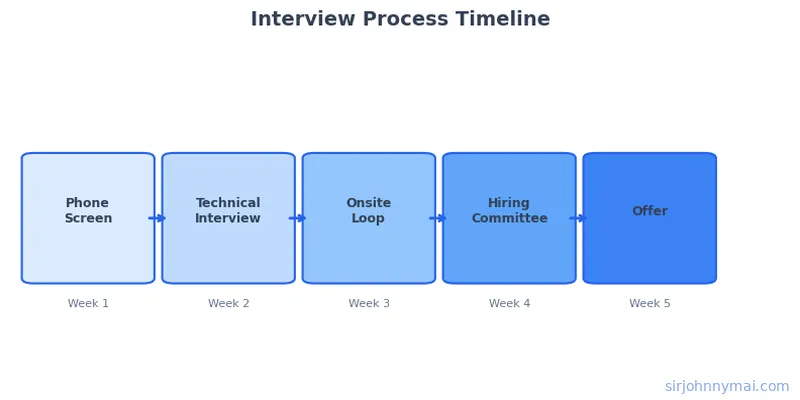
The salary structures also differ. While base salaries for Senior PMs in the EV space often mirror FAANG (ranging from 180k to 260k USD), the equity is far more volatile. You are often betting on a company's ability to scale manufacturing, which is a different risk profile than betting on a software ecosystem. The interview process typically spans 5 to 7 rounds, including a deep-dive technical review and a cross-functional leadership screen.
> 📖 Related: Anthropic TPM Career Path 2026: How to Break In
What is the actual career trajectory for a PM in the EV industry?
The path moves from Component PM to System PM, and eventually to Vehicle Program Manager or VP of Product. A Component PM focuses on a narrow slice, such as the infotainment system or the thermal loop. A System PM manages the interaction between these slices—for example, how the infotainment system communicates battery state-of-charge to the driver.
The jump from System PM to Vehicle Program Manager is where most fail because it requires a shift from product thinking to industrial thinking. You are no longer optimizing a feature; you are optimizing a Bill of Materials (BOM). I once saw a high-performing PM struggle in this transition because they kept proposing high-cost sensor upgrades that destroyed the vehicle's margin.
The ultimate goal in this industry is not just to be a product leader, but to be a platform architect. The industry is moving toward a model where the car is a subscription service. The PMs who will lead the next decade are those who can bridge the gap between the physical asset (the car) and the digital service (the subscription), effectively turning a one-time hardware sale into a lifetime value stream.
Building Your Interview Toolkit
- Map out the current EV value chain, specifically identifying the dependencies between cell chemistry, pack design, and vehicle range.
- Build a mental library of hardware trade-offs (e.g., cost vs. weight vs. durability) to avoid sounding like a pure software PM.
- Study the regulatory environment for automotive safety (ISO 26262) to speak the language of the safety engineers.
- Practice the "Hardware Delay" scenario: develop a framework for descoping features without moving the SOP (Start of Production) date.
- Work through a structured preparation system (the PM Interview Playbook covers the system design and trade-off frameworks with real debrief examples) to sharpen your judgment signals.
- Analyze three competing EV platforms and identify exactly where their software fails to meet the hardware's potential.
Blind Spots That Sink Candidacies
Mistake 1: Treating the car like a smartphone on wheels.
Bad: Proposing a weekly update cycle for the braking system to iterate based on user feedback.
Good: Proposing a tiered update strategy where infotainment is updated weekly, but safety-critical systems follow a rigorous 6-month validation cycle.
Mistake 2: Over-indexing on UX and under-indexing on the BOM.
Bad: Suggesting a massive 50-inch curved display because it looks futuristic in a slide deck.
Good: Analyzing the power draw and heat dissipation of a display and how it impacts the overall vehicle range.
Mistake 3: Using software-only terminology in cross-functional meetings.
Bad: Telling a mechanical engineer that a physical part is just a "blocker" that can be "pivoted" in the next sprint.
Good: Acknowledging the lead times for tooling and dies, and working backward from the hard freeze date to set software milestones.
FAQ
Do EV PMs make more than traditional automotive PMs?
Yes, because the talent pool is being poached from Big Tech. EV PMs generally command a 20-40% premium over legacy internal combustion engine PMs due to their expertise in software integration and agile methodologies.
Which is harder: transitioning from software to EV, or automotive to EV?
Software to EV is harder. Automotive PMs already understand the constraints of physical production and safety regulations. Software PMs must unlearn the habit of instant deployment and learn to respect the laws of physics and supply chain lead times.
What is the most important metric for an EV PM?
It is not DAU or MAU, but the balance between Vehicle Margin and Feature Value. If a feature increases the cost of the car by 500 dollars but doesn't increase the perceived value or safety by a proportional amount, it is a failure.
Ready to build a real interview prep system?
Get the full PM Interview Prep System →
The book is also available on Amazon Kindle.