Uber PM behavioral interviews test whether you can navigate ambiguity, drive impact without authority, and recover from failure — not whether you have a polished story. The interview typically spans 3-4 rounds with 2-3 behavioralfocused sessions, and your answers will be evaluated against the company's 14 cultural attributes. Prepare 5-7 stories that demonstrate ownership, obsession with the user, and operational excellence, but never script your responses — interviewers detect rehearsed answers immediately.
What Behavioral Questions Does Uber Ask PM Candidates?
Uber behavioral questions fall into three categories: leadership without authority, handling ambiguity, and recovering from failure. The most common questions include "Tell me about a time you had to influence someone without direct reporting authority," "Describe a project where the requirements changed mid-way," and "Give me an example of a mistake you made and how you fixed it."
In a 2023 hiring committee debrief I observed, a candidate with excellent technical skills was rejected because every story centered on what they personally built, not what they enabled others to build. The hiring manager said: "We need PMs who multiply the team, not just contribute individually." That's the judgment signal at Uber.
The follow-up questions are where candidates fail. After your initial story, expect "What would you do differently?" and "How did that experience change how you approach [similar situation]?" Uber interviewers are trained to dig into your decision-making process, not just the outcome. Prepare to defend your choices with data, but also acknowledge what you couldn't measure.
> 📖 Related: Uber vs Lyft PM Career Path: Insider Comparison
How Does Uber Evaluate Leadership in PM Interviews?
Uber evaluates leadership through the lens of their 14 cultural attributes, with "Be an Owner" and "Champion the Mission" carrying the most weight in behavioral interviews. Your stories should demonstrate that you treated the company's problems as your personal responsibility and that you could articulate why your work mattered to Uber's broader mission of transportation and logistics.
Not every leadership story needs to be about managing a team. In fact, some of the strongest answers come from situations where you had no formal authority. A candidate I debriefed once described how she aligned three engineering teams on different priorities by mapping each team's OKRs to a company-wide initiative, then presenting the connection to leadership. She didn't manage any of those teams. She got an offer.
The evaluation rubric at Uber has four levels: "Does not meet" (no clear ownership or impact), "Meets" (clear story but limited scale), "Exceeds" (demonstrated influence across teams with measurable outcomes), and "Exceptional" (led through ambiguity and created lasting change). Most candidates land in "Meets" because their stories are too narrow. To reach "Exceeds," your story needs to show that you created leverage — that your work multiplied the impact of people around you.
What Is the Uber PM Interview Timeline?
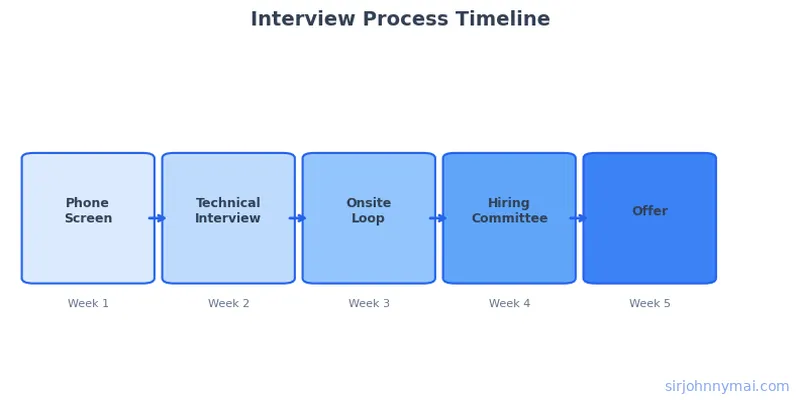
The Uber PM interview process typically takes 2-4 weeks from initial recruiter screen to offer decision, with 4-5 rounds total. The structure usually includes: a recruiter phone screen (30 minutes), a hiring manager screen (45-60 minutes), and 2-3 final round interviews with cross-functional partners including engineering, design, and operations.
After your final round, expect a decision within 3-5 business days. If you don't hear back within a week, follow up with your recruiter — delays often mean the committee is debating, not that you've been rejected. In one case I know of, a candidate received an offer 12 days after their final round because the hiring manager was traveling and the committee needed to reconvene.
The behavioral portion is distributed across all rounds, not isolated to a single interview. Your first call with the recruiter will include behavioral questions. Your hiring manager screen will be 50% behavioral. Your final round will include at least one dedicated behavioral interview alongside product sense and execution discussions.
> 📖 Related: Uber vs Lyft PM Compensation: Real Numbers Compared
How Should I Answer "Tell Me About Yourself" at Uber?
The "Tell me about yourself" question at Uber is not a warm-up — it's a signal about your self-awareness and ability to prioritize. Most candidates treat it as a chronological recap of their resume. That's a mistake. Uber interviewers want to hear a narrative that connects your past experience to why you're a fit for this specific role.
Structure your answer in three parts: your origin story (why you became a PM), your growth arc (one pivot point that changed your approach), and your forward thesis (why Uber). Keep it under 90 seconds. The origin story should reveal a motivation that aligns with Uber's mission — solving transportation inefficiencies, building products at scale, or creating access to opportunity.
A candidate I coached answered this question by describing growing up in a city with no reliable public transit and watching his grandmother struggle to access healthcare. He connected that to wanting to build products that increase mobility access. Then he traced his career toward increasingly complex logistics problems. The hiring manager told him afterward that this was the most grounded "Tell me about yourself" they'd heard in months. He got the offer.
The mistake is trying to impress with every accomplishment. The judgment signal is whether you can tell a coherent story about who you are and why this role matters to that story.
What Are Uber's Cultural Values and How Do They Test Them?
Uber's cultural values are tested through behavioral questions that probe for specific attributes: "Be an Owner" (do you treat company problems as personal?), "Champion the Mission" (can you articulate why this work matters?), "Always Be Hustlin'" (do you drive results with limited resources?), and "Customer Obsession" (do you build for users or for metrics?).
The most commonly tested attribute is "Be an Owner." Expect questions like "Describe a time you fixed a problem that wasn't in your job description" or "Tell me about a decision you made that impacted the business." The key is demonstrating that you took responsibility for outcomes, not just tasks.
"Customer Obsession" shows up in questions about trade-offs. If you had to choose between improving a feature for power users versus acquiring new users, what would you do and why? The right answer depends on the business context — but interviewers are evaluating whether you can reason from user needs rather than just stating a preference.
One thing that trips candidates up: they try to reference Uber's values explicitly in their answers. That's unnecessary and can feel performative. Instead, let your stories naturally demonstrate the attributes. The interviewer will do the mapping.
How Many Rounds Are in Uber PM Interviews?
Uber PM interviews typically have 4-5 rounds: recruiter screen, hiring manager screen, and 2-3 final round interviews. The exact count varies by team and level — senior PM roles may include an additional executive round.
Each round has a different focus. The recruiter screen verifies basic fit and timeline. The hiring manager screen assesses whether you're a strong behavioral and cultural match. The final round includes product sense (how you solve problems), execution (how you drive results), and behavioral (leadership and values) components, often with different interviewers for each.
One round that surprises candidates: the "partner" interview, where you'll meet with someone from engineering, design, or operations. This isn't a formality — they're evaluating whether you can collaborate cross-functionally. Expect questions like "How would you convince an engineer to work on your feature instead of theirs?" or "Describe a time you disagreed with design and how you resolved it."
The overall process is designed to evaluate you from multiple angles. No single interview is make-or-break, but the behavioral component appears in every round, so you can't afford to be weak there.
The Prep That Actually Matters
- Identify 5-7 stories from your experience that demonstrate ownership, influence without authority, handling ambiguity, and recovering from failure. Each story should have a clear beginning, middle, and end with measurable impact.
- Map each story to Uber's cultural attributes. You don't need to mention the attributes explicitly, but you should know which ones your stories demonstrate.
- Practice answering "Tell me about yourself" with a three-part narrative: origin, growth arc, forward thesis. Keep it under 90 seconds and connect your story to why Uber.
- Prepare for follow-up questions by documenting what you would do differently, what you learned, and how the experience changed your approach. Uber interviewers dig deeper than surface-level stories.
- Review Uber's recent product launches, blog posts, and CEO communications to understand current priorities. Reference specific initiatives naturally in your answers where relevant.
- Work through a structured preparation system — the PM Interview Playbook covers Uber-specific behavioral frameworks with real debrief examples from candidates who went through the process.
- Do a mock interview with someone who has conducted PM interviews at Uber or similar companies. Get feedback on whether your stories sound authentic or rehearsed.
Where Candidates Lose Points
BAD: Scripting every answer word-for-word. GOOD: Knowing the structure and key points of your stories, but staying flexible enough to adapt when interviewers ask unexpected follow-up questions.
BAD: Telling stories that only highlight what you personally built. GOOD: Telling stories that show how you enabled others, influenced without authority, or created leverage for your team.
BAD: Answering "Tell me about yourself" with a chronological resume recap. GOOD: Telling a narrative that connects your personal motivation to your career path to why Uber specifically matters to you.
BAD: Claiming you have no failures or weaknesses. GOOD: Being specific about a real mistake, what you learned, and how you changed — this is what interviewers actually want to hear.
BAD: Memorizing Uber's cultural values and dropping them into answers. GOOD: Letting your stories naturally demonstrate the attributes without explicitly naming them; the interviewer will make the connection.
FAQ
How long does the Uber PM interview process take?
The process typically takes 2-4 weeks from recruiter screen to offer, with 4-5 interview rounds. After your final round, expect a decision within 3-5 business days. Delays beyond a week usually mean the committee is still deliberating, not that you've been rejected — follow up with your recruiter if you haven't heard anything.
What behavioral questions are asked most frequently at Uber?
The most common questions test ownership ("Tell me about a time you fixed something that wasn't your job"), influence without authority ("How did you convince someone to do something they didn't want to do?"), handling ambiguity ("Describe a project where requirements changed mid-way"), and failure recovery ("Tell me about a mistake and how you fixed it"). Follow-up questions asking "What would you do differently?" are where many candidates fail.
How does Uber evaluate cultural fit in behavioral interviews?
Uber evaluates cultural fit through their 14 cultural attributes, with "Be an Owner" and "Champion the Mission" carrying the most weight. Interviewers use a four-level rubric: Does Not Meet, Meets, Exceeds, and Exceptional. Most candidates land in "Meets" because their stories are too narrow. To reach "Exceeds," demonstrate that you created leverage — that your work multiplied the impact of people around you.
Ready to build a real interview prep system?
Get the full PM Interview Prep System →
The book is also available on Amazon Kindle.