IBM offers a structured, yet often slow, path for Product Managers, prioritizing internal longevity over rapid external mobility; candidates must actively navigate its complex matrix to demonstrate impact beyond immediate product scope. Growth primarily comes from expanding influence and leading more ambiguous, cross-organizational initiatives, not merely delivering features. Success is measured by sustained internal value creation, demanding a long-term strategic mindset.
This article is for ambitious Product Managers currently at IBM, or those considering a move to IBM, who seek to understand the actual mechanisms of career advancement within a large, established enterprise. It is specifically for individuals who recognize that traditional "move fast and break things" startup mentalities or pure FAANG-style product development frameworks often fail within IBM's ecosystem. The insights provided are for those prepared to engage with organizational politics, long sales cycles, and complex stakeholder landscapes, seeking a deliberate and often deeply specialized career trajectory.
How do Product Managers grow their careers at IBM?
Internal growth at IBM is a deliberate, multi-year progression, heavily reliant on sustained performance and navigating the matrixed organization, not simply delivering features. The IBM system rewards those who can consistently articulate and execute on a vision that aligns with broader strategic imperatives, often across multiple business units. Advancement is less about individual product success and more about the ability to influence and orchestrate outcomes through others, demonstrating mastery over the "adjacent possible"—making calculated, lateral shifts that build a broader skill set within IBM's vast ecosystem.
In a Q3 debrief for a Senior PM role, a candidate from IBM, despite deep expertise in a specific software offering, struggled to articulate how their product strategy connected to the broader enterprise portfolio. The feedback wasn't about their technical knowledge, which was strong, but their perceived inability to operate beyond their silo.
The hiring committee concluded they were an expert, but not yet a leader capable of driving cross-organizational impact. This reflects a core truth: IBM values PMs who can connect the dots across its fragmented product landscape. Growth isn't merely about managing a larger product; it's about managing a larger set of relationships and organizational dependencies.
The progression often involves taking on projects with increasing levels of ambiguity and organizational complexity. A Product Manager might move from owning a single component of a larger product to managing an entire product line, or even a portfolio of products. This shift demands not just deeper product knowledge, but a significant upgrade in stakeholder management, executive communication, and the ability to drive consensus among disparate groups. The problem isn't your technical skill; it's your organizational leverage. You are not just building software; you are building internal alliances.
> 📖 Related: Pinterest AI PM Career Path 2026: How to Break In
What are the typical career paths for an IBM Product Manager?
IBM's career paths for Product Managers generally follow established corporate hierarchies, emphasizing increasing scope, team leadership, or deep technical specialization, rather than purely rapid, iterative product launches. The typical trajectory progresses from Product Manager to Senior Product Manager, then potentially to Group Product Manager, Principal Product Manager (a deep individual contributor track), or Director of Product Management. These paths are well-defined within IBM's internal talent frameworks, but the pace is often slower than in more agile tech companies.
The "two-pizza team" paradox, while seemingly at odds with IBM's scale, highlights how effective growth often comes from operating within smaller, empowered units and demonstrating full ownership within that scope.
A PM might start managing a feature set within a larger product, then ascend to managing the entire product, before taking on a portfolio of products or leading a team of PMs. The key differentiator for advancement isn't just delivering features, but demonstrating an ability to strategically position a product, articulate its market value, and secure internal resources for its development and launch.
During a hiring manager conversation about a Principal PM role, the distinction was drawn between a "technical PM" and a "business PM" track at IBM. The technical PM track emphasizes deep architectural understanding, API strategy, and developer ecosystem engagement, often leading to roles like Chief Product Architect or Distinguished Engineer.
The business PM track, conversely, focuses on market analysis, pricing, GTM strategy, and P&L ownership, leading towards roles like Product Line Executive or General Manager. The judgment here is that candidates must consciously choose and cultivate expertise within one of these specific, often divergent, growth vectors. Not pursuing one with intentionality will lead to stagnation.
What skills are most important for career advancement as an IBM Product Manager?
Advancement within IBM demands a mastery of internal navigation, cross-functional influence, and a deep understanding of enterprise-level product complexities, beyond merely delivering functional features. While core product management skills like market analysis and roadmap planning are foundational, the ability to build and maintain robust internal relationships is paramount. This environment requires a nuanced approach to "internal market-making"—successful IBM PMs don't just build products; they build internal coalitions and secure buy-in across vast organizational silos to ensure their product's success.
A strong IBM PM must become adept at translating technical capabilities into business value for diverse internal stakeholders, including sales, services, and other product lines. This means developing exceptional communication skills, particularly in tailoring messages to different audiences, from engineers to executive leadership. The problem isn't lacking ideas; it's failing to garner the necessary support to realize them. You must cultivate a reputation as a trusted partner, not just a product owner.
In a hiring committee discussion, an IBM candidate was being evaluated for a Director-level position. Their resume highlighted numerous product launches and revenue achievements.
However, the committee's debate centered not on their "impact" (what they delivered), but their "influence" (how they achieved those deliveries within IBM's complex structure). Specific questions arose about how they navigated conflicts with sales, secured engineering resources from a shared pool, or gained buy-in from a senior leader whose product might be displaced. The judgment was clear: direct results are insufficient; the path and political acumen matter more for senior roles.
> 📖 Related: From UIUC Engineering to Cisco PM: The Non-FAM Path That Works
What are the salary expectations and promotion timelines for IBM Product Managers?
IBM's compensation and promotion cycles for Product Managers are typically predictable and tied to a structured performance review system, often lagging FAANG in top-tier salary bands but offering stability.
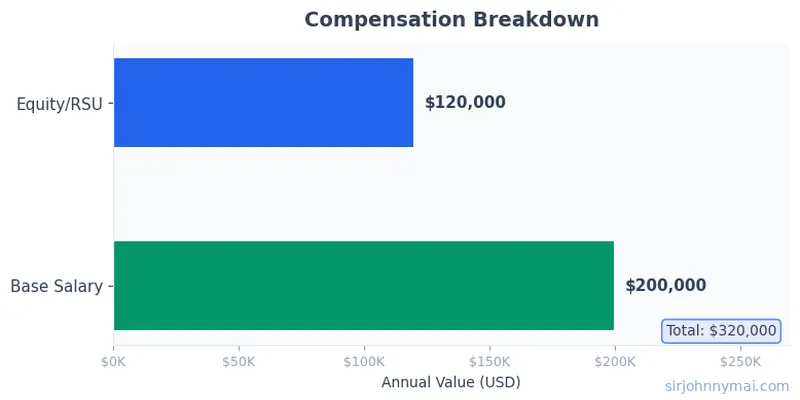
A Product Manager at IBM can expect a salary range generally from $120,000 to $180,000, while a Senior Product Manager typically earns between $160,000 and $220,000, with Group PMs or Directors ranging from $200,000 to $300,000+, excluding significant stock grants that are common in FAANG. These figures are base and bonus, with stock typically forming a smaller component than at hyper-growth tech companies.
Promotions generally occur every 2-4 years, provided consistent high performance and demonstrated readiness for the next level of responsibility. This timeline is significantly longer than the 1-2 year cycles often seen at rapidly scaling startups or even some FAANG divisions. The "golden handcuffs" effect is real within IBM; while not always market-leading in raw compensation, the stability, comprehensive benefits, and defined career progression can create inertia, making external moves less appealing despite potentially higher compensation elsewhere.
During a compensation negotiation for a Principal PM role at a FAANG company, the candidate's IBM compensation history directly informed the low end of the offered band. While their experience was valued, the committee noted that IBM's compensation structure, particularly its equity component, was not directly comparable to FAANG. This isn't a judgment on individual worth, but a reflection of differing compensation philosophies and market positions. IBM offers a reliable, steady climb, not a speculative rocket ship.
How does IBM compare to FAANG for Product Manager career growth?
IBM's career growth model for Product Managers is fundamentally different from FAANG, favoring methodical progression and deep enterprise domain expertise over rapid iteration and broad consumer impact. While FAANG companies often prioritize speed, direct consumer engagement, and individual product ownership with high autonomy, IBM's model emphasizes the ability to integrate products into larger enterprise solutions, manage complex stakeholder ecosystems, and drive long-term strategic value within a vast, established market. The problem isn't one model being "better," but rather a fundamental mismatch in operating principles.
The "organizational gravity" principle is acutely relevant here; IBM's sheer size and legacy create a powerful gravitational pull, often making internal pivots more viable and rewarding than external leaps for those deeply embedded. A PM at IBM might spend years mastering the intricacies of a specific industry vertical (e.g., healthcare, finance) or a particular technology stack (e.g., AI/ML for enterprise, hybrid cloud). This depth is a significant asset within IBM but can be perceived as overly specialized by FAANG companies looking for broader, more agile product experience.
A hiring manager once expressed frustration with an IBM candidate who couldn't articulate an "MVP" in a FAANG-contextualized interview, because their world involved multi-year enterprise releases where "minimum viable" was a multi-million dollar, months-long effort. This isn't a failure of the candidate, but a clash of paradigms. IBM growth is about mastering complexity and longevity; FAANG growth is about velocity and market disruption. Candidates must understand which paradigm they are operating within and adapt their narratives accordingly.
The Prep That Actually Matters
- Master IBM's internal organizational structure and key strategic initiatives: Identify the critical business units and their interdependencies.
- Cultivate strong relationships with cross-functional leaders: Proactively schedule 1:1s with peers and senior leaders outside your immediate product team to understand their priorities.
- Develop a narrative of your impact that extends beyond feature delivery: Focus on business outcomes, revenue generated, or efficiency gains, not just product launches.
- Identify and articulate your chosen career track: Decide whether your ambition lies in deep technical specialization (Principal PM) or broader leadership and P&L ownership (Director/Executive).
- Work through a structured preparation system (the PM Interview Playbook covers enterprise product strategy and stakeholder management frameworks with real debrief examples) to refine your communication of complex scenarios.
- Seek out opportunities to lead initiatives that span multiple product lines or geographies: Demonstrate your ability to navigate ambiguity and drive consensus.
- Understand the financial implications of your product decisions: Connect your roadmap items directly to P&L impacts, cost savings, or new revenue streams.
Traps That Cost Candidates the Offer
- Focusing solely on individual product features rather than enterprise value:
BAD: "I launched feature X which had Y usage." (Describes output, not outcome)
GOOD: "I led the development of feature X, which enabled our enterprise customers to reduce their operational costs by Z%, directly contributing $W million in new ARR through increased adoption of our core platform." (Connects feature to business value and P&L impact)
- Neglecting internal networking and stakeholder influence:
BAD: "My product was technically superior, but sales struggled to position it." (Blames external factors, lacks ownership of cross-functional success)
GOOD: "Recognizing a gap in sales enablement, I proactively partnered with the regional sales leaders to co-develop new messaging and training modules, resulting in a 15% increase in qualified pipeline for my product in Q4." (Demonstrates initiative, collaboration, and influence)
- Expecting rapid promotion cycles akin to startups or FAANG:
BAD: Constantly seeking a promotion after 18 months, leading to frustration and perceived stagnation.
GOOD: Strategically planning for a 3-year growth trajectory, identifying key skills and projects needed to demonstrate readiness for the next level within IBM's established timeline, and focusing on sustained, incremental impact.
FAQ
What are the key differences in leadership style at IBM for PMs compared to FAANG?
IBM leadership for PMs emphasizes consensus-building, long-term strategic alignment, and navigating a vast matrixed organization, contrasting with FAANG's often more autocratic, rapid decision-making, and direct ownership models. IBM leaders must master the art of influence without direct authority over all resources.
Is it possible for an IBM Product Manager to transition to a FAANG company?
Yes, but it requires deliberate framing; IBM PMs must translate their enterprise experience into terms FAANG understands, focusing on impact, user empathy (even for enterprise users), and agility within constraints. The challenge isn't capability, but articulation and adaptation to a different cultural lexicon.
What is the role of technical depth in career growth for an IBM Product Manager?
Technical depth is critical at IBM, often more so than at many consumer-focused FAANG roles, particularly for Principal or Architect tracks; it enables credible conversations with engineers and enterprise clients, but must be balanced with business acumen and strategic thinking for leadership roles. Pure technical expertise without business context will limit advancement.
Ready to build a real interview prep system?
Get the full PM Interview Prep System →
The book is also available on Amazon Kindle.