Designers fail the transition to Product Management not because they lack product sense, but because they cannot surrender ownership of the solution to the data. The market rewards designers who can articulate the business constraint behind a user need, not those who simply advocate for better UX. Your portfolio proves you can solve for the user; your interview must prove you can solve for the company.
From Designer to PM: Navigating the Career Path
Can a designer really become a successful Product Manager?
Designers become successful Product Managers only when they stop treating user experience as the primary objective and start treating it as one variable in a broader business equation. In a Q3 debrief I chaired for a candidate moving from a top-tier design agency to a FAANG PM role, the hiring committee rejected her because she spent 45 minutes defending the aesthetics of a feature rather than addressing the revenue risk of launching it.
She argued from a place of user purity; the business needed an argument about market timing and resource allocation. The problem isn't your design background — it's your inability to decouple user delight from business viability. A designer thinks about how to make a button work; a PM thinks about whether the button should exist at all given the opportunity cost.
The transition works only if you can demonstrate that you have made painful trade-offs where user experience was degraded to satisfy a business metric. I recall a candidate who described cutting a beloved onboarding animation because it increased drop-off rates on low-bandwidth networks, directly impacting activation numbers in emerging markets. That story landed because it showed restraint, not advocacy.
Most designer-to-PM candidates fail because they present case studies where the user won every time. Real product management is about the times the user lost so the business could survive. Your narrative must shift from "I fought for the user" to "I calculated the risk of ignoring the user against the cost of implementation."
The organizational psychology at play here is the shift from craft identity to outcome identity. As a designer, your value is tied to the quality of your output. As a PM, your value is tied to the impact of the outcome, regardless of who produced the work.
If you cannot separate your ego from the pixel-perfect mockup, you will be eaten alive in a cross-functional environment. The candidates who succeed are the ones who view design as a tool in the toolbox, not the definition of the job itself. They speak the language of leverage, not just aesthetics.
What specific skills transfer from design to product management?
The only design skills that transfer effectively to product management are qualitative data synthesis and the ability to visualize abstract systems for stakeholders. In a hiring committee meeting for a senior PM role, a former designer's ability to map out a complex stakeholder ecosystem on the whiteboard saved them, while their lack of SQL knowledge was forgiven as trainable.
The insight here is counter-intuitive: your ability to draw is less important than your ability to use visuals to align conflicting business interests. Most candidates think their empathy is the transferable skill, but empathy without a framework for decision-making is just noise.
The critical distinction is not between designing interfaces and managing roadmaps, but between solving for a single user journey and optimizing for a system of constraints. A designer solves for the happy path; a PM solves for the edge cases that break the business model.
I watched a candidate fail because they designed a beautiful solution for the 80% use case but had no plan for the 20% of users who generated 50% of the support costs. The hiring manager noted that the candidate was still thinking like a creator, not an operator. You must demonstrate that you can identify the invisible constraints—legal, technical, financial—that dictate product shape.
Your research skills transfer only if you can pivot from "what users want" to "what users will pay for or engage with consistently." In one debrief, a candidate cited user interviews to justify a feature, but when pressed on the sample size and potential bias, they crumbled. A PM must be a skeptic of their own data, whereas a designer is often an advocate for their findings.
The shift requires you to attack your own assumptions with the same vigor you used to defend them. If you cannot quantify the confidence level of your qualitative data, it is useless in a prioritization debate.
How do FAANG companies evaluate designer candidates for PM roles?
FAANG companies evaluate designer candidates for PM roles by intentionally stress-testing their willingness to kill their own darlings. During a loop at a major tech giant, I presented a scenario where the user-friendly solution directly contradicted the monetization strategy. The candidate, a former lead designer, tried to find a third way to preserve the UX, missing the point that the exercise was about making a hard business call. The judgment signal we looked for was the speed at which they accepted the business constraint and pivoted to mitigation, not avoidance.
The evaluation framework is not X, but Y: we are not testing if you can design a better mousetrap, but if you can decide not to build a mousetrap when the market demands cheese. In a specific hiring debrief, a candidate was rejected because their solution to a latency problem was to "improve the loading state design" rather than questioning the architectural decision causing the latency.
The committee noted they were optimizing the symptom, not the root cause. This is the designer trap: polishing the interface when the product strategy is flawed.
Recruiters and hiring managers look for evidence that you can operate in ambiguity without a visual crutch. Designers often rely on mockups to think; PMs must think in logic trees and probability.
In an interview setting, if you reach for the whiteboard to draw a UI before you've defined the success metric, you signal a lack of strategic depth. The bar is higher for you because you have to prove you aren't just a "UI PM." You must demonstrate fluency in metrics, experimentation, and technical trade-offs that have nothing to do with pixels.
What is the biggest mindset shift required for this transition?
The single largest mindset shift required is moving from being the advocate for the user to being the steward of the business risk. In a tense conversation with a hiring manager, I defended a candidate who admitted they would launch a "ugly" feature if it solved the core metric, provided the long-term brand equity wasn't permanently damaged.
This willingness to compromise on craft for the sake of velocity and data collection is anathema to most designers but essential for PMs. The problem isn't your care for quality — it's your definition of quality now including speed and cost.
You must internalize that a good product decision is often the one that feels slightly uncomfortable to your design sensibilities. I recall a debate where a designer-turned-PM argued against a necessary but intrusive permission request, while the winning candidate argued for a phased rollout to measure the churn impact. The latter understood that product management is the art of managing trade-offs, not maximizing a single dimension. Your new job is to balance the triangle of user value, business viability, and technical feasibility, knowing that one corner will always be compromised.
The psychological hurdle is the loss of tangible ownership. As a designer, you own the Figma file. As a PM, you own a spreadsheet and a vision that engineers and designers will interpret and change.
In a debrief, a candidate expressed frustration that their "vision" was altered by engineering constraints. The feedback was blunt: if you need to control the implementation to feel successful, you are not ready for PM. Your success is now entirely derivative of others' execution. You must find satisfaction in the team's output, even if it looks different from your mental model.
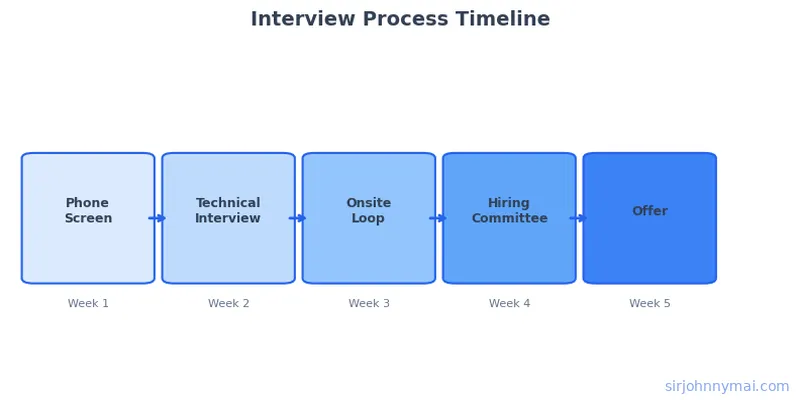
What does the interview process look like for a designer applying to PM roles?
The interview process for a designer applying to PM roles mirrors the standard PM loop but with heightened scrutiny on the analytical and strategic segments. You will face a Product Sense question, but instead of asking you to design a feature, they will ask you to define the success metrics and potential failure modes of a feature you designed.
In a recent loop, a candidate was asked to critique their own portfolio piece from a business perspective, specifically identifying where they over-engineered the solution. This "anti-portfolio" exercise reveals whether you can step outside your creator bias.
Expect a dedicated Estimation or Analytics round where your design background offers no shield. You will be asked to size a market or analyze a dataset to find a drop-off point.
The bar is the same as for any other candidate; there is no curve for designers. In fact, the expectation is often higher because the assumption is that you are "creative," so failing to structure a logical argument is penalized more heavily. One candidate failed because they tried to "design" a solution to a data problem rather than breaking it down mathematically.
The Behavioral round will focus on conflict resolution, specifically times you disagreed with data or business goals. We are not looking for stories where you convinced a stakeholder to adopt your design.
We want to hear about a time you were wrong, or a time you had to support a decision you hated because the data supported it. A specific scene from a debrief involved a candidate who described forcing a design change through sheer persistence; the committee flagged this as a lack of collaboration and data-driven decision making. They wanted to hear about listening, adapting, and aligning, not bulldozing.
Focused Preparation Guide
- Audit your past projects specifically for business trade-offs: Identify three instances where you compromised user experience for business or technical reasons. If you cannot find three, you have not been operating at a PM level. Re-frame these stories to highlight the metric impact, not the design outcome.
- Practice metric-first problem solving: Take five of your favorite design case studies and rewrite the problem statement to focus entirely on the business metric it moved. Remove all references to "user delight" unless tied to a quantifiable retention or revenue number.
- Work through a structured preparation system (the PM Interview Playbook covers product sense frameworks with real debrief examples) to ensure your answers follow a logical, non-linear structure that doesn't rely on visual aids.
- Simulate the "No" scenario: Practice answering questions where the correct answer is to not build the product or to kill a feature. Your ability to articulate the "why not" is more valuable than your ability to justify the "why."
3. Master the language of constraints: Review technical and business constraints common in your target industry. Can you explain why a specific API limitation or legal requirement would force a product pivot?
Common Mistakes Designers Make When Pivoting to PM
Mistake 1: The Solution-First Bias
Bad Example: In an interview, when asked how to improve a checkout flow, the candidate immediately starts drawing a new single-page checkout design on the whiteboard.
Good Example: The candidate asks clarifying questions about the current drop-off rates, the cost of acquisition, and the technical debt of the current system before hypothesizing any solution.
Judgment: Jumping to the solution signals that you are still a craftsman looking for a problem to solve, not a strategist looking for a problem to validate.
Mistake 2: Over-reliance on Qualitative Data
Bad Example: Justifying a product direction solely based on "user interviews" or "feedback sessions" without acknowledging sample size, bias, or quantitative correlation.
Good Example: Stating, "While user interviews suggest X, the quantitative data shows a conflicting trend, so I would run an A/B test with a 5% sample to validate before full rollout."
Judgment: Treating anecdotal evidence as fact is a fatal flaw in product leadership; it shows an inability to manage risk.
Mistake 3: Defending the "Perfect" Experience
Bad Example: Arguing that a feature must be launched with full fidelity and animation, refusing to consider a "minimum lovable product" approach due to timeline pressures.
Good Example: Proposing a phased rollout where the core utility is delivered first, with enhancements added only if the core metric moves.
Judgment: Perfectionism is the enemy of iteration; a PM who cannot ship "good enough" to learn is a liability to the organization's velocity.
FAQ
What are the most common interview mistakes?
Three frequent mistakes: diving into answers without a clear framework, neglecting data-driven arguments, and giving generic behavioral responses. Every answer should have clear structure and specific examples.
Any tips for salary negotiation?
Multiple competing offers are your strongest leverage. Research market rates, prepare data to support your expectations, and negotiate on total compensation — base, RSU, sign-on bonus, and level — not just one dimension.
Is a design degree required to transition from design to product management?
No, a design degree is irrelevant to product management success; your ability to make judgment calls under uncertainty is what matters. Hiring committees care about your track record of shipping products and influencing outcomes, not your formal education in aesthetics. The degree might get you the initial design interview, but it holds no weight in the PM loop. Focus your narrative on your decision-making process, not your credentials.
Do I need to learn SQL and coding to be taken seriously as a former designer?
You do not need to be a proficient coder, but you must possess enough technical literacy to estimate effort and understand system constraints. The failure point is not lacking syntax knowledge, but lacking the ability to challenge engineering estimates or understand the implications of architectural choices. If you cannot discuss APIs, databases, or latency in basic terms, you will be perceived as a liability in technical discussions.
How should I explain my career pivot in the PM interview?
Frame your pivot as an evolution from solving for the interface to solving for the business outcome, citing specific examples where you drove strategy beyond design. Do not present it as "wanting more influence" or "being tired of design," as this signals dissatisfaction rather than strategic growth. Your story must demonstrate that you have already been operating as a PM within your design role and are simply seeking the title to match the responsibility.
<!-- AUTHOR_BLOCK -->
Johnny Mai is a Product Leader at a Fortune 500 tech company with experience shipping AI and robotics products. He has conducted 200+ PM interviews and helped hundreds of candidates land offers at top tech companies.
Next Step
For the full preparation system, read the 0→1 Product Manager Interview Playbook on Amazon:
Read the full playbook on Amazon →
If you want worksheets, mock trackers, and practice templates, use the companion PM Interview Prep System.