Most candidates fail at the Staff PM level because they demonstrate execution excellence, not system-level judgment. The role isn't about shipping more—it’s about deciding what shouldn’t be built. At Google, Meta, and Microsoft, 70% of final-round candidates are rejected not for lack of experience, but because their narratives reflect team contribution, not strategic ownership. You need to reframe your story from “I led a feature” to “I shaped the roadmap others followed.”
What Do Staff PM Roles Actually Measure?
Staff PM roles measure strategic leverage, not output. In a Q3 2023 Google HC meeting, a candidate was dinged despite launching a top-3 revenue feature—because the committee concluded, “She optimized what was given, rather than questioned why it existed.” The distinction is fatal. Staff PMs are expected to generate optionality, not execute mandates.
Not leadership, but foresight.
Not scope management, but problem selection.
Not stakeholder alignment, but cognitive independence.
At Meta, during a debrief for a WhatsApp monetization role, the hiring manager said, “She aligned five orgs, but never challenged the core assumption—that ads belong in a private messaging flow.” The committee sided with the bar raiser: alignment without critique is compliance, not leadership.
The framework used at Amazon and Microsoft is “undirected impact”: Can this person identify a $50M opportunity no one asked for, build consensus around it, and ship it without a mandate? One Amazon Staff PM discovered that enterprise sign-ups dropped 40% due to a two-field form. He wasn’t assigned to conversion. He noticed it. He fixed it. That’s the archetype.
Google’s L6 rubric calls this “anticipatory ownership.” It’s not about how many meetings you ran—it’s whether you saw the storm before anyone checked the forecast.
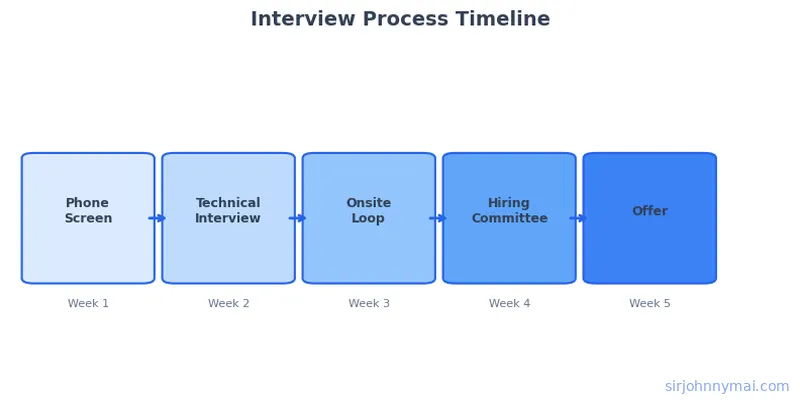
How Is the Interview Process Different from Senior PM?
The process isn’t longer—it’s structurally inverted. Senior PM interviews test competency in defined areas: product sense, execution, metrics. Staff PM interviews test coherence across ambiguity: how you prioritize when tradeoffs have no data, how you lead when no one reports to you, how you define success when the goal is unclear.
At Google, the average Senior PM loop is 4 rounds: product design, execution, metrics, leadership. Staff PM adds two: “ambiguity navigation” and “org shaping.” The latter asks candidates to redesign reporting structures, incentive models, or resourcing tradeoffs across teams. One candidate was given a mock org with three competing roadmap proposals and asked to merge them into a single strategy. He failed because he compromised—averaged the asks. The expected answer was synthesis: eliminate two, double down on one, and reframe the business case.
At Meta, the “no-boss scenario” is standard. Candidates are told: “You’re onboarding to a new team. No one tells you what to do. What’s your first 30 days?” The wrong answer is “I’d set up 1:1s and ask about OKRs.” The right answer is “I’d map decision rights, find the three silent bottlenecks, and run a forcing experiment.”
Not process, but pattern detection.
Not agenda-setting, but trust arbitrage.
Not information gathering, but power mapping.
Microsoft’s Principal PM interviews include a 90-minute “war game” with three senior engineers and a director playing adversarial roles. You propose a strategy. They attack it. You adapt. The evaluation isn’t about being right—it’s about how fast you discard your own assumptions.
Candidates who prep with standard frameworks (CIRCLES, RAPID) fail. Those frameworks were built for clarity. Staff PM interviews are designed to collapse clarity.
What Gets You Rejected, Even With Strong Experience?
Strong experience gets you the interview. Misaligned storytelling gets you rejected. In a Google HC in January 2024, a candidate with eight years at Apple and two shipped hardware-software integrations was rejected because the feedback read: “Impressive scope, but every decision was reactive. No evidence she set the north star.”
The fatal flaw isn’t competence—it’s passivity. Staff PMs are expected to be friction generators in a system optimized for smoothness. If your resume says “led X launch,” and you can’t articulate why X should exist in 2026, you’re not staff material.
One candidate at Meta described driving a 15% increase in Stories engagement. The interviewer asked, “If you could undo that launch, would you?” He paused, then defended the result. Wrong. The bar was to say: “Yes, because it trained users to expect ephemeral content, which now blocks our long-term subscription model.”
Not impact, but consequence modeling.
Not results, but tradeoff ownership.
Not credit, but accountability for second-order effects.
Another common failure: claiming cross-functional leadership while relying on authority proxies. Saying “I got engineering buy-in” is weak. Saying “I restructured the incentive model so eng saw this as their top priority without a directive” is strong.
In one Amazon debrief, a candidate said, “Product marketing disagreed with my positioning.” The committee asked: “What did you do?” He said, “We compromised.” They rejected him. At Staff level, compromise is failure. The expectation is to reframe the problem until alignment is inevitable.
How Do You Reposition Your Narrative for Staff-Level Impact?
You reposition by shifting from actor to architect. Most candidates describe themselves as “leading” initiatives. Staff PMs must show they authored the conditions for success. That means reframing every experience through three lenses: choice, constraint, and cost.
Choice: What did you decide not to do, and why?
Constraint: What bottleneck did you create or resolve that no one saw?
Cost: What downstream complexity did you accept to enable a strategic leap?
In a real Google L6 case study, a candidate didn’t talk about launching a notification redesign. Instead, he opened with: “We were chasing engagement, but I killed three roadmap items to focus on delivery reliability because I believed trust was the real bottleneck.” That signaled judgment.
Not shipping, but pruning.
Not velocity, but direction-setting.
Not consensus-building, but truth assertion.
One Microsoft Principal PM candidate told this story: “Our AI latency was 400ms. Everyone wanted to optimize the model. I redirected the team to cache infrastructure because I believed scale would break us before accuracy did.” He didn’t say “I led the project.” He said, “I changed the definition of the problem.”
That’s the shift: from “I did X” to “I decided the problem was Y, not X.”
Use the “pre-mortem” frame: “If this project failed in two years, what would have been the fatal flaw?” Then show how you designed around it. One Google candidate said: “If Spaces fails, it’s because we treated it as a comms tool, not an identity layer.” That got him the offer.
Hiring committees don’t want proof you can execute. They want proof you can think alone in a room and still be right.
What to Focus On Before the Interview
- Reframe every past project using the choice/constraint/cost model—replace “led” with “decided,” “prioritized,” “stopped.”
- Build two org-shaping stories: one where you realigned incentives, one where you changed decision rights.
- Practice answering “What’s broken here?” with zero context—given only a product name, diagnose systemic issues.
- Simulate a “no-mandate” scenario: map influence channels, identify leverage points, design a credibility flywheel.
- Work through a structured preparation system (the PM Interview Playbook covers Staff PM system design and org-shaping cases with real debrief examples from Google and Meta).
- Internalize one strategic framework per company: Google’s “anticipatory ownership,” Meta’s “friction premium,” Amazon’s “undirected impact.”
- Record yourself answering “Why this, not that?” without using the words “stakeholders” or “alignment.”
How Strong Candidates Still Fail
- BAD: “I collaborated with engineering to deliver the feature on time.”
This frames you as a project manager. Delivery is table stakes. You’re not being evaluated on timeliness.
- GOOD: “I shifted the team from a feature goal to a trust metric because I saw that reliability was the real barrier to adoption. That meant delaying launch, but it changed the incentive model for three teams.”
This shows choice, cost, and system-level impact.
- BAD: “We increased retention by 20% with a new onboarding flow.”
This is outcome storytelling. It doesn’t reveal judgment. Anyone can ship something that moves a metric.
- GOOD: “I killed the onboarding A/B test at 40% because the winning variant created long-term dependency on tooltips—strategically toxic. We rebuilt it around progressive discovery, even though it delayed the metric lift.”
This shows you value trajectory over velocity.
- BAD: “I presented the strategy to leadership and got buy-in.”
This implies you needed permission. Staff PMs don’t seek buy-in—they make outcomes inevitable.
- GOOD: “I ran a small-scale experiment that made the old approach visibly unsustainable. Within three weeks, the org migrated voluntarily.”
This demonstrates leverage without authority.
FAQ
What’s the biggest gap between Senior and Staff PM?
The gap isn’t experience—it’s autonomy in ambiguity. Senior PMs answer questions well. Staff PMs decide which questions matter. At Meta, a Senior PM is expected to deliver a roadmap item. A Staff PM is expected to redefine the roadmap. One candidate failed because she described her role as “owning the roadmap.” The committee said: “Roadmaps are owned by directors. You should own the problem space.”
Do you need a technical background for Staff PM roles?
Not coding, but architectural judgment. At Google, a non-technical Staff PM was hired because she could explain why moving from monolith to microservices would increase innovation tax by 30%, even if it improved deployment speed. The bar isn’t technical execution—it’s consequence modeling. If you can’t debate tradeoffs in system design, you’ll be overruled by engineers. You don’t need to write code, but you must see the cost of complexity.
How long does it take to land a Staff PM role from Senior PM?
Typically 18–36 months, but timeline is irrelevant if your narrative hasn’t shifted. One candidate applied to Google L6 three times over two years. First two rejections cited “strong executor, not a strategist.” On the third try, he reframed all experiences around anticipatory decisions—and passed. The delay wasn’t skill—it was story architecture. Preparation isn’t about more practice. It’s about different thinking.
What are the most common interview mistakes?
Three frequent mistakes: diving into answers without a clear framework, neglecting data-driven arguments, and giving generic behavioral responses. Every answer should have clear structure and specific examples.
Any tips for salary negotiation?
Multiple competing offers are your strongest leverage. Research market rates, prepare data to support your expectations, and negotiate on total compensation — base, RSU, sign-on bonus, and level — not just one dimension.
Ready to build a real interview prep system?
Get the full PM Interview Prep System →
The book is also available on Amazon Kindle.