Google Cloud PM roles demand a distinct profile, prioritizing deep technical acumen, enterprise customer understanding, and sophisticated go-to-market execution over consumer product intuition. Success in these interviews hinges on demonstrating an architectural perspective on cloud technologies and a strategic grasp of B2B market dynamics, not just feature ideation. The hiring committee rigorously evaluates a candidate's ability to navigate complex stakeholder landscapes and drive revenue-generating platforms.
Google Cloud PM: Insights and Interview Questions
What defines a Google Cloud PM role differently from other Google PM roles?
A Google Cloud PM role fundamentally differs from consumer PM roles by demanding a sophisticated understanding of enterprise sales, developer ecosystems, and infrastructure-level product strategy, rather than solely focusing on end-user psychology.
My experience in debriefs consistently reveals that candidates who approach Cloud PM with a consumer-centric mindset often fail to demonstrate the necessary grasp of enterprise value propositions. The problem isn't their product sense; it's their inability to shift from thinking about "users" to thinking about "customers" and their "customers' customers," navigating the layers of value creation in a B2B context.
In a Q3 debrief for a Cloud AI PM role, the hiring manager explicitly pushed back on a candidate's solution for a new ML feature because it lacked any articulated channel strategy or sales enablement plan. The candidate focused entirely on the user journey within the product, missing the critical insight that for an enterprise product, the journey often begins with a sales engineer, an account executive, or a partnership integration. The expectation for a Cloud PM is to understand the entire revenue funnel, from solution architects to procurement, not just the technical implementation.
This isn't about ideation; it's about execution within a complex commercial framework. Consumer PMs often focus on delight; Cloud PMs prioritize reliability, scalability, and predictable cost structures for their clients. The organizational psychology within Google Cloud itself reflects this: product teams are deeply intertwined with sales, solutions engineering, and support, a far cry from the relatively insulated consumer product development cycles. This means internal stakeholder management and cross-functional influence are paramount, often more so than with consumer products.
What technical depth is expected for a Google Cloud PM?
Google Cloud PMs are expected to possess a genuine architectural understanding of distributed systems and cloud technologies, extending far beyond buzzword familiarity; superficial knowledge signals a critical lack of readiness.
I've observed countless debriefs where candidates can articulate what a Kubernetes cluster does, but falter when asked about the trade-offs between managed services and self-managed solutions for a specific enterprise workload, or the implications of eventual consistency in a global database service. The problem isn't that they don't know the terms; it's that they don't understand the underlying engineering challenges and the resulting product implications for enterprise customers.
For a core compute PM role, a candidate was asked to design an API for a new serverless function offering. They presented a plausible API structure, but when probed on latency implications for cold starts, scaling limits, or security considerations for multi-tenancy, their answers became vague and theoretical. This isn't about coding ability; it's about demonstrating an intuitive grasp of how the system works at a fundamental level, understanding the constraints and opportunities that define a product's capabilities.
A strong Cloud PM can engage credibly with senior engineers, understanding their challenges and advocating for solutions that balance technical feasibility with market demand. In one hiring committee discussion, a candidate was downgraded because their "technical depth" score was borderline, not because they couldn't define terms, but because they couldn't discuss the why behind architectural choices or the impact of those choices on customer adoption and operational overhead. This isn't just about speaking the language; it's about thinking in the paradigm of highly available, scalable, and secure infrastructure.
How does the interview process for Google Cloud PM differ?
The Google Cloud PM interview process places a heavier emphasis on technical product strategy, enterprise go-to-market, and complex stakeholder management scenarios compared to consumer PM roles, often featuring more rigorous system design and B2B case studies. While the core Google PM interview categories (Product Sense, G&L, Tech, Leadership, Behavioral) remain, their weighting and specific content shift dramatically.
For instance, a Cloud Product Sense round might involve designing a new service for a specific industry vertical (e.g., healthcare data analytics on GCP) rather than a general consumer app feature. This requires not only product ideation but also an understanding of regulatory compliance, data residency, and industry-specific integration points.
I recall a specific debrief for a Cloud Security PM where a candidate excelled in general product sense but failed the technical deep dive because they couldn't articulate the differences between various encryption key management services or the operational overhead of securing a hybrid cloud environment. The interview process for Cloud roles often includes a dedicated "Technical Deep Dive" round, sometimes even two, where candidates are expected to diagram complex architectures, discuss API design principles for platform extensibility, or debug a theoretical system failure.
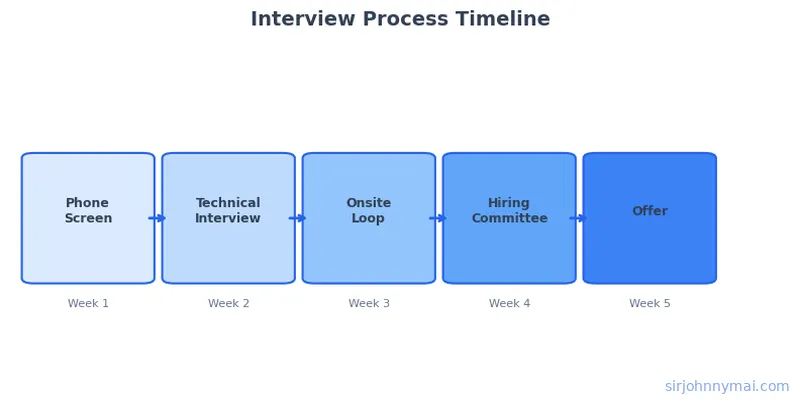
Furthermore, the G&L (Go-to-Market & Leadership) round is often less about general project management and more about crafting specific sales plays, channel strategies, and managing partnerships with ISVs or system integrators. The entire process, from initial recruiter screen to offer, typically spans 6-8 weeks, involving 5-7 distinct interview rounds, including a final virtual onsite loop of 4-5 interviews. Compensation for a typical L4 (PM II) Cloud PM role generally ranges from $200K-$280K total compensation, with L5 (Senior PM) roles extending to $300K-$450K+ depending on location and negotiation.
How does Google Cloud assess product strategy and GTM skills?
Google Cloud rigorously assesses product strategy and go-to-market (GTM) skills by demanding candidates articulate not just what to build, but why it matters for specific enterprise segments and how it will generate revenue and drive adoption through structured sales motions. Candidates often mistakenly present generic market sizing or vague partnership ideas; this fails to demonstrate the required depth. The problem isn't a lack of ideas; it's a lack of precision in connecting product features to business outcomes and actionable GTM plans.
In a hiring committee discussion for a Cloud Data Analytics PM, a candidate was praised for their detailed proposal on how to leverage existing Google Cloud sales channels, partner ecosystems, and even specific field engineering engagements to drive initial adoption of a new data warehousing feature. They didn't just say "partner with SIs"; they named types of SIs, described their typical engagement models, and outlined a joint value proposition.
This demonstrates an understanding of the organizational psychology within Google Cloud itself – that products don't sell themselves, but require active enablement of the sales force, clear competitive positioning, and a well-defined customer journey that often involves multiple touchpoints with technical and business stakeholders. Assessing strategy involves not just identifying a market gap but outlining a credible path to capture it, including pricing strategies, competitive differentiation, and a phased rollout plan that accounts for technical complexity and customer readiness. It's not about being an expert in sales; it's about demonstrating a strategic partnership with sales and marketing functions.
What common pitfalls do candidates encounter in Google Cloud PM interviews?
Candidates frequently stumble in Google Cloud PM interviews by providing generic, consumer-oriented answers, lacking the requisite technical depth, or failing to articulate a credible enterprise go-to-market strategy, signaling a fundamental misunderstanding of the Cloud business. A common pitfall observed in debriefs is the "feature factory" mindset, where candidates focus on an endless list of features without prioritizing based on customer impact, technical feasibility, or business value. This isn't about knowing all the answers; it's about demonstrating judgment in the face of ambiguity and constraint.
During a G&L round, a candidate for a Cloud Networking PM position suggested a marketing campaign for a new VPN service that mirrored a consumer ad, completely missing the enterprise buyer's need for security certifications, compliance guarantees, and integration with existing network infrastructure. The problem wasn't a bad idea; it was the misapplication of a framework to the wrong customer base. Another frequent issue is insufficient technical detail: candidates can describe a service but cannot discuss its underlying architecture, scalability limitations, or the specific APIs required for integration.
In a "Technical Deep Dive," a candidate was asked to design a notification service for GCP. They proposed a functional system but failed to consider regionality, failure modes, or the cost implications of various messaging patterns. The signal received was that they lacked the practical, operational understanding critical for Cloud products. These pitfalls often stem from not internalizing that Cloud PM is fundamentally about building platforms and services for other businesses, with different drivers and decision cycles than consumer products.
Essential Preparation Steps
- Conduct in-depth research into specific Google Cloud products, services, and their target enterprise customer segments. Understand the competitive landscape with AWS and Azure, focusing on Google's unique differentiators.
- Deepen your understanding of core cloud concepts: distributed systems, microservices, APIs, data storage options (SQL/NoSQL), networking, security best practices (IAM, encryption), and AI/ML fundamentals.
- Practice B2B product sense questions: designing solutions for specific industry verticals (e.g., finance, healthcare), addressing enterprise pain points (e.g., data governance, hybrid cloud, cost optimization).
- Prepare for technical deep-dive questions: diagramming system architectures, discussing API design principles, and outlining trade-offs for scalability, reliability, and security.
- Develop clear enterprise go-to-market strategies: consider sales enablement, channel partnerships, pricing models, and how to articulate value to technical and business decision-makers.
- Refine your behavioral responses by preparing specific examples that demonstrate leadership, conflict resolution within engineering teams, and influencing without authority, especially in cross-functional Cloud contexts.
- Work through a structured preparation system (the PM Interview Playbook covers technical product strategy, enterprise customer frameworks, and B2B GTM with real debrief examples).
- Network with current Google Cloud PMs to gain insights into their day-to-day responsibilities and specific product area challenges.
How Strong Candidates Still Fail
- Generic "Consumer PM" Mindset:
BAD: Proposing a new search feature for Google Cloud that focuses on "delighting users" with animated results and social sharing, without addressing enterprise needs like audit trails, role-based access control, or integration with existing data lakes.
GOOD: Proposing a new search feature that prioritizes finding specific compliance documents across diverse data sources, integrating with enterprise identity management systems, and providing granular access controls, clearly articulating the cost savings or risk reduction for an IT administrator. The problem isn't feature ideation; it's misaligned value proposition.
- Lack of Technical Depth Beyond Buzzwords:
BAD: Stating that a solution uses "serverless containers and AI" to solve a problem, but when pressed on how serverless containers achieve specific latency requirements or how the AI model is trained and deployed in a multi-tenant environment, the candidate offers vague, high-level answers.
GOOD: Explaining that a solution leverages Cloud Run for stateless microservices to achieve burst scalability, detailing the trade-offs with GKE for stateful applications, and discussing specific API gateways and authentication mechanisms to ensure secure multi-tenancy, demonstrating an understanding of the underlying architecture. The problem isn't vocabulary; it's the absence of practical understanding.
- Ignoring Enterprise Go-to-Market Complexity:
BAD: For a new Cloud product, suggesting "we'll launch it and market it on the Google Cloud website" as the primary GTM strategy, without considering sales enablement, partner programs, pricing models, or the need for professional services.
GOOD: Outlining a phased GTM plan that includes identifying target customer segments, creating sales playbooks for account executives, partnering with independent software vendors (ISVs) for ecosystem integration, defining a tiered pricing strategy, and planning for initial technical workshops and proofs-of-concept with lighthouse customers. The problem isn't a lack of ambition; it's a failure to grasp the intricate commercial motions of enterprise sales.
FAQ
What is the most critical skill for a Google Cloud PM?
The most critical skill is the ability to bridge deep technical understanding with sophisticated enterprise business strategy, translating complex infrastructure capabilities into tangible value for B2B customers. It is not about simply understanding technology; it is about understanding how businesses leverage that technology to solve their problems and drive revenue.
How technical do I need to be for a Google Cloud PM role?
You need to possess a solid architectural understanding of distributed systems, cloud infrastructure, and relevant technical domains (e.g., networking, security, data) to credibly engage with senior engineers and make informed product decisions. This is not about coding; it is about understanding system design, trade-offs, and operational implications.
What is the typical salary range for a Google Cloud PM?
For an L4 (PM II) Google Cloud PM, total compensation typically ranges from $200K-$280K, while an L5 (Senior PM) can expect $300K-$450K+, varying by location and individual negotiation. These figures encompass base salary, stock grants, and performance bonuses, reflecting the high demand for specialized Cloud talent.
Ready to build a real interview prep system?
Get the full PM Interview Prep System →
The book is also available on Amazon Kindle.