Landing a Fintech PM role without direct experience is achievable by meticulously translating adjacent skills, demonstrating a high aptitude for technical and regulatory complexities, and crafting a narrative that prioritizes judgment over mere exposure. Hiring committees prioritize candidates who exhibit robust analytical rigor, a nuanced understanding of risk, and the capacity for rapid domain mastery, even if their background is not explicitly financial. Your success hinges not on what you have done, but on how effectively you articulate what you can do in a high-stakes industry.
This guide is for product managers currently working outside the financial sector, or professionals in adjacent fields (e.g., data science, consulting, engineering, operations) with strong analytical and problem-solving skills, who aspire to transition into a Product Manager role within a Fintech company. It is designed for individuals who understand the rigor of FAANG-level hiring and are prepared to strategically bridge their existing capabilities with the unique demands of financial technology, acknowledging the higher stakes and specialized knowledge required. This is not for entry-level candidates with no professional experience.
How can I pivot into Fintech PM without prior domain experience?
Direct Fintech experience is not always a prerequisite; successful pivots hinge on demonstrating adjacent capabilities and a compelling capacity for rapid domain mastery. Hiring committees are not exclusively seeking candidates who have built financial products before, but rather those who possess the foundational skills and intellectual curiosity to quickly internalize the complexities of the Fintech landscape. The critical misstep many candidates make is presenting their past work in generic terms, failing to actively bridge it to the core challenges of financial technology.
In a Q3 debrief for a Growth PM role at a prominent payment processor, a candidate from an e-commerce platform initially faced skepticism due to their lack of direct payment system experience. However, the L6 interviewer championed their ability to articulate how their experience optimizing checkout flows, managing fraud detection rules, and integrating third-party payment gateways in a high-volume retail environment directly mapped to the core responsibilities of the Fintech role.
This wasn't a superficial connection; the candidate detailed specific metrics, technical challenges, and user journey considerations that mirrored Fintech problems. The problem isn't your lack of direct experience; it’s your failure to translate existing, relevant experience into a compelling narrative for the specific Fintech problem space.
The organizational psychology at play is risk aversion. Hiring a PM in Fintech without direct experience is perceived as a higher risk.
Your application and interview performance must systematically de-risk you by highlighting transferable skills like data analysis, systems thinking, regulatory awareness (even if from a different domain), and a proven track record of shipping complex, secure products. It's not about memorizing financial jargon; it’s about understanding the underlying mechanisms of value transfer, security, and compliance that underpin all successful digital financial services. Your ability to dissect a complex payment flow or a lending decision model, even hypothetically, signals a deeper aptitude than simply listing past roles.
> 📖 Related: Morgan Stanley PM hiring process complete guide 2026
What specific skills do Fintech hiring committees prioritize for new entrants?
Fintech hiring committees prioritize analytical rigor, technical fluency, and a keen understanding of risk and regulatory environments as non-negotiable foundations for new entrants. These attributes are considered more critical than superficial domain exposure because they indicate a candidate’s capacity to navigate the intricate and highly regulated nature of financial products. A candidate who can dissect a complex data set to identify fraud patterns or articulate the trade-offs in a distributed ledger design holds significantly more appeal than one who merely expresses "interest" in finance.
I recall a hiring manager for a small business lending product PM role rejecting a candidate with strong general product sense but no demonstrated understanding of credit risk models, compliance frameworks, or even basic balance sheet concepts. The candidate could design user flows for loan applications but faltered when asked about underwriting criteria, default rates, or the impact of interest rate changes on portfolio health.
The hiring committee concluded that while product sense was present, the fundamental judgment required for a high-stakes financial product was absent. The priority isn't just shipping features; it’s shipping secure, compliant, and defensible features that protect both users and the institution.
Successful new entrants typically possess a robust understanding of data structures, API integrations, and system architecture, often gleaned from engineering or data science backgrounds. They can articulate how technology mitigates financial risk or enables regulatory compliance. This technical fluency isn't about writing code in the PM role, but about effectively partnering with engineering and understanding the technical debt or scalability implications of product decisions.
Furthermore, an explicit awareness of regulatory bodies (e.g., SEC, FCA, CFPB) and their impact on product development is paramount. The problem isn't your inability to build a financial product, but your lack of demonstrated judgment regarding the unique constraints and risks inherent in the financial system. This judgment is often signaled through a structured approach to problem-solving that inherently considers security, compliance, and financial implications from the outset.
How should I tailor my resume and story for a Fintech PM role?
Your resume and interview narrative must actively bridge your past experiences to Fintech challenges, demonstrating direct relevance and a clear learning trajectory rather than simply listing past accomplishments. Generic descriptions of "driving product strategy" or "leading cross-functional teams" are insufficient; your story must explicitly connect your prior impact to the specific pain points and opportunities within financial technology. The resume acts as a predictive model for your future performance in a new domain, and it must predict success in this specific domain.
Consider a resume review where a candidate from a gaming company successfully reframed their experience. Instead of "Managed in-app purchases," their bullet read: "Designed and launched robust payment processing systems for high-volume in-app transactions (500k+ daily), reducing fraud rates by 15% through anomaly detection algorithms and enhancing user trust in financial interactions." This reframing immediately highlighted transferable skills in payment systems, fraud prevention, and user trust – all critical for Fintech.
This wasn't merely re-wording; it was a strategic re-interpretation of impact through a Fintech lens. The resume isn't a job description; it’s a future-fit argument.
When crafting your story, emphasize instances where you dealt with sensitive data, managed security protocols, optimized for financial efficiency, or navigated complex regulatory landscapes in any industry. Quantify these achievements with metrics that resonate with financial outcomes, such as revenue impact, cost reduction, or risk mitigation.
During interviews, directly address the "lack of Fintech experience" by acknowledging it, then immediately pivoting to how your transferable skills (e.g., analytical rigor from consulting, systems thinking from engineering, user trust building from consumer tech) provide a strong foundation. Frame your career transition as a deliberate, informed choice driven by a genuine understanding of Fintech's unique challenges and your specific aptitude for solving them. This demonstrates judgment, self-awareness, and intentionality, which are highly valued by hiring committees.
> 📖 Related: uc-berkeley-to-discord-pm-2026
What are common interview pitfalls for candidates lacking Fintech PM experience?
Superficial answers lacking depth in financial concepts, a failure to connect product ideas to business model implications, and an underdeveloped sense of risk are immediate red flags for candidates without prior Fintech PM experience. Interviewers are not seeking perfection, but they are looking for signals of judgment under pressure in a domain where mistakes carry significant financial, regulatory, and reputational consequences. Many candidates, attempting to mask their lack of direct experience, default to generic product management frameworks without tailoring them to the unique constraints of finance.
I observed an interview where a candidate proposed an innovative payment solution for small businesses. While the user experience design was thoughtful, they completely overlooked critical aspects such as Know Your Customer (KYC) and Anti-Money Laundering (AML) requirements, the unit economics of transaction fees, or the operational overhead of dispute resolution.
When pressed on these points, their answers were vague, demonstrating a fundamental gap in understanding the operational realities and regulatory burdens of financial services. This wasn't a test of memorization; it was a test of holistic judgment in a complex system. The problem isn't about having all the answers; it’s about asking the right questions and demonstrating a structured approach to ambiguous, high-stakes problems.
Another common pitfall is a lack of technical depth when discussing financial products. For example, when asked about building a real-time fraud detection system, a candidate might speak generally about "using machine learning" without discussing data sources, model explainability, latency requirements, or the trade-offs between false positives and false negatives.
This signals a lack of readiness for the close partnership required with engineering in Fintech, where technical constraints are often tightly coupled with regulatory and security requirements. To mitigate these pitfalls, engage deeply with problem statements, explicitly acknowledge financial constraints and regulatory considerations, and demonstrate a structured thought process that addresses security, compliance, and profitability from the outset.
What salary expectations are realistic for a Fintech PM role without prior experience?
Candidates without prior direct Fintech PM experience should realistically expect to land at the lower end of the compensation band for their target level, with potential for a leveling adjustment if their transferable skills are exceptionally strong. Compensation reflects perceived value and risk; less direct experience often translates to higher perceived risk by the hiring company, necessitating a more conservative initial offer. This isn't a punitive measure, but a practical assessment of the ramp-up time and specific domain knowledge required.
In a compensation committee debate, an L5 offer for a candidate with a strong background in enterprise software PM but no direct Fintech experience was approved at 15% below the median for that level. The rationale was not a lack of general PM capability, but the anticipated investment in their domain-specific learning and the higher perceived risk for initial project assignments within a heavily regulated sector.
The hiring manager successfully argued for the L5 placement based on the candidate's strong technical acumen and structured thinking, but the initial salary was benchmarked lower to account for the lack of specific Fintech domain knowledge. The negotiation isn't solely about your past compensation; it's about your projected impact in this new domain.
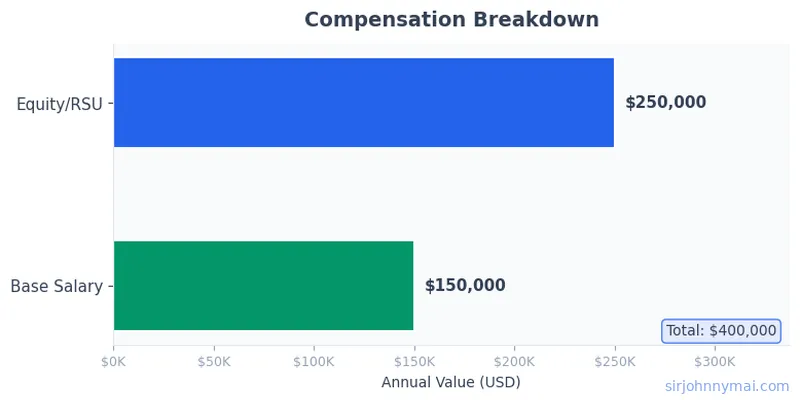
For a new entrant at a FAANG-level Fintech company, expect a base salary potentially in the $150,000-$200,000 range for an L4-L5 equivalent, with total compensation (including stock and bonus) pushing into the $250,000-$350,000 range, depending heavily on company tier, location, and the specific role. However, candidates with minimal direct domain experience should anticipate offers closer to the bottom quartile of these ranges.
Your primary focus should be securing the role and demonstrating rapid impact, which will then unlock higher compensation adjustments in subsequent performance reviews. The key is to demonstrate that your learning curve will be steep and your contributions will quickly justify a higher valuation.
Where Candidates Should Invest Time
Deep Dive into Fintech Fundamentals: Master the core concepts of payments, lending, investing, banking, and insurance. Understand the key players, business models, and regulatory frameworks (e.g., KYC, AML, PCI DSS).
Analyze Fintech Product Case Studies: Dissect existing Fintech products (e.g., Square, Stripe, Chime, Robinhood) to understand their user journeys, revenue models, technical architectures, and competitive advantages.
Translate Your Experience: For every past project, explicitly articulate how your impact relates to financial efficiency, risk mitigation, security, compliance, or user trust in a financial context. Quantify with metrics.
Develop Technical Fluency: Be prepared to discuss API integrations, database structures, security protocols, and scalability challenges relevant to financial data and transactions. This does not mean coding, but understanding technical trade-offs.
Practice Domain-Specific Product Questions: Work through a structured preparation system (the PM Interview Playbook covers product sense, strategy, technical depth, and behavioral questions with real debrief examples, including frameworks for navigating high-stakes domains like Fintech). Focus on questions like "Design a new credit card for Gen Z" or "How would you reduce fraud on a peer-to-peer payment app?"
Understand Regulatory Impact: Research the relevant financial regulations for your target company's products and be ready to discuss how they influence product design, data handling, and go-to-market strategy.
Network Strategically: Connect with PMs currently working in Fintech. Conduct informational interviews to gain insights into specific company challenges and culture.
Common Pitfalls in This Process
- Generic Answers to Domain-Specific Questions:
BAD: "I'd use a user-centered design approach and iterate quickly to build a new lending product." (This applies to almost any product and lacks Fintech specificity.)
GOOD: "To build a new lending product for gig workers, I’d start by understanding their unique income volatility and credit needs, then research alternative data sources for underwriting beyond traditional FICO scores, while simultaneously mapping out the regulatory compliance landscape for fair lending practices and data privacy (e.g., FCRA, CCPA)." (Demonstrates domain awareness, analytical rigor, and risk consideration.)
- Downplaying or Ignoring Lack of Fintech Experience:
BAD: "My experience in X is totally applicable to Fintech, no problem." (Overconfidence without substance signals ignorance.)
GOOD: "While I don't have direct Fintech PM experience, my background in building secure, high-volume transaction systems at Y, coupled with my deep dive into payment regulations, has prepared me to quickly bridge that gap. I've spent the last six months intensely studying the intricacies of real-time payments and credit risk modeling, and I’m eager to apply that learning here." (Acknowledges the gap, then proactively bridges it with specific, actionable efforts.)
- Failing to Connect Product Ideas to Business Model & Risk:
BAD: Proposing a new feature for a trading app that focuses solely on user engagement without mentioning its impact on transaction volume, revenue per user, or the potential for regulatory scrutiny (e.g., gamification concerns).
- GOOD: "A new social trading feature could boost engagement, but we'd need to model its impact on transaction fees and ensure robust disclaimers and risk education are integrated to prevent 'meme stock' behavior, which could attract regulatory attention and damage user trust. We'd also need to assess the technical lift for real-time data feeds and compliance monitoring." (Considers user, business, technical, and regulatory dimensions.)
FAQ
- Is a finance degree essential for a Fintech PM role without prior experience?
A finance degree is not essential, but a demonstrated understanding of financial concepts, business models, and market dynamics is non-negotiable. Many successful Fintech PMs come from engineering, data science, or general product backgrounds, having acquired domain knowledge through self-study and relevant project experience. Your ability to speak the language of finance, even without a formal degree, is what matters to the hiring committee.
- How important is technical background for a non-Fintech PM transitioning to Fintech?
A strong technical background is highly advantageous, often outweighing a lack of direct Fintech experience, particularly at FAANG-level companies. Fintech products are deeply technical, involving complex systems, data security, and API integrations. Your ability to understand architectural trade-offs, discuss data pipelines, and effectively partner with engineering is a critical signal of your potential to succeed in the domain.
- Should I target specific types of Fintech companies if I have no experience?
Focus on companies whose products align with your existing transferable skills. If you have experience with data analytics and fraud, target payment processors or risk management platforms. If your background is in consumer engagement, consider neobanks or wealth management apps. Avoid niche, highly regulated areas like institutional trading if your technical or compliance understanding is nascent; start with areas where your existing strengths can be more easily leveraged.
Ready to build a real interview prep system?
Get the full PM Interview Prep System →
The book is also available on Amazon Kindle.