Perplexity's Generative AI PM role demands a rare blend of deep ML understanding and sharp product execution, focusing on first-principles thinking over buzzwords. Success hinges on demonstrating a concrete grasp of RAG systems, model evaluation, and user experience for AI outputs, filtering out candidates who merely understand AI at a surface level. This is a technical product role disguised as a generalist one.
The Generative AI PM interview at Perplexity is not a test of your ability to parrot industry trends, but a brutal assessment of your technical depth and product judgment in a domain still being defined. This process filters out generalist PMs, seeking instead individuals who can navigate the complexities of model limitations, data pipelines, and user trust in an AI-native product. Your ability to think in first principles about RAG systems, model evaluation, and the cost implications of inference will be the primary differentiator.
What technical depth does Perplexity expect from a Generative AI PM?
Perplexity expects Generative AI PMs to possess a foundational understanding of machine learning principles, particularly around large language models, RAG architectures, and model evaluation, moving beyond high-level conceptual knowledge to practical implications. The hiring committee is not looking for an ML engineer, but for a PM who can effectively partner with one, understanding the trade-offs inherent in building and shipping AI-native products. This means knowing the difference between fine-tuning and prompt engineering, understanding embedding spaces, and grasping the implications of different inference strategies.
In a Q3 debrief, a candidate who spoke eloquently about "AI ethics" and "societal impact" but couldn't articulate the trade-offs between different embedding models for a specific use case was immediately flagged.
The feedback was concise: "They understand the what of AI, not the how or why it matters for engineering decisions." The problem isn't your vocabulary — it's your inability to connect that vocabulary to engineering realities and product outcomes. Perplexity operates at the frontier of applied AI; a PM must be able to contribute to the technical discourse, not just translate it.
The expectation is not just familiarity with terms, but an understanding of their practical implications. You should be able to discuss latency, cost, and accuracy trade-offs for different model sizes or RAG strategies.
This is not about memorizing the latest papers, but about demonstrating an intuition for ML systems design. The critical insight here is that Perplexity values a PM who can challenge technical assumptions with informed product questions, rather than simply accepting them. It’s not about being an ML engineer, but about understanding engineering constraints and possibilities deeply enough to influence technical roadmaps.
> 📖 Related: Palo Alto Networks PMM interview questions and answers 2026
How should I approach product design questions for Perplexity's AI products?
Product design questions at Perplexity demand a first-principles approach, focusing on user problems specific to AI outputs, data quality, and model limitations, rather than merely applying standard product frameworks. Your designs must account for the inherent uncertainties and failure modes of generative AI, such as hallucination, bias, and outdated information, weaving solutions directly into the user experience. The evaluation centers on your ability to design for trust, explainability, and error handling in a novel interaction paradigm.
I recall a debrief where a candidate proposed a new feature for Perplexity, an AI-driven summarization tool, but neglected to address the hallucination risk or the latency implications for the user experience. Their design focused on a "perfect AI" scenario.
The hiring manager immediately pointed out, "This design assumes the model always gets it right, which is a fundamental misunderstanding of generative AI product design." The problem wasn't the idea itself, but the lack of a robust strategy for dealing with AI's imperfections. Most candidates design for a perfect AI; Perplexity wants you to design for an imperfect, evolving system.
Your solutions must be grounded in the realities of Perplexity's core product: providing accurate, cited answers. This means thinking about source attribution, real-time data integration, and mechanisms for user feedback on AI outputs.
The focus isn't on a general "user problem," but on the "AI-specific user problem" – dealing with uncertainty, trust, and explanation. You must demonstrate an ability to translate model capabilities and limitations into tangible user experiences, acknowledging that the interaction patterns for AI are still being defined. Your product judgment is assessed by your ability to foresee and mitigate AI-native failure states.
What kind of strategy questions are asked, and how should I answer them?
Perplexity's strategy questions probe your understanding of defensible moats in generative AI, business model innovation, and the competitive landscape, requiring insights beyond generic market analyses. The hiring committee seeks candidates who can articulate Perplexity's unique position against both traditional search engines and other AI-native competitors, identifying pathways for long-term growth and differentiation. This isn't about reciting market size, but about identifying specific, actionable strategies for Perplexity to build lasting value.
During an offer negotiation, a candidate impressed us not just with their product vision, but their ability to articulate Perplexity's unique data advantage over competitors relying purely on synthetic data or less robust RAG systems. Their analysis highlighted how Perplexity's real-time indexing and citation capabilities created a superior user experience that was difficult for others to replicate.
This wasn't a general "AI is important" statement, but a specific competitive analysis for Perplexity. The hiring committee prioritizes candidates who can articulate a vision for Perplexity's specific edge, not just the broader AI market.
Your answers must demonstrate an understanding of the underlying economics of generative AI, including inference costs, data acquisition, and model training. Strategic discussions often revolve around how Perplexity can scale its current advantages, whether through novel monetization models, expansion into new verticals, or further technological breakthroughs. It's not about predicting the future of AI, but about identifying Perplexity's path to sustained competitive advantage in a rapidly evolving landscape. The ability to identify strategic leverage points unique to Perplexity's architecture and user value proposition is paramount.
> 📖 Related: Anthropic AI PM Interview Questions 2026: Complete Guide
How is execution and analytical ability evaluated for this role?
Execution and analytical ability for a Generative AI PM at Perplexity are assessed through your capacity to define metrics for model performance, manage complex data pipelines, and make trade-offs under uncertainty, often with limited historical data. This role demands a PM who can not only launch features but also rigorously measure their impact, especially when traditional A/B testing methodologies might be insufficient or too slow for rapid AI iteration. Your ability to establish monitoring systems and interpret non-traditional metrics for AI product health is critical.
A candidate recounted a scenario where they had to launch an ML feature without perfect A/B test conditions, outlining their fallback metrics, synthetic data generation for testing, and a comprehensive monitoring plan post-launch. This demonstrated a pragmatic approach to execution in an ambiguous environment. The feedback from the interviewing panel was that this candidate understood the realities of shipping cutting-edge AI, not just the ideal process. Many candidates focus on "what" to build; Perplexity evaluates "how" you will build and measure it in a volatile environment.
You must be able to articulate how you would define success for an AI-generated answer, considering factors like factual accuracy, completeness, helpfulness, and source diversity. This moves beyond simple click-through rates to more nuanced quality assessments.
The expectation is a PM who can design experiments, even imperfect ones, to validate hypotheses about model improvements or user interactions. It's not about having an MBA-level understanding of business metrics, but a practitioner's grasp of model health and user engagement metrics in an AI context. Your analytical rigor for data-driven decisions in the face of AI's inherent black-box nature is constantly under scrutiny.
Focused Preparation Guide
- Deep dive into Perplexity's product, understanding its strengths, weaknesses, and unique value proposition compared to traditional search and other AI products.
- Thoroughly research Retrieval Augmented Generation (RAG) architectures, understanding their components (retrieval, generation, embedding models), trade-offs, and common failure modes.
- Practice ML system design questions, focusing on components like data pipelines, model serving, evaluation, and feedback loops for generative AI applications.
- Define a comprehensive set of metrics for AI product success, encompassing model performance (accuracy, hallucination rate), user experience (latency, helpfulness), and business impact (cost, retention).
- Prepare to discuss specific examples of how you've managed technical debt, made data-driven decisions with imperfect data, or navigated ambiguity in prior roles.
- Work through a structured preparation system (the PM Interview Playbook covers advanced technical product strategy and execution frameworks with real debrief examples, directly applicable to Perplexity's challenges).
- Develop informed opinions on the future of search, the competitive landscape of generative AI, and Perplexity's strategic position within it.
Traps That Cost Candidates the Offer
Here are common pitfalls I've observed in Perplexity Generative AI PM debriefs:
- Surface-level AI knowledge:
BAD: "AI is the future; we need more personalized experiences and smart assistants that understand users better." (This is a generic statement that applies to any AI company.)
GOOD: "Integrating a fine-tuned LLM for intent classification pre-RAG can reduce irrelevant context, improving answer accuracy by an estimated 15% while managing inference costs by filtering out low-relevance queries earlier in the pipeline." (Demonstrates specific technical understanding and connection to product/business outcomes.)
- Generic product frameworks without AI context:
BAD: "My product process starts with user research, then ideation, prototyping, and A/B testing, focusing on user needs." (This describes a standard PM process without addressing AI-specific challenges.)
GOOD: "For this AI feature, my first step would be to define the acceptable hallucination rate and latency thresholds, then prototype with different prompt engineering strategies and RAG component selections, before conducting targeted qualitative user testing to assess trust and helpfulness, as traditional A/B metrics might not capture nuanced AI output quality." (Integrates AI-specific considerations into every stage of the product process.)
- Ignoring Perplexity's specific product and mission:
BAD: "I'd build a social network feature into Perplexity to foster community engagement around search results." (Ignores Perplexity's core mission of direct, cited answers and its user value proposition, which is not primarily social.)
GOOD: "Given Perplexity's focus on grounded, cited answers, a key challenge is balancing real-time information retrieval with source credibility; I'd explore a multi-modal RAG approach that prioritizes authoritative sources for time-sensitive queries, perhaps with a real-time fact-checking layer to flag low-confidence claims before generation, ensuring answer quality without sacrificing speed." (Directly addresses Perplexity's unique problem space and proposes a technically informed solution aligned with its mission.)
Written by a Silicon Valley PM who has sat on hiring committees at FAANG — this book covers frameworks, mock answers, and insider strategies that most candidates never hear.
Get the PM Interview Playbook on Amazon →
FAQ
Q: Do I need a Computer Science degree to be a Generative AI PM at Perplexity?
Judgment: A formal CS degree is not strictly required, but a deep technical foundation in machine learning, data science, or engineering is non-negotiable for a Perplexity Generative AI PM role. Candidates are evaluated on their practical understanding of ML systems and their ability to engage with engineers on a technical level, which can come from diverse educational or professional backgrounds.
Q: How long is the Perplexity Generative AI PM interview process?
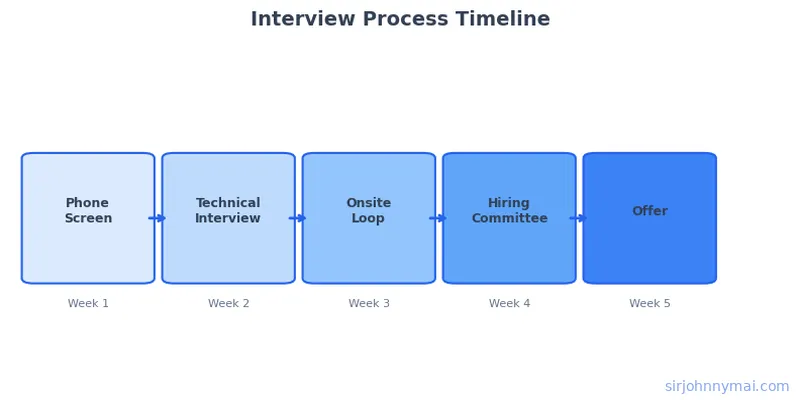
Judgment: The Perplexity Generative AI PM interview process typically spans 3-5 weeks, involving 5-7 rounds after the initial recruiter screen, designed to rigorously assess technical depth, product judgment, and cultural fit. This includes technical product sense, execution, strategy, and a final leadership or hiring manager round.
Q: What salary can I expect for a Generative AI PM role at Perplexity?
Judgment: Generative AI PM compensation at Perplexity is highly competitive, generally ranging from $200K-$280K base salary with significant equity, placing it at the top tier for technical PM roles in Silicon Valley. Total compensation often exceeds $400K-$600K, reflecting the specialized skill set and high demand for this type of role at an AI-native company.