How to Transition from Software Engineer to PM: Closing the Gap: Here is a direct, actionable answer based on real interview data and hiring patterns from top tech companies.
Most engineers fail to transition to product management because they over-index on technical depth and under-communicate product judgment. The gap isn’t skill — it’s narrative framing. Success requires repositioning technical experience as product insight, not proof of engineering competence.
Why Do Engineering Backgrounds Struggle to Break Into PM Roles?
Engineers fail PM interviews not because they lack capability, but because they misread the evaluation criteria. In a Q3 2023 hiring committee at Google, a senior engineer from Android was rejected for a GPM role — not due to weak answers, but because every response began with “We optimized the API latency by 40ms” instead of “I prioritized reducing latency because user drop-off spiked at 300ms.”
The problem isn’t technical precision — it’s product framing. Hiring managers aren’t asking, “Can you build this?” They’re asking, “Can you decide what to build — and why?”
Not competence, but context. Not depth, but distribution of attention. Not execution, but escalation of abstraction.
At Amazon, PM interviews are scored on Ownership, Customer Obsession, and Invent and Simplify. Engineers default to Dive Deep and Deliver Results — two bars they can clear easily but two that don’t win offers. I watched a candidate with a Stanford CS degree and five backend systems shipped get dinged because he couldn’t articulate trade-offs between user delight and system stability.
Product management is a judgment role. Engineering is an execution role. Transitioning means retraining your reflexes: stop proving you can do the work; start showing you know which work matters.
One structural mismatch: engineers are rewarded for minimizing risk. PMs are rewarded for managing it. In a debrief at Meta, a hiring manager said, “He gave a flawless technical spec. But when I asked what would happen if the launch failed, he listed rollback procedures — not user impact or competitive response.” That’s the gap: process orientation instead of consequence orientation.
You don’t need to unlearn engineering. You need to reframe it. Your code isn’t the end — it’s evidence. The product is the argument. Your job is to make the case.
What Skills Are Actually Evaluated in PM Interviews?
PM interviews test decision-making under uncertainty, not knowledge retrieval. At Apple’s product leadership interviews, candidates are given ambiguous prompts like “Improve the iPad experience” and evaluated on how quickly they define scope, identify users, and establish success metrics — not on feature ideas.
In a typical PM loop, you’ll face four core evaluations:
- Product Sense (45-minute case): Can you define a problem worth solving?
- Behavioral (STAR format): Can you show leadership without authority?
- Execution (metrics & prioritization): Can you ship and learn?
- Leadership/GTM (go-to-market, strategy): Can you align teams and stakeholders?
Engineers often prep for the first and third — they can whiteboard a metrics dashboard in 10 minutes. But they fail the behavioral and leadership rounds because they default to team dynamics they controlled (e.g., “I led the sprint planning”) rather than influence they exerted without formal power (“I convinced UX to delay the redesign because analytics showed adoption risk”).
Not collaboration, but coalition-building. Not teamwork, but persuasion. Not ownership, but accountability under ambiguity.
I sat in on a Microsoft HC where a candidate described debugging a race condition across services. Technically sharp. But when asked, “How did you decide which team to engage first?” he said, “I checked the ownership docs.” Wrong answer. The expected response: “I assessed blast radius and user impact, then escalated to the team with highest leverage.”
That’s the signal: judgment over compliance.
Salaries reflect this divide. In 2024, L5 PMs at tech firms earn $220K–$330K TC. L5 engineers in the same org make $240K–$350K. The compensation gap has closed — but the evaluation bar for PMs is higher in soft domains. You’re being assessed on what you choose, not what you build.
One framework I use: the 3x3 Evaluation Grid. Across three dimensions — user impact, business value, technical feasibility — and three roles — engineer, tech lead, PM — the PM must operate at the intersection. Engineers optimize feasibility. PMs optimize the balance.
Your prep must simulate that tension.
How Should Engineers Reposition Their Experience for PM Roles?
Engineers don’t lack PM-relevant experience — they mislabel it. The key is translation, not reinvention.
In a hiring committee at Stripe, a senior backend engineer was approved for a PM role because he reframed a data pipeline migration as a customer insight story: “We noticed 18% of webhook failures correlated with merchant onboarding drop-off, so I initiated a cross-functional review that led to redesigning the integration docs — which cut support tickets by 35%.”
That’s not an engineering story. It’s a product story disguised as an ops fix.
Repositioning means three shifts:
- From output to outcome: Don’t say “I built a caching layer.” Say “I reduced API latency to improve onboarding flow completion — which increased activation by 12%.”
- From task to trade-off: Don’t say “We shipped faster.” Say “We delayed two minor features to prioritize error logging because crash rates were obscuring real user pain.”
- From role to responsibility: Don’t say “I was the tech lead.” Say “I coordinated design, legal, and support teams to align on launch scope because inconsistent messaging was causing user confusion.”
Not what you did, but why it mattered. Not your title, but your influence. Not your code, but your constraint.
I’ve reviewed over 300 internal transfer packets. The ones that succeed don’t list projects — they tell decision arcs. One engineer at LinkedIn got promoted to PM because his transfer doc opened with: “In Q2 2022, I noticed search relevance decayed after 48 hours. Instead of tuning the model, I questioned the retention hypothesis — which led us to shift from recency to relationship strength in ranking. DAU in feed interactions rose 9%.”
That’s product thinking. The code was a footnote.
Your resume should be a product document, not an engineering log. Every bullet must answer: What user problem did this solve? What trade-offs were made? What evidence shows it worked?
One structural fix: use the “Because” rule. Every achievement must include the word “because” in your mind. “Improved API performance by 40% because slow load times were causing drop-off in the checkout flow.” That forces causality — the core of product thinking.
Engineers often skip this because they assume the “because” is obvious. It’s not. To non-technical evaluators, technical wins are noise without narrative.
How Many PM Interviews Should You Expect, and How Should You Prep?
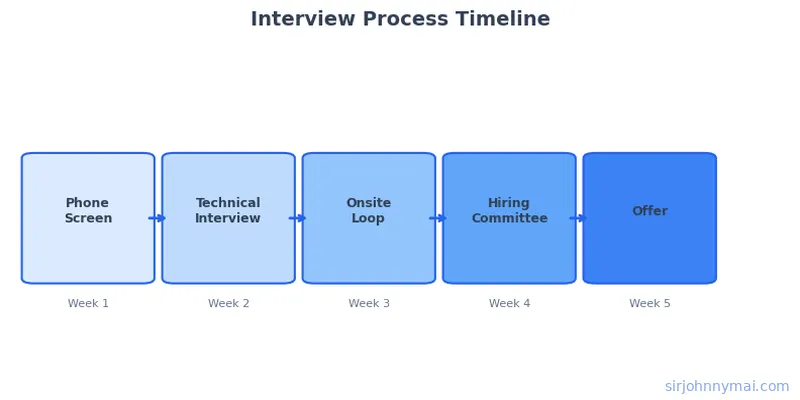
A typical PM interview loop is 4–6 rounds over 2–3 weeks. You’ll face one product case, one behavioral, one execution/metrics, one leadership/GTM, and possibly a take-home or presentation round.
At Google, PM candidates average 5.2 interviews. At Amazon, it’s 4–5 loops plus a Writing Exercise. At smaller startups, it may be as few as 3.
Engineers often underestimate prep time. They assume their domain knowledge will carry them. It won’t. You need 80–120 hours of targeted practice — not just mock interviews, but real case writing.
The most common failure point: treating the product case like a technical design problem. Engineers dive into solution architecture before defining the user or success metrics.
BAD: “For improving YouTube Shorts, I’d build a recommendation engine using embedding similarity and watch time decay.”
GOOD: “First, I’d define the goal: increase time spent by casual viewers. Then I’d identify the drop-off point — maybe after 3 videos — and diagnose causes: content fatigue, repetition, or poor pacing. Only then would I consider algorithmic changes.”
Not solution-first, but problem-first. Not architecture, but diagnosis. Not scale, but segmentation.
At a Meta debrief, a candidate was dinged because he proposed a full-stack redesign for Messenger’s group chat after 8 minutes. The feedback: “He didn’t ask who the user was. Was it teens? Families? Professionals? The solution was technically sound but context-blind.”
You must practice cold starts. Take ambiguous prompts — “Improve Maps for seniors” — and force yourself to spend 5 minutes defining scope, user, and success before touching features.
One tactic: use the 1-3-5 framework. In 1 minute, state the user and goal. In 3 minutes, list three problem hypotheses. In 5 minutes, pick one and sketch a solution.
I’ve seen engineers improve their case scores by 40% just by adding a structured framing phase.
Mock interviews are non-negotiable. Do 8–12 with experienced PMs. Record them. Review not just content, but tone. Are you directing the conversation or reacting? PMs lead. Engineers follow.
The difference shows in hesitation. Engineers say, “I think we could…” PMs say, “We should, because…”
That linguistic shift matters. It signals decision ownership.
Work through a structured preparation system (the PM Interview Playbook covers product sense cases with real debrief examples from Google, Meta, and Amazon — including how candidates repositioned technical projects into product narratives).
What’s the Fastest Path to a PM Role — Internal Transfer or External Hire?
Internal transfer is the fastest and highest-success path. At most tech firms, internal PM hires close 3x faster than external ones — median time-to-offer is 28 days vs. 85 days.
Why? Trust compression. Hiring managers assume technical credibility. The question isn’t “Can you understand engineers?” It’s “Can you think like a PM?”
In a debate on Amazon’s Device team, a hiring manager said, “I’ll take the SDE who’s already in the war room over the external PM who’s never touched our codebase — if he can show product judgment.”
That’s the opening.
To exploit it, start before the process. In your current role, volunteer for PM-adjacent work: write PR/FAQs, lead sprint reviews, define OKRs, own launch comms. Document it.
At Google, an engineer on Gmail got moved to a PM role because he independently drafted a feature proposal for undo send — complete with user research, success metrics, and risk assessment — and circulated it to leads.
He didn’t ask for a transfer. He demonstrated readiness.
External hiring is harder. Recruiters filter for “PM-shaped” resumes. If your title has never been PM, you’ll face resume screeners who don’t know how to interpret engineering roles.
One workaround: add a “Product Impact” section to your resume. List initiatives where you drove product outcomes — even without the title. Use PM language: “defined product requirements,” “prioritized backlog,” “measured engagement lift.”
But don’t fake it. In a Stripe HC, a candidate claimed “owned product roadmap” for a tool used by 3 teams. The bar raiser dug in: “Did you set pricing? GTM? Roadmap trade-offs with other initiatives?” The answer was no. Red flag.
Not ownership, but scope of decision rights.
Internal moves succeed when you’ve already acted like a PM. External moves require proxies for proof.
If you’re external, target growth-stage startups (Series B–D). They’re more flexible on titles. At a fintech startup, I saw an engineer hired as “Technical Product Lead” — a hybrid role that became full PM in 9 months.
But if you’re aiming for FAANG, internal is the path. It’s not just faster — it’s safer. You’re betting on familiarity, not reinvention.
The Preparation Playbook
- Reframe 3–5 engineering projects as product stories using the “Because” rule
- Practice 8–12 mock interviews with current PMs, focusing on behavioral and product sense rounds
- Build a PRD or one-pager for a feature idea and get feedback from a PM
- Identify internal stakeholders and begin contributing to product discussions in your current role
- Work through a structured preparation system (the PM Interview Playbook covers product sense cases with real debrief examples from Google, Meta, and Amazon — including how candidates repositioned technical projects into product narratives)
- Target internal transfers before external applications if at a tech company
- Audit your resume: ensure every bullet answers “What user problem?” and “What trade-off?”
Traps That Cost Candidates the Offer
- BAD: “I reduced API latency by 40%.”
- GOOD: “I reduced API latency by 40% because slow loads were causing 18% drop-off in onboarding — which increased activation by 12%.”
The first is a technical outcome. The second is a product insight. Hiring committees discard the first; they debate the second.
- BAD: Leading the product case with solution architecture.
- GOOD: Spending 5 minutes framing the problem: user, goal, success metrics.
Engineers fail by rushing to build. PMs win by defining what “win” means. The structure of your thinking is the signal.
- BAD: Claiming “owned product roadmap” without decision scope.
- GOOD: Saying “I influenced Q3 priorities by presenting churn data to the PM, which moved our feature up two spots.”
Precision in language reveals precision in thinking. Overclaiming triggers bar raisers. Understating — with evidence — builds credibility.
FAQ
Can I transition to PM without an MBA?
Yes. At Google and Meta, 70% of new PM hires don’t have MBAs. Technical depth is an advantage if framed as user insight, not engineering prowess. The MBA is a social proof substitute — not a requirement.
How long does the transition typically take?
Internal moves take 2–5 months from decision to offer. External hires average 6–11 months. The bottleneck isn’t interviews — it’s narrative development. Engineers who reframe their experience in 8–12 weeks move fastest.
Should I apply for Associate Product Manager (APM) roles?
Only if you’re early-career. APM programs are for 0–3 years experience. For mid-level engineers, they’re a demotion. Target L4/L5 PM roles. Your engineering seniority should map to PM level, not reset it.
Ready to build a real interview prep system?
Get the full PM Interview Prep System →
The book is also available on Amazon Kindle.